Benford’s Law: Why 1 Beats 9 as a Leading Digit
Explorable Illusions · Published
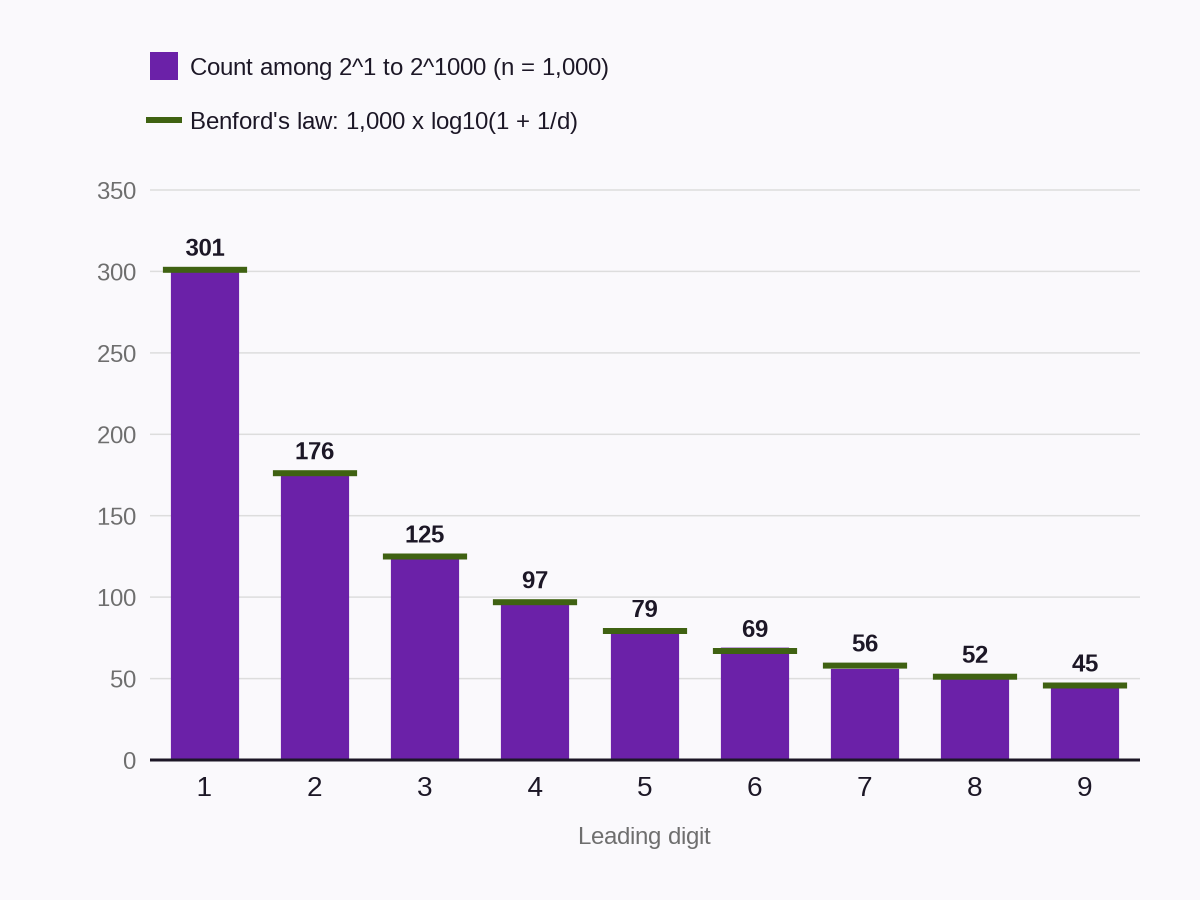
Of the first 1,000 powers of 2, 301 start with the digit 1. Only 45 start with 9, and Benford's law describes the pattern: in lists like this one, the leading digit d turns up with a share of log10(1 + 1/d), about 30.1% for 1 and 4.6% for 9, not 1 in 9 each. Simon Newcomb printed the same nine shares in 1881, in the American Journal of Mathematics. A 2020 primer by Arno Berger and Theodore Hill shows why powers of 2 follow the law and lists many kinds of data that do not.
Protocol · 4 parts
At a glance
- Name
- Benford's law
- Also called
- First-digit law
- First recorded
- Earliest source read for this page: Simon Newcomb, 1881, a two-page note in the American Journal of Mathematics. The law takes its name from Benford, whose 1938 paper is known here only from a reference list.
- Type
- Number pattern: how often each digit leads a number in some lists and data sets
- Main explanations
- For powers of 2: follows from a theorem of Weyl, as Berger and Hill show. log10(2^n) = n x log10(2), and because log10(2) is irrational these values spread evenly once whole numbers are dropped. For real-world data: no simple general explanation is known.
- On this page
- Static figures and recomputable data: exact leading-digit counts for five program-made lists, including the first 1,000 powers of 2 (301 start with 1)
benfords-law-glance.csv (CSV) · what the file holds and its license
If all nine digits were equally likely, about 111 of those 1,000 powers would start with 9. On this page, the gasp point is the last bar: 45, close to the 46 the law predicts.
What does Benford's law say?
Read the first nonzero digit of a number: 2,019 starts with 2, and 0.0381 starts with 3. Benford's law, also called the first-digit law, says what share of the numbers in a list start with each digit d: log10(1 + 1/d).
For d = 1 that is log10 2, about 30.1%, and for d = 9 it is log10(10/9), about 4.6%. So in a list that follows the law, 1 leads about 6.6 times as often as 9.
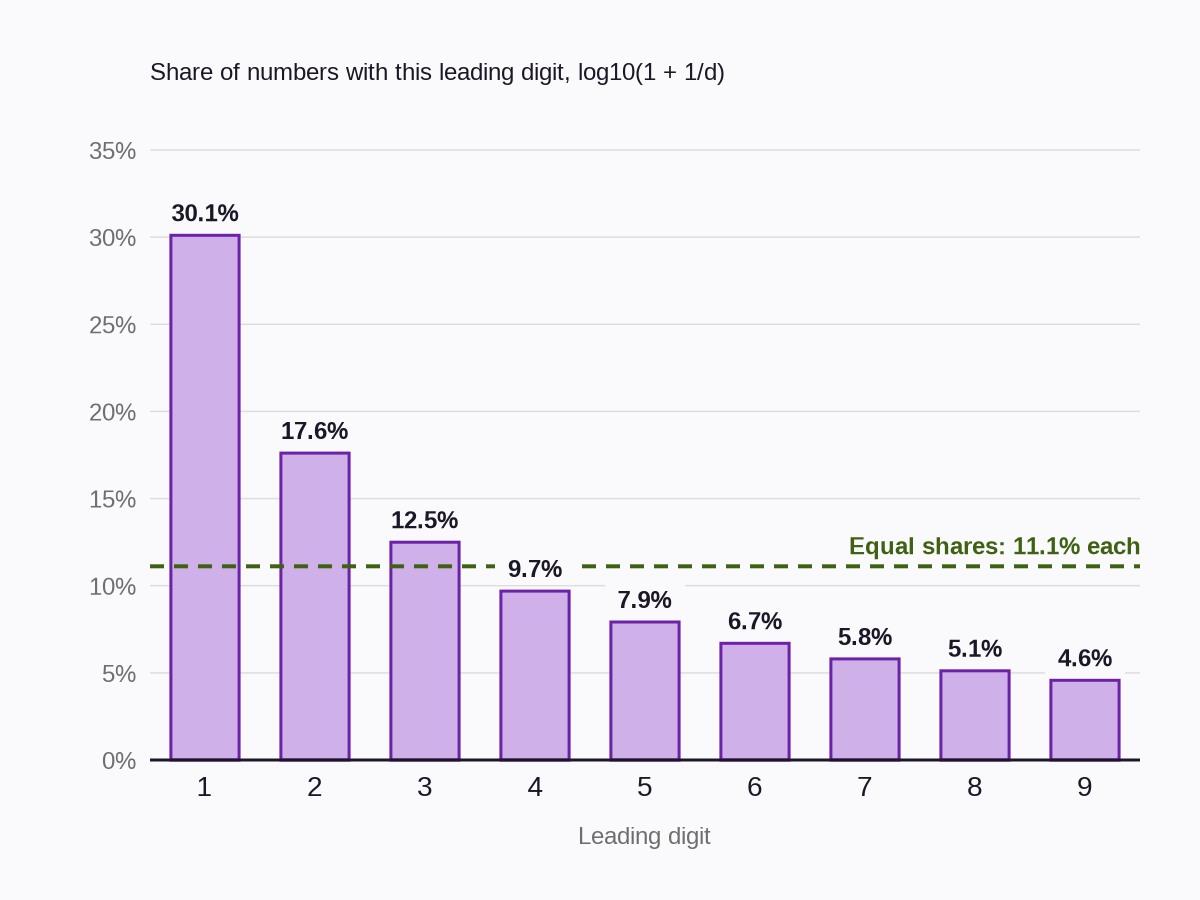
The nine shares add up to exactly 1. Each share is the log of (d + 1)/d, and multiplying 2/1 by 3/2 and so on up to 10/9 gives 10, whose log10 is 1. Berger and Hill define the law as a property of a whole list, so a list either follows it or does not. Luck evening out, the idea behind the gambler's fallacy, plays no part here: every power of 2 is fixed, and the uneven shares come from the rule that makes the list.
Where did Newcomb see it?
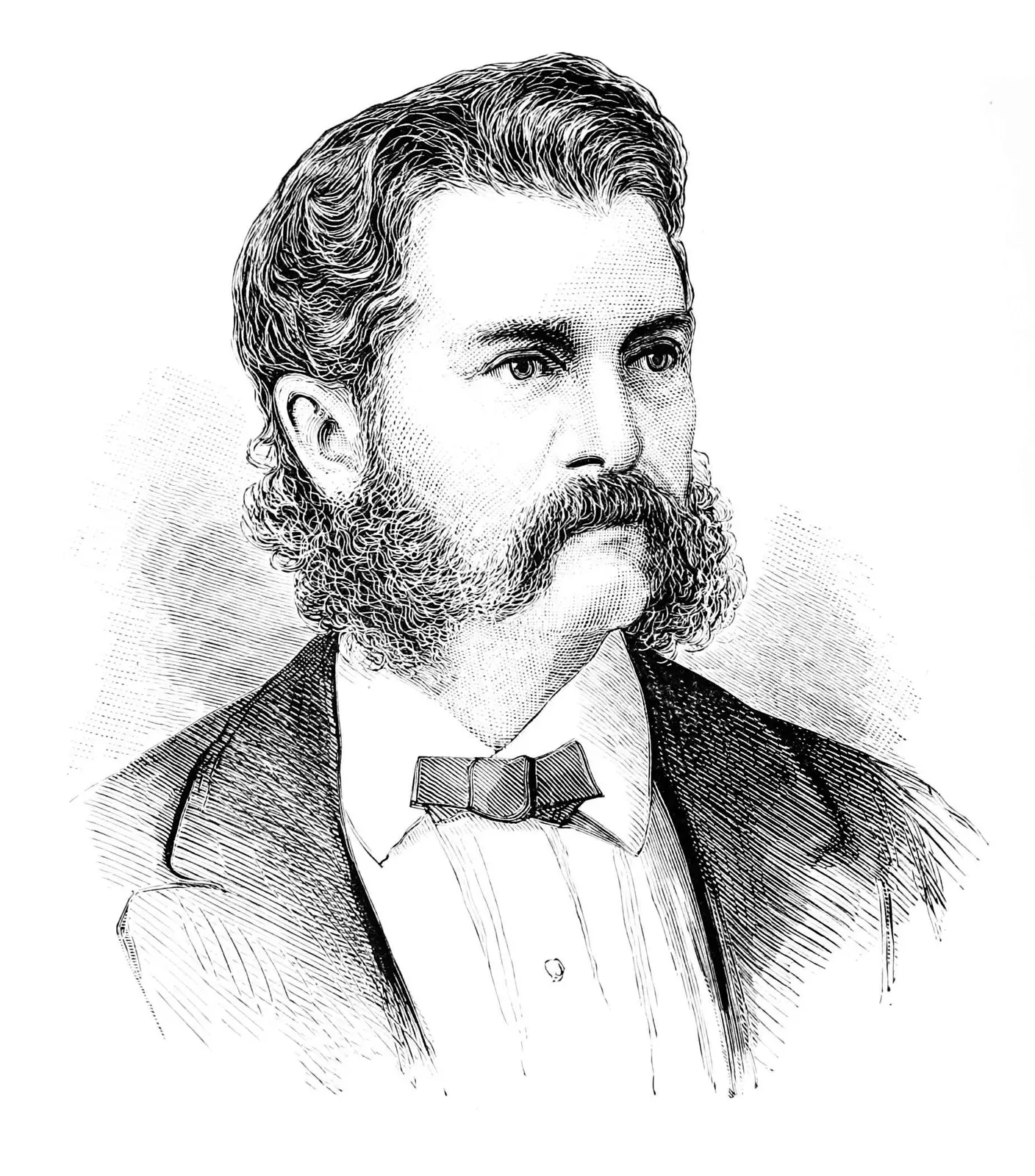
Simon Newcomb opened a two-page note in 1881 with a remark about books of logarithms. Anyone who used them much, he wrote, would notice “how much faster the first pages wear out than the last ones.” His next sentence gave the pattern: “The first significant figure is oftener 1 than any other digit, and the frequency diminishes up to 9.”
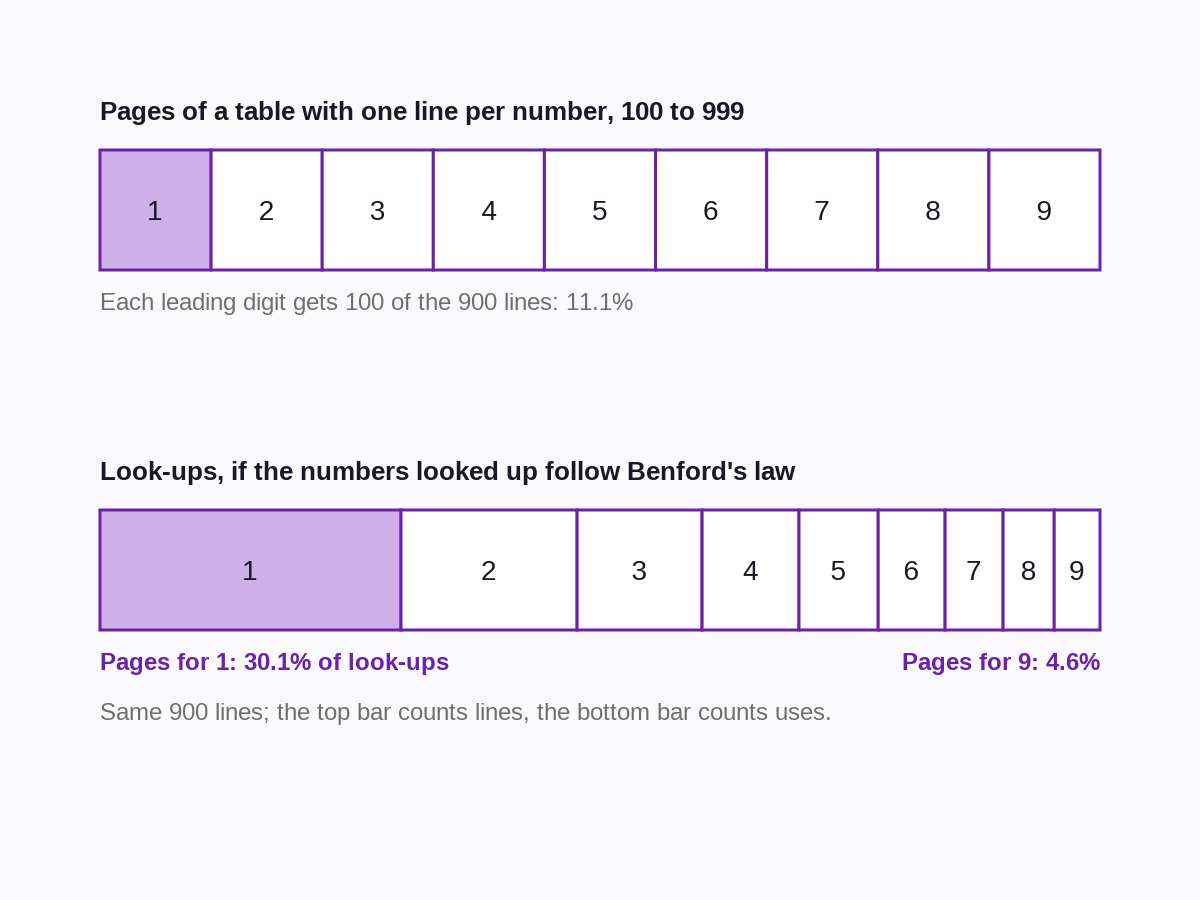
A log table lists numbers in order. In a table with one line for each number from 100 to 999, each leading digit gets 100 of the 900 lines. If the numbers people look up follow the law, the pages for 1 get 30.1% of the look-ups and the pages for 9 get 4.6%. This is the page's model of the wear, not a count of any real book.
Newcomb's own rule was that “all mantissæ of their logarithms are equally probable.” For a number of 1 or more, the mantissa is the part of its logarithm after the decimal point. On page 40 he printed the chance of each first digit, from 0.3010 for 1 down to 0.0458 for 9, and this page's program matches all nine values when it rounds log10(1 + 1/d) to four places. The law takes its name from Benford, whose 1938 paper in the Proceedings of the American Philosophical Society appears in Berger and Hill's reference list; this page did not read that paper. The Necker cube is another entry that starts from a plain printed figure, one that can flip between two readings.
Why do powers of 2 follow it?
Picture a ruler marked by logarithms, running from 1 to 10, where the distance from 1 to any number t is log10 t. The stretch from 1 to 2 takes 30.1% of the length. The stretch from 9 to 10 takes 4.6%. A number starts with 1 when its spot on this ruler, after dropping whole powers of 10, lands in the first stretch.
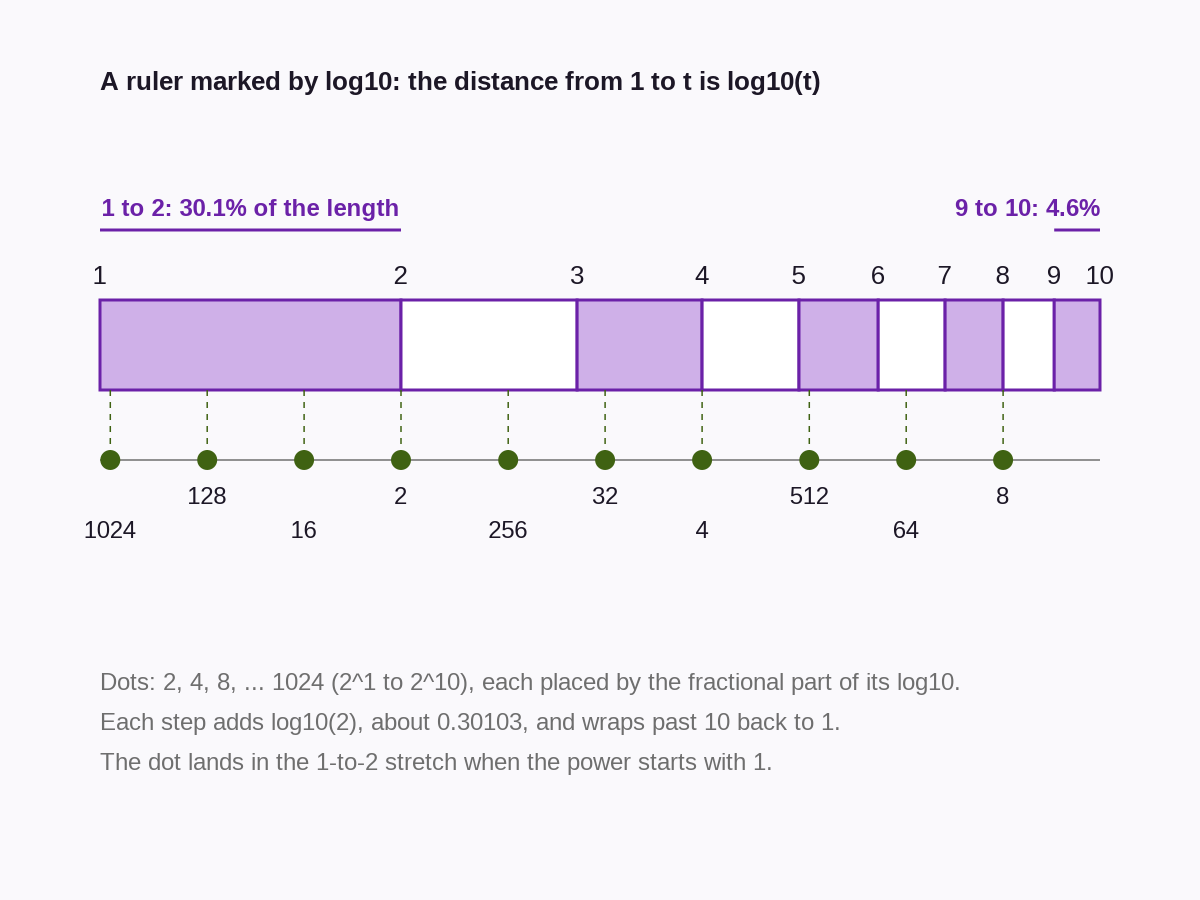
Each doubling moves a number log10 2, about 0.30103, along the ruler, wrapping back to 1 whenever it passes 10. Of the ten numbers 2 through 1024, three land in the first stretch: 16, 128 and 1024. Because log10 2 is irrational, the steps never land on the same spot twice. In the long run they spread evenly over the ruler, a classical theorem of Weyl that Berger and Hill apply to this exact example.
So the share of powers of 2 that start with 1 tends to log10 2. In the first 10,000 powers, this page's count is 3,010. As with the birthday paradox, the surprise fades once you count the right thing, which here is the length of each stretch of the ruler.
When does Benford's law fail?
Many lists do not follow the law. Berger and Hill give powers of the square root of 10 as one example: 10^(n/2) runs 3.16…, 10, 31.6…, 100, and so on, so every term starts with 1 or 3. This page's program counted the first 1,000 terms: 500 start with 1, 500 start with 3, and no other digit ever leads.
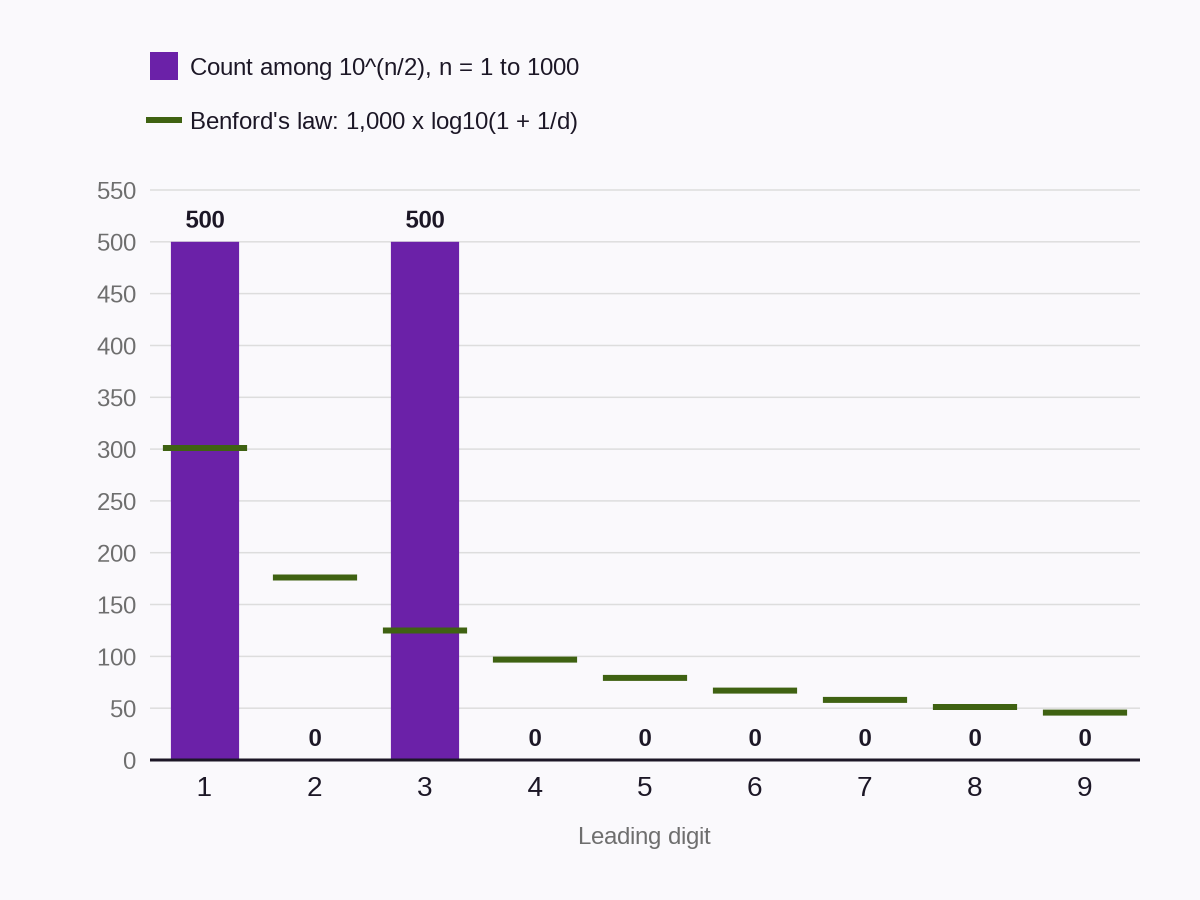
The primer lists other misses. Neither the counting numbers 1, 2, 3 and on nor any list drawn evenly from a range, however wide, follows the law.
A smooth bell curve can miss badly too. For one centered on 7 with a standard deviation of 1, this page's calculation gives a leading 1 only about 0.14% of the time, against 30.1% under the law. For real-world data, Berger and Hill write that no simple explanation is known for why the law shows up.
Check it yourself
Every count below is exact: the program wrote out each number in full (for 10^(n/2), its whole-number part) and read its first digit. No sampling is involved. Every list is made by a rule, not taken from outside data.
| Leading digit | log10(1 + 1/d), 4 places | Newcomb 1881, p. 40 | 2^1 to 2^1000 | 2^1 to 2^10000 | 3^1 to 3^1000 | 10^(n/2), n = 1 to 1000 | 1 to 999 |
|---|---|---|---|---|---|---|---|
| 1 | 0.3010 | 0.3010 | 301 | 3,010 | 300 | 500 | 111 |
| 2 | 0.1761 | 0.1761 | 176 | 1,761 | 177 | 0 | 111 |
| 3 | 0.1249 | 0.1249 | 125 | 1,249 | 123 | 500 | 111 |
| 4 | 0.0969 | 0.0969 | 97 | 970 | 98 | 0 | 111 |
| 5 | 0.0792 | 0.0792 | 79 | 791 | 79 | 0 | 111 |
| 6 | 0.0669 | 0.0669 | 69 | 670 | 66 | 0 | 111 |
| 7 | 0.0580 | 0.0580 | 56 | 579 | 59 | 0 | 111 |
| 8 | 0.0512 | 0.0512 | 52 | 512 | 52 | 0 | 111 |
| 9 | 0.0458 | 0.0458 | 45 | 458 | 46 | 0 | 111 |
Download the digit counts (CSV) · what the file holds and its license
Now break it
Change one thing about how the list is made: add instead of multiply.
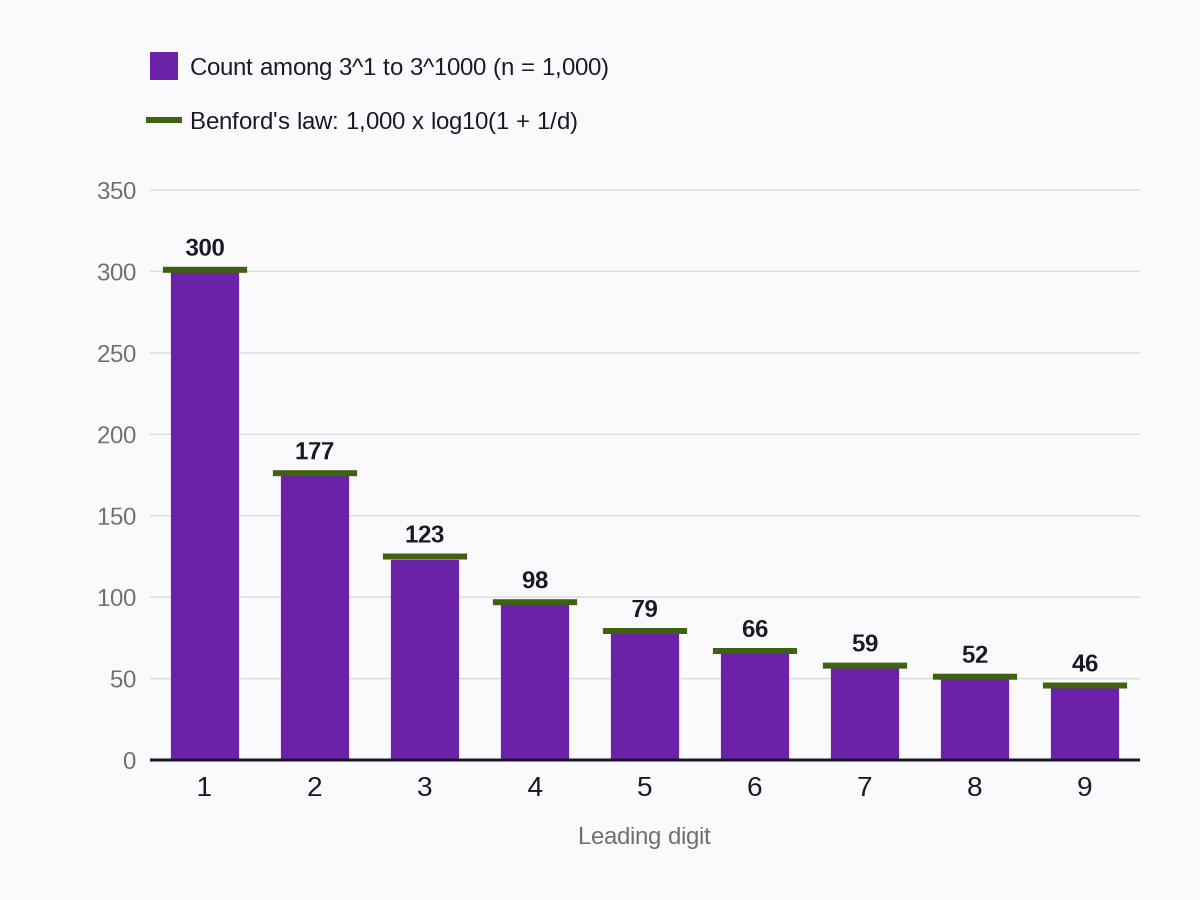
Swap doubling for tripling first, and the shape holds: 300 of the first 1,000 powers of 3 start with 1, and 46 start with 9. Berger and Hill list powers of 3 among the lists that follow the law.
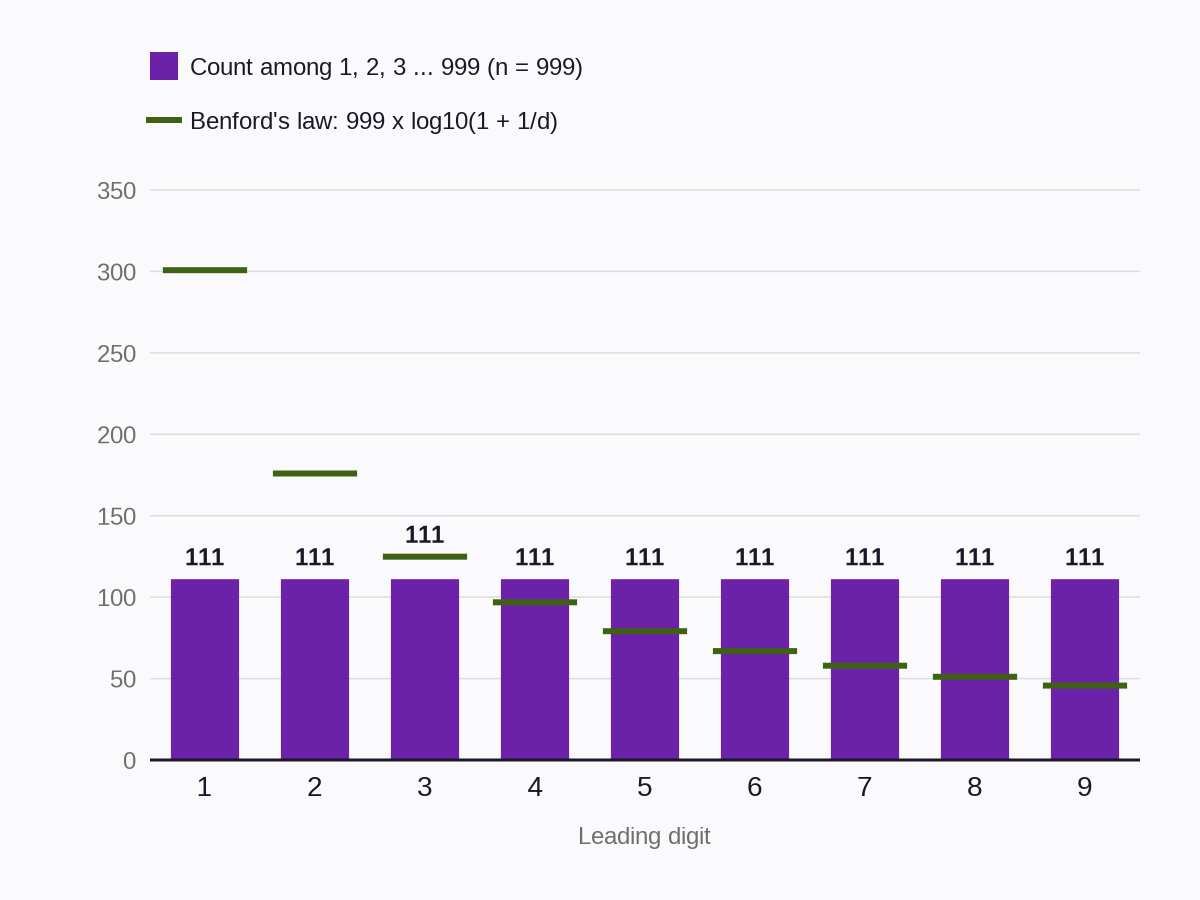
Now count up by 1 instead. Every digit leads exactly 111 times, and the bar for 1 drops from 300 to 111. The same flat result holds for any stretch from 1 to a number made only of 9s.
Try this next: Galton board — beads that pile up into a bell shape, a kind of spread that does not follow Benford's law.
Sources
- Simon Newcomb, “Note on the Frequency of Use of the Different Digits in Natural Numbers,” American Journal of Mathematics 4 (1881): 39–40. https://archive.org/details/sim_american-journal-of-mathematics_1881_4Read: full text (pages 39–40), checked against the page images
- Arno Berger and Theodore P. Hill, “The Mathematics of Benford’s Law – A Primer,” arXiv:1909.07527, version 3 (2020). https://arxiv.org/abs/1909.07527Read: full text
Cite this page
Explorable Illusions. (2026). Benford’s Law: Why 1 Beats 9 as a Leading Digit. Explorable Illusions. Published 2026-11-13. https://explorableillusions.com/probability/benfords-law/
Add the date you read it. Figures and CSV files on this page are CC BY 4.0 unless their credit line says otherwise.
How pages here are checked Corrections log Report an error: contact@explorableillusions.com
More in Probability Playground
 Probability Playground
Monty Hall Problem: Standard Rules Make Switching Win 2 in 3
Under the standard rules, switching wins the Monty Hall problem 2 times in 3, because the host knows where the car is. See the count and 100,000-round runs.
Picture credit (illustration)
Illustration: Explorable Illusions. Generated schematic image — not a photograph, historical record, or test stimulus. Reuse: CC BY 4.0 (https://creativecommons.org/licenses/by/4.0/), to the extent any rights exist.
 Probability Playground
Birthday Paradox: 23 People Make 253 Pairs That Can Match
In a room of 23 people, a shared birthday is slightly more likely than not: 50.7%, exact, under the standard 365-day model. Count the 253 pairs and see why.
Picture credit (illustration)
Illustration: Explorable Illusions. Generated schematic image — not a photograph, historical record, or test stimulus. Reuse: CC BY 4.0 (https://creativecommons.org/licenses/by/4.0/), to the extent any rights exist.
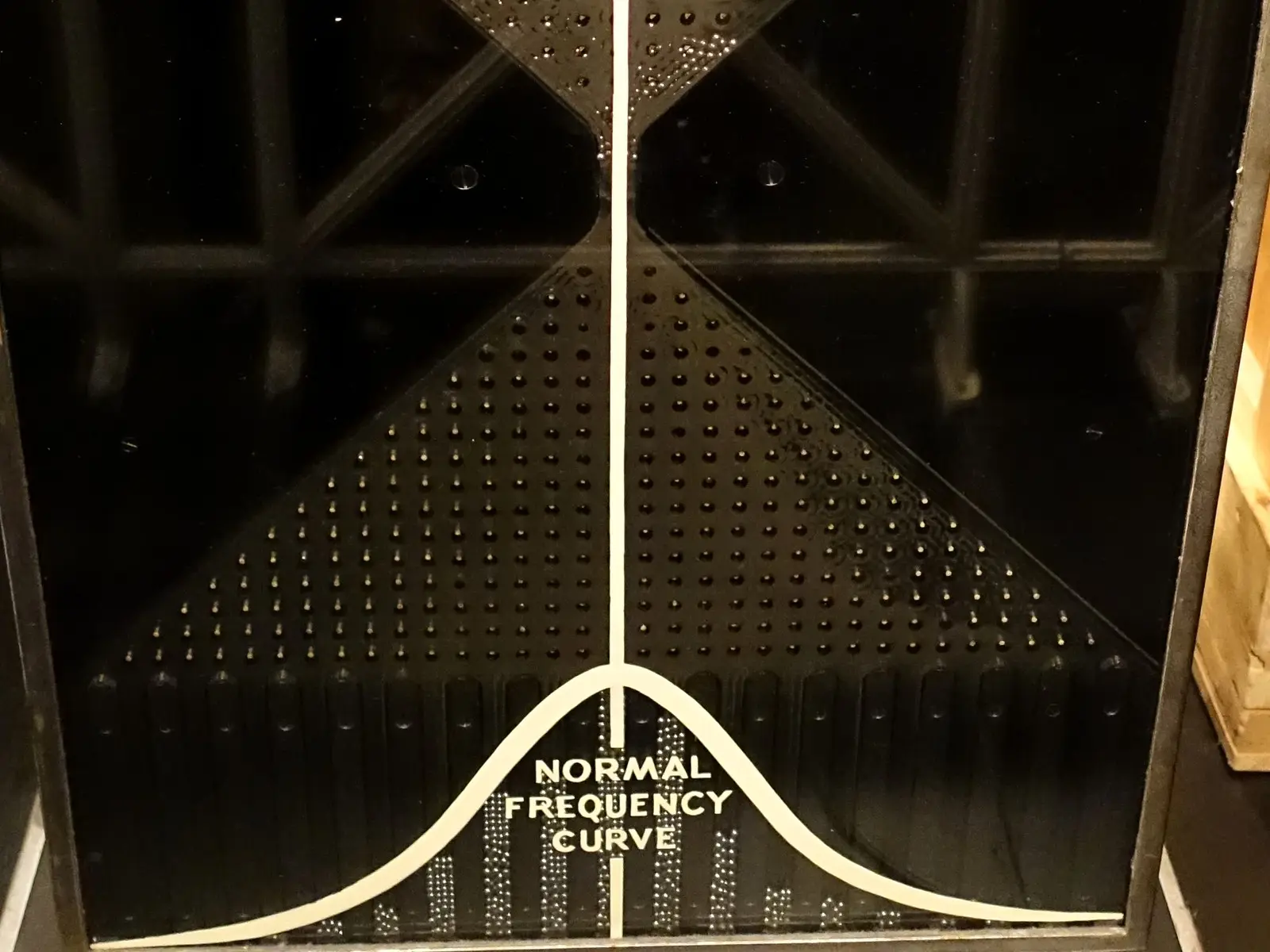 Probability Playground
Galton Board: On a Fair Board, the Bell Is a Count of Paths
On a fair 12-row Galton board, exactly 2,508 of 4,096 paths, about 61.2%, end in the middle three bins. Run the board and see where the bell comes from.
Picture credit
"Galton Quincunx, 1933 – Museum of Science and Industry (Chicago)" by Daderot — https://commons.wikimedia.org/wiki/File:Galton_Quincunx,_1933_-_Museum_of_Science_and_Industry_(Chicago)_-_DSC06712.JPG — CC0 1.0 (https://creativecommons.org/publicdomain/zero/1.0/); modified: cropped to a 4:3 frame on the lower half of the board (lower pin triangle, bead columns, Normal Frequency Curve), removing the upper half, the museum placard and the stand; a strip of a neighbouring crate remains at the right edge; scaled to 1600 x 1200 px