Necker Cube: Necker Drew a Rhomboid, Not a Cube
Explorable Illusions · Published
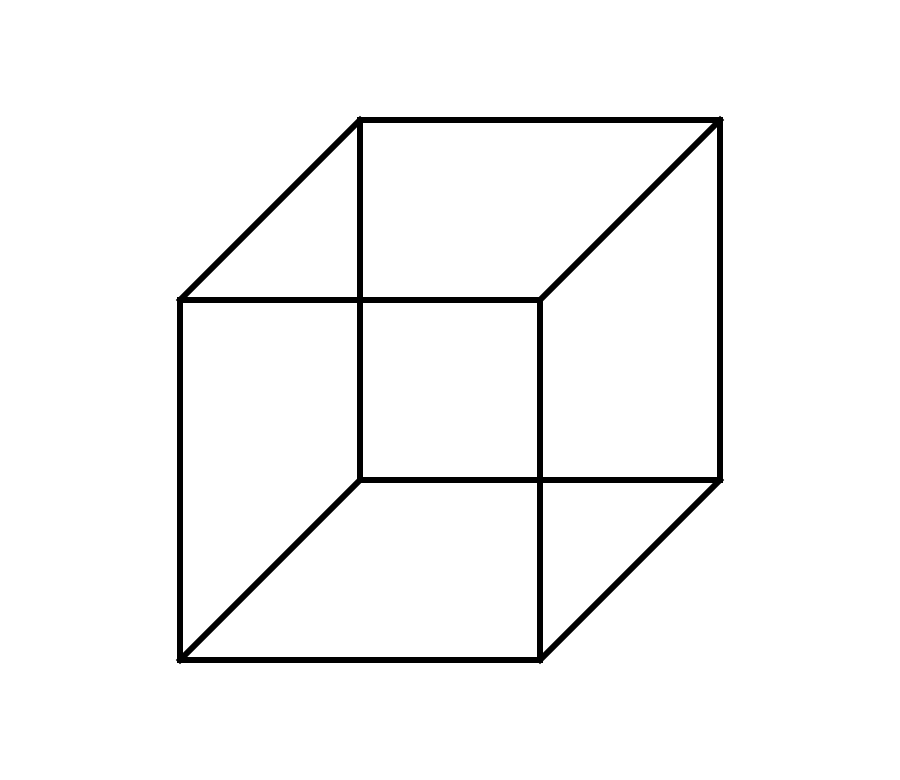
Watch the cube below for a few seconds: its front face may jump to the back. The Necker cube is a line drawing that fits two 3D readings equally well, so the one you see can flip. It is named for L. A. Necker, who described the flip in an 1832 letter in the Philosophical Magazine, but his own figure was a slanted rhomboid, a crystal form. Why the flip happens is still debated.
Protocol · 4 parts
Shown at its working size, not shrunk: on a narrow screen, scroll the figure sideways.
At a glance
- Name
- Necker cube, named for L. A. Necker (his own 1832 figure was a rhomboid and carries no such name)
- Also called
- Necker-Wheatstone cube (the caption in Titchener 1901)
- First recorded
- 1832: L. A. Necker, professor of mineralogy at Geneva, in a letter to Sir David Brewster; his drawing was a rhomboid from crystallography, not a cube
- Type
- Ambiguous figure: a flat line drawing that fits two 3D readings, and the reading in view can flip
- Effect note
- Effects vary from person to person; how often the cube flips differs between viewers, and a 2014 review describes a viewer's switch rate as highly stable; in a 1968 study the review reports, the instruction to switch produced more flips than the instruction to hold one view
- Main explanations
- Necker's own account (1832): an involuntary change in the eye's focus on one corner. Bottom-up account: the reading in view wears out through adaptation, and noise times the switch. Top-down account: attention and intention shape the flips, including a pull toward the from-above view. The cause is still debated.
- On this page
- Static figures and recomputable data: a coordinate table for every edge of the cube and of two changed versions
necker-cube-glance.csv (CSV) · what the file holds and its license
Keep your eyes on the drawing for up to 30 seconds, no longer, and note which square looks nearest at the start and whether the other square jumps forward. Nothing in the drawing marks front or back. Every edge has one width, nothing is shaded, and no line is broken where two edges cross; the coordinate table below lists every edge.
What did Necker actually draw?
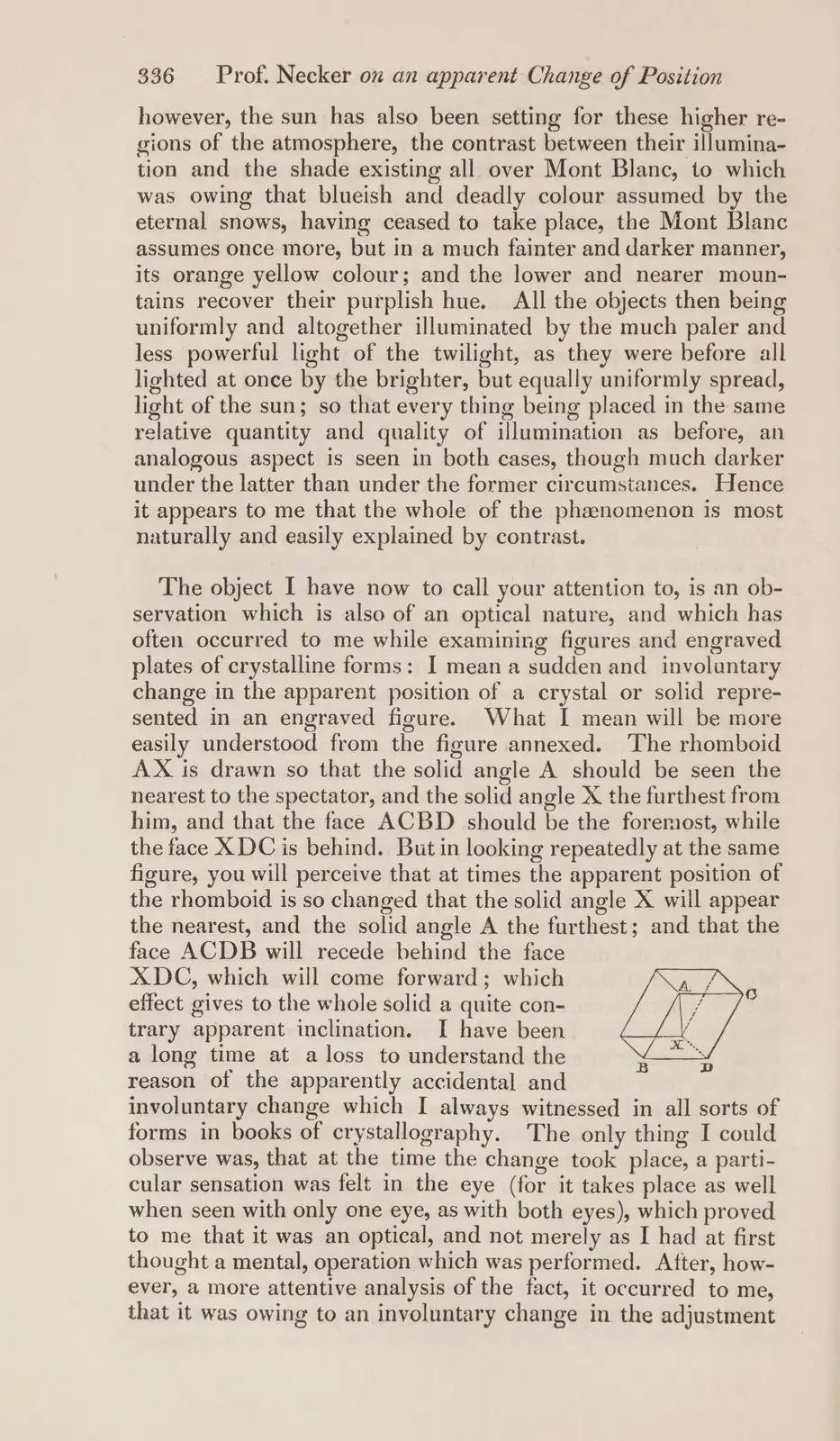
L. A. Necker was a professor of mineralogy at Geneva. In a letter to Sir David Brewster, printed in the November 1832 issue of the Philosophical Magazine, he described “a sudden and involuntary change in the apparent position of a crystal or solid represented in an engraved figure.” He wrote that it often happened to him with plates of crystals.
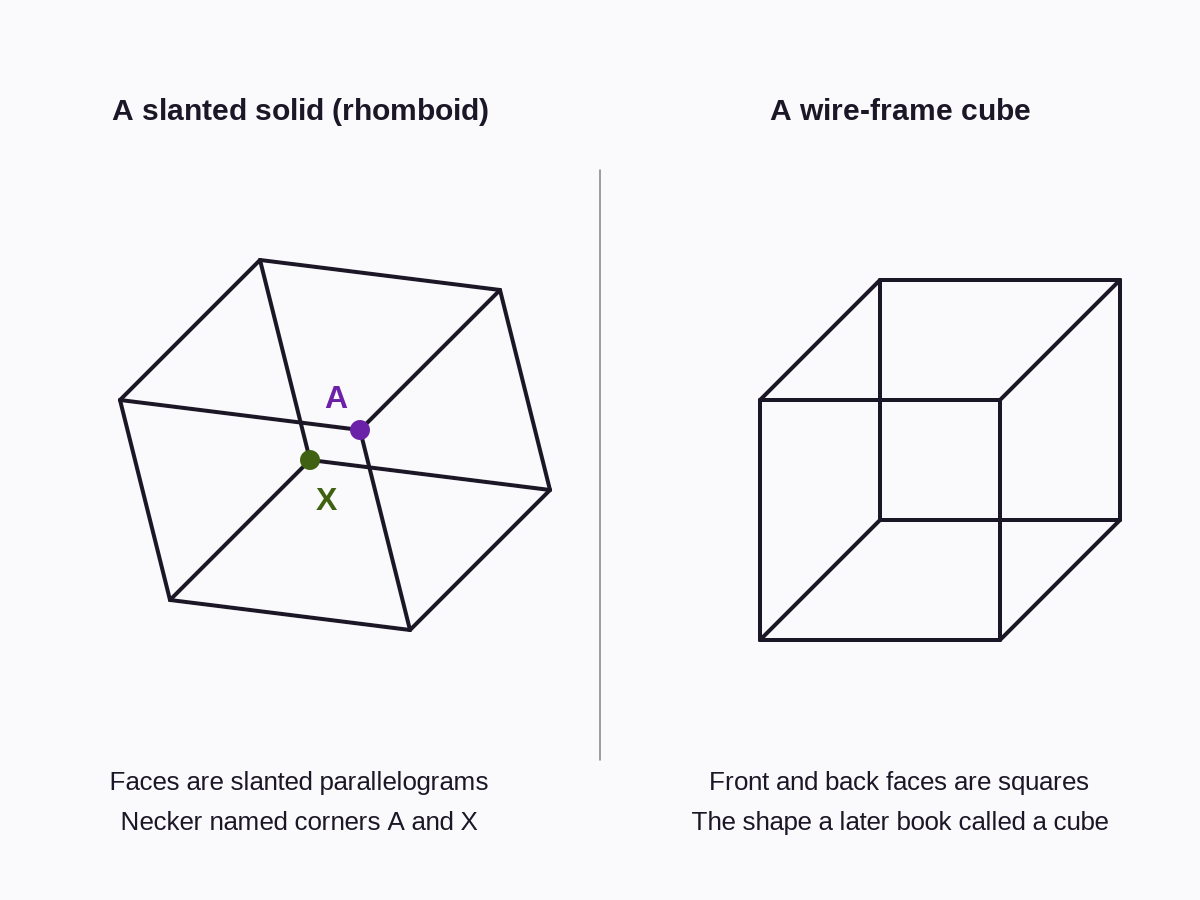
The figure printed with the letter, on page 336, is not a cube: Necker calls it “the rhomboid AX,” and its faces are slanted parallelograms, the kind of solid drawn in books on crystal shapes. He explains that it “is drawn so that the solid angle A should be seen the nearest to the spectator, and the solid angle X the furthest from him.” Yet when he looked at it again and again, X could come to the front while A dropped behind.
A cube appears in Titchener's laboratory manual Experimental Psychology (1901). Fig. 32 on page 155 is a white wire cube on black, captioned “The Necker-Wheatstone Cube.” The next page says it “may be seen either with the face abcd or with the surface efgh nearer the observer.” The cube at the top of this page follows that form, with sizes chosen by this site.
How did Necker explain the flip?
Necker first took the flip for a trick of the mind. Then he noticed that “a particular sensation was felt in the eye” at the moment of change, and that it happened with one eye as well as with two. He decided it was “owing to an involuntary change in the adjustment of the eye for obtaining distinct vision.” In his account, the corner seen sharply was taken to be nearest and the blurred corners further back.
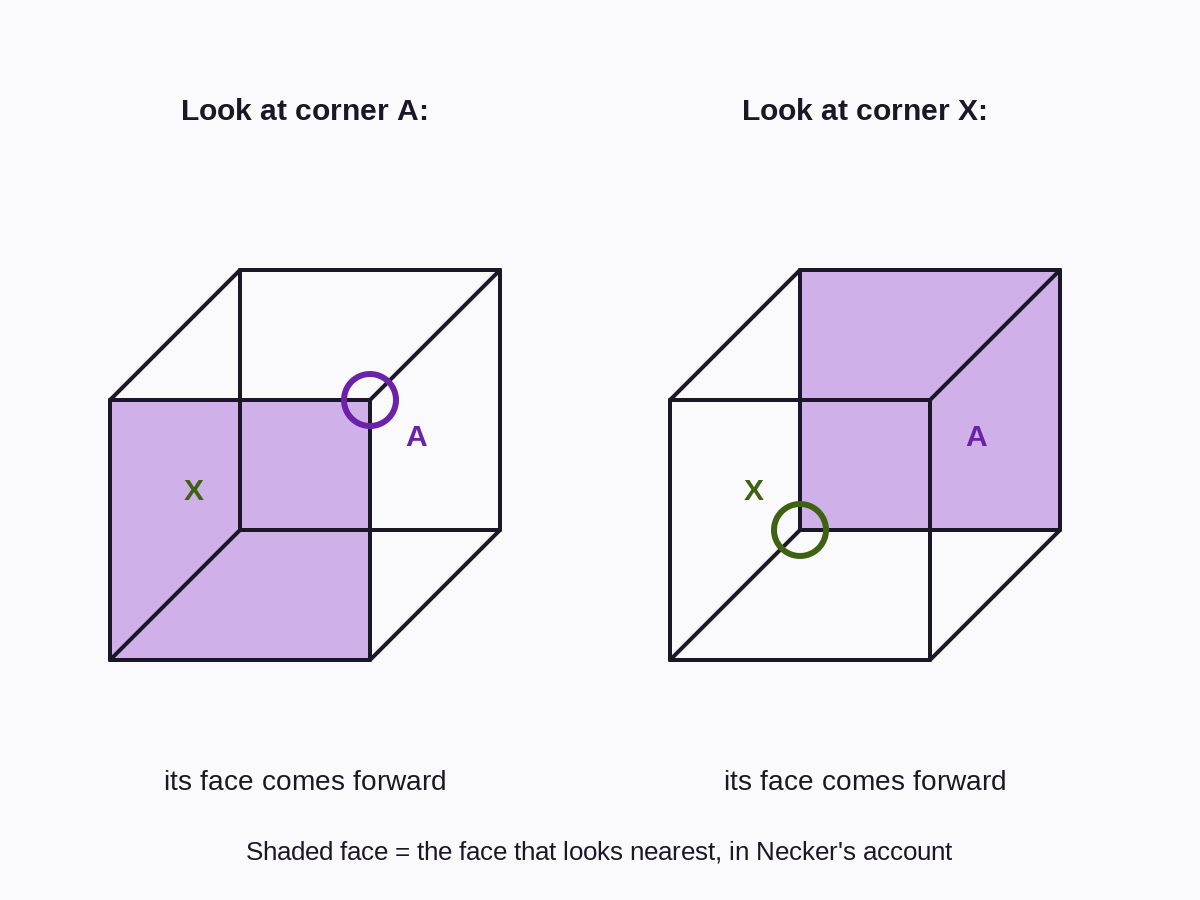
He backed it with three tests, as he reports them. Looking steadily at A or at X let him choose which way the solid sat. A convex spectacle lens slid between eye and page made the flip happen, which he put down to the lens moving the image of X onto the spot he was looking at. Through a pinhole in a card that hid one of the two corners, the visible corner always looked nearest, and the flipping stopped.
Try the first test on the cube at the top. Its two inner corners, where three edges meet inside the outline, play A and X. Look straight at one for a few seconds, then the other, and see whether that steers the flip.
A 2014 review by Scocchia, Valsecchi and Triesch lists Necker among early writers who tied such flips to where the eye is pointed. The generic model that review describes is built from neural adaptation and noise, not from the eye's focus.
What are the two ways to see it?
The drawing at the top is two squares with sides of 360 units, the back one shifted 180 units right and 180 units up, with four lines joining matching corners. Read the lower-left square as the front face, and the cube is seen from above; read the upper-right square as the front, and the same lines become a cube seen from below. Both readings use all 12 lines, and the drawing gives no reason to prefer either.
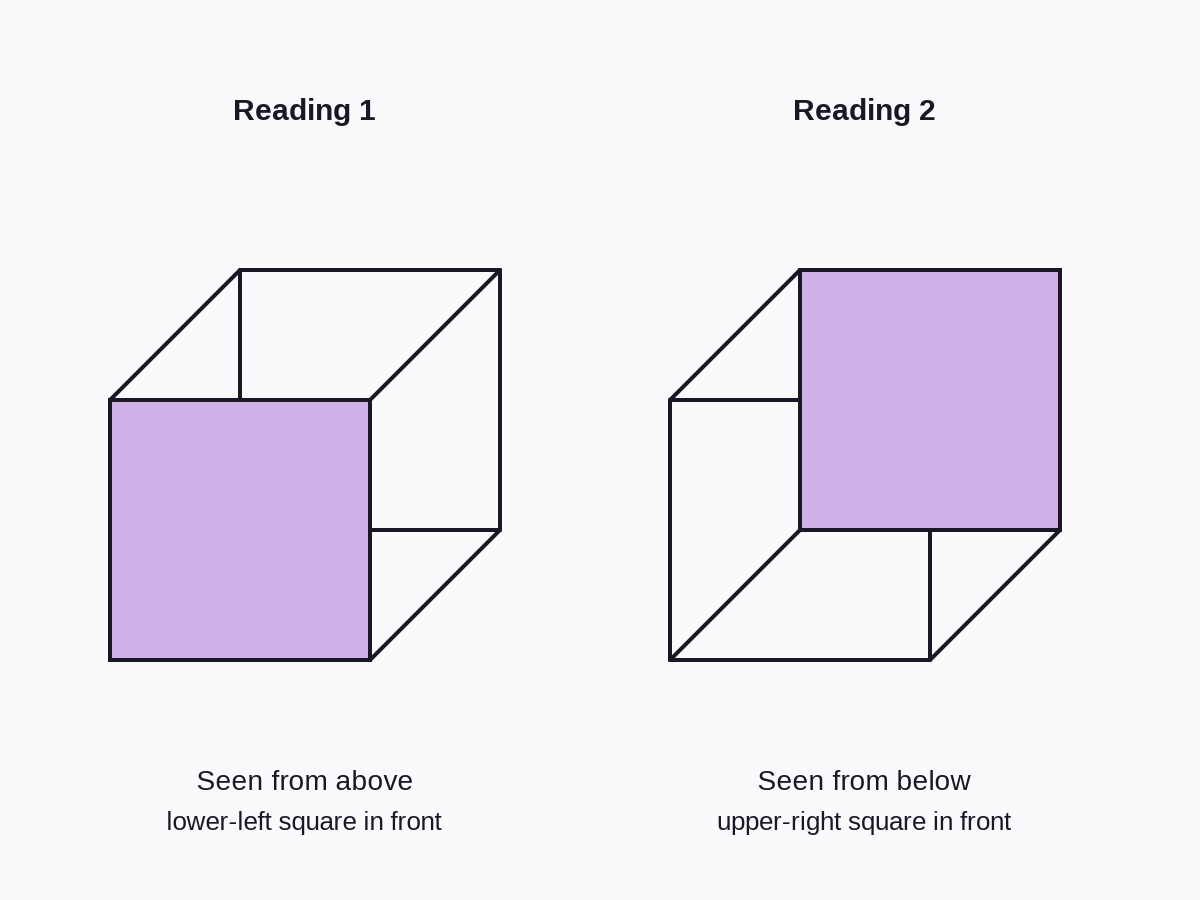
Viewers may not treat the two readings evenly. Kornmeier and colleagues, who studied a lattice made of nine Necker cubes, write that “observers’ perception seems to be a priori biased in favour of a from-above-perspective.” They suggest this “may reflect a kind of everyday-statistics: We typically look much more often down than up on objects.” If the lower-left square came forward first for you, that matches their account, and if it did not, effects vary from person to person.
Why does the cube flip?
The cause is still debated, and the current accounts come in two kinds. One account says the flip starts in the visual signal itself. In the models Scocchia and colleagues describe, two groups of nerve cells each stand for one reading and compete. In their words, “Adaptation can be thought of as a slow mechanism of neuronal fatigue (time scale of seconds) that leads to the winning population getting ‘tired’,” so the other reading takes over, and random noise sets the exact moment.
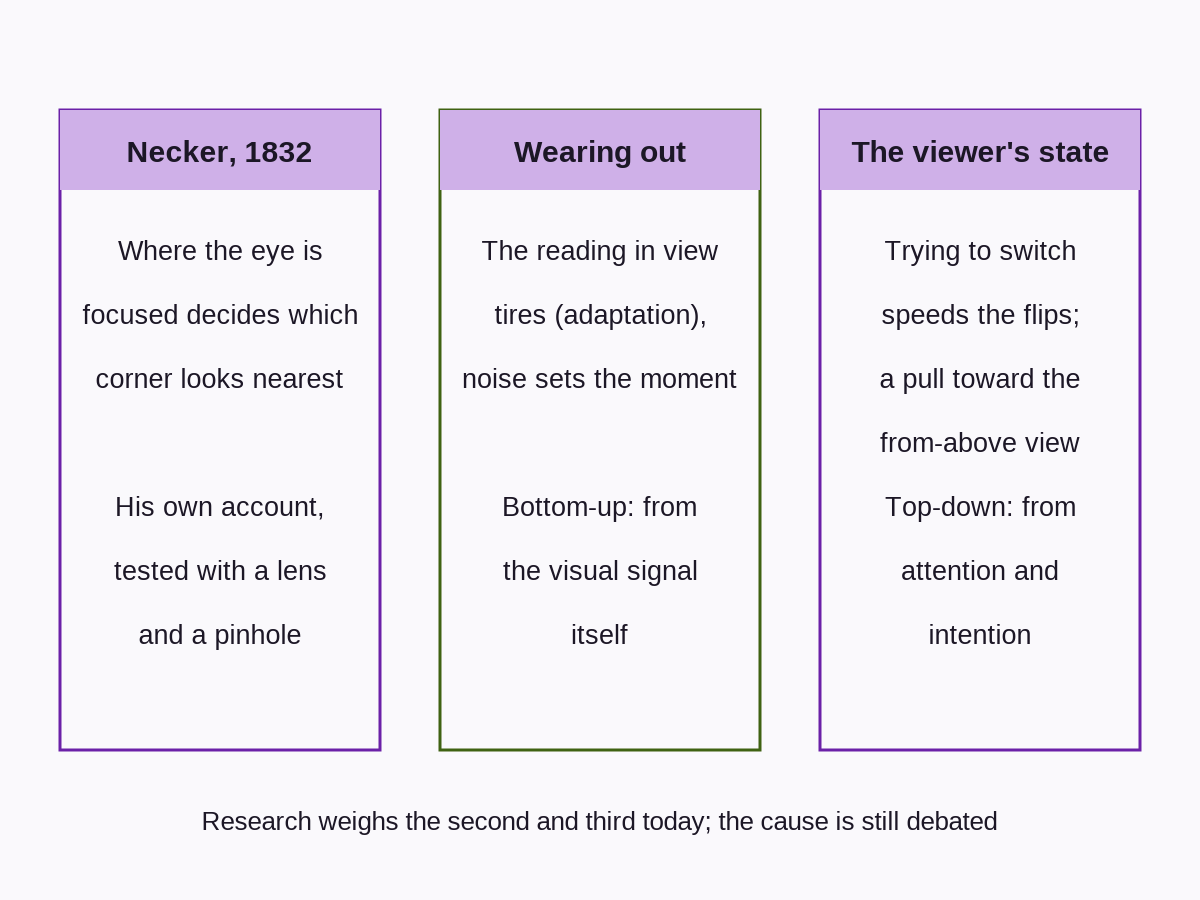
A second account looks at the viewer. The same review reports a 1968 study by Pelton and Solley in which the instruction to switch the Necker cube as often as possible produced more flips than the instruction to hold one view. It also reports that will alone does not seem able to stop the flips completely.
The pull toward the from-above view is another factor of this kind. Kornmeier and colleagues frame perception as a weighing of the signal from the eyes, called bottom-up, against concepts held in memory, called top-down.
| Account | What it says | Source |
|---|---|---|
| Necker's own (1832) | An involuntary change in the eye's focus makes the sharply seen corner look nearest | Necker 1832, pp. 336–337 |
| Wear and noise (bottom-up) | The reading in view tires through neural adaptation, and noise times the switch | Scocchia et al. 2014 |
| The viewer's state (top-down) | Trying to switch speeds up the flips, and viewers may favor the from-above view | Scocchia et al. 2014; Kornmeier et al. 2017 |
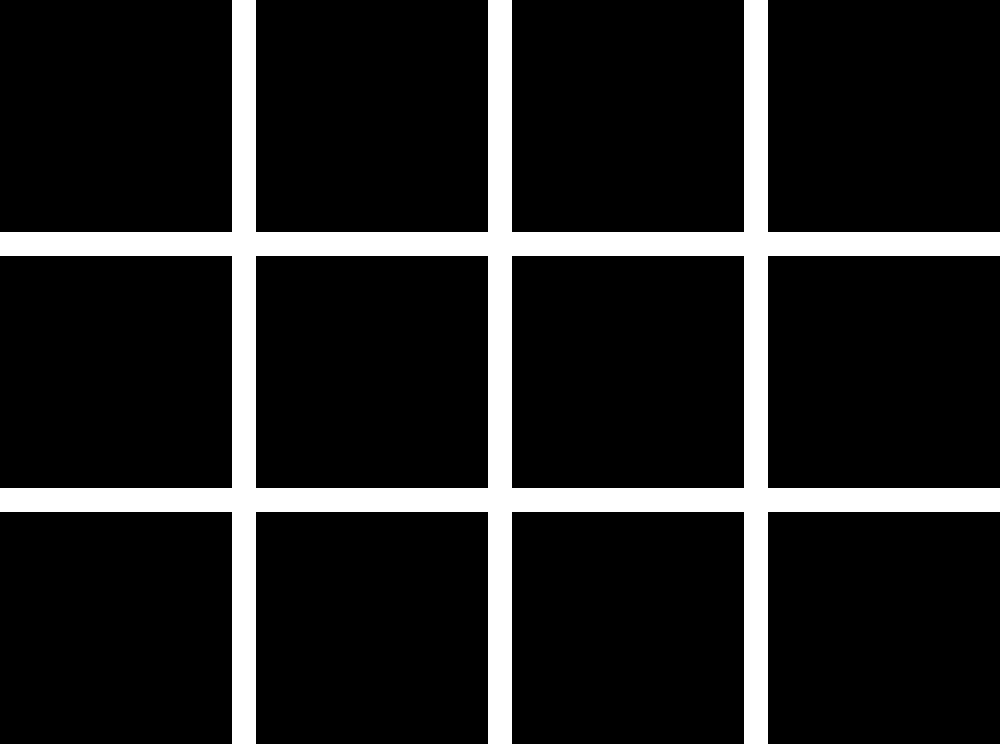
This page did not test either modern account. The Hermann grid makes a claim about brightness, so it gets a fill check instead. The Ebbinghaus illusion changes how big a circle looks, not how deep a shape sits.
Like this one, the story of Benford's law starts with what someone noticed in the pages of a printed book.
Check it yourself
The gasp point here is a table, not a trick. The figure file for the cube holds a white background and 12 black lines, and nothing else. Both squares have sides of 360 units, and the four joining lines are each about 254.56 units long.
| Figure | Edges | Line width | Pieces drawn | What differs |
|---|---|---|---|---|
| Cube at the top | 12 | 6 units each | 12 | Nothing: no gaps, no dashes, no shading |
| Change 1: gaps | 12 | 6 units each | 14 | Two back edges cut by a 30-unit gap where a front edge crosses |
| Change 2: smaller back square | 12 | 6 units each | 12 | Back square side 252 units, 0.7 of the front |
A check reads the three figure files and compares every line with the table. The page shows the cube at least 150 pixels wide, so that the thinnest line stays at least one pixel wide. On a narrower screen it scrolls sideways instead of shrinking.
Download the edge coordinates (CSV) · what the file holds and its license
Now break it
Each change below adds one depth cue to the cube at the top. Look at each for a few seconds, never more than 30, and note whether it still flips.
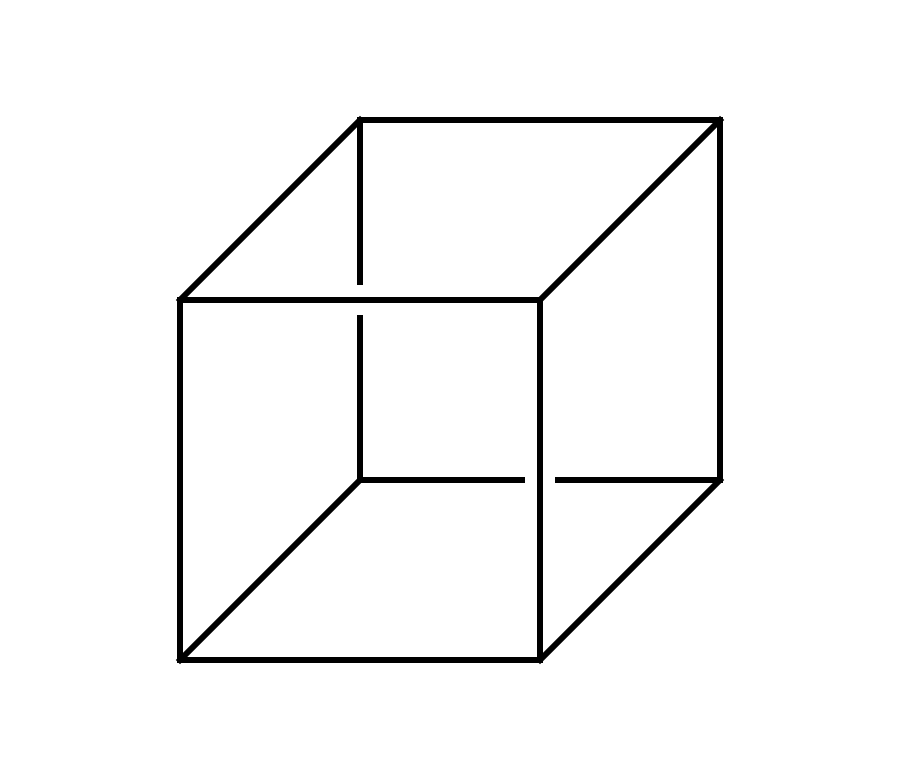
Shown at its working size, not shrunk: on a narrow screen, scroll the figure sideways.
Cut the back edges where they pass behind. A gap reads as one line hiding another, which marks the lower-left square as the front. Decide whether the cube stays put or still slips.
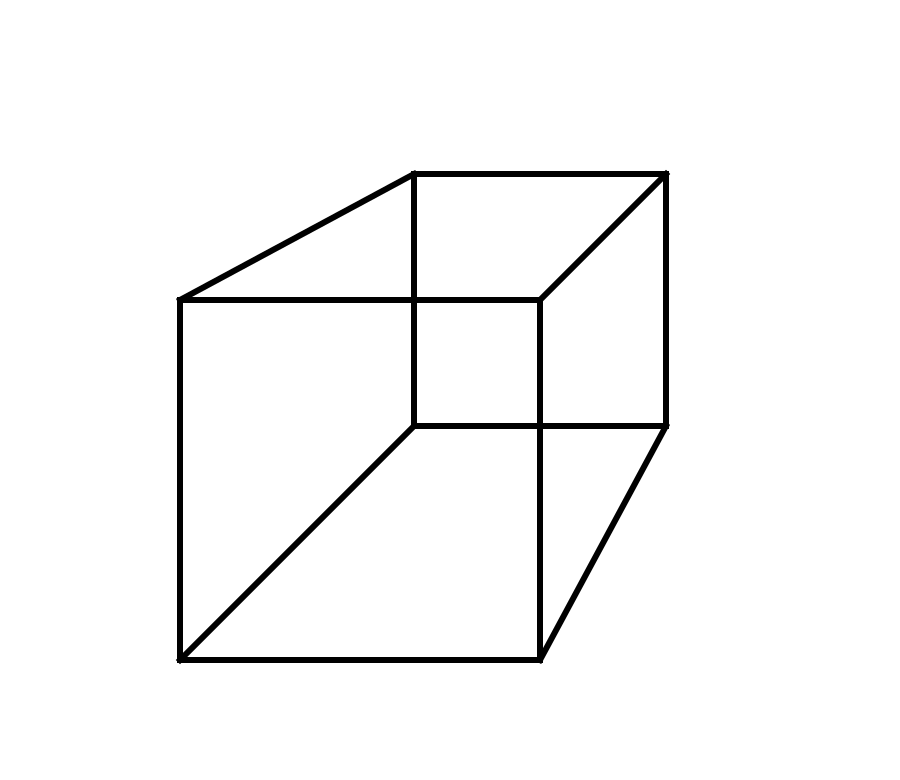
Shown at its working size, not shrunk: on a narrow screen, scroll the figure sideways.
Shrink the back square to 252 units, 0.7 of the front. Far things look smaller, so the small square may settle at the back. Necker's pinhole test gives a third change: cover one inner corner of the cube at the top with a fingertip and watch whether the flips stop.
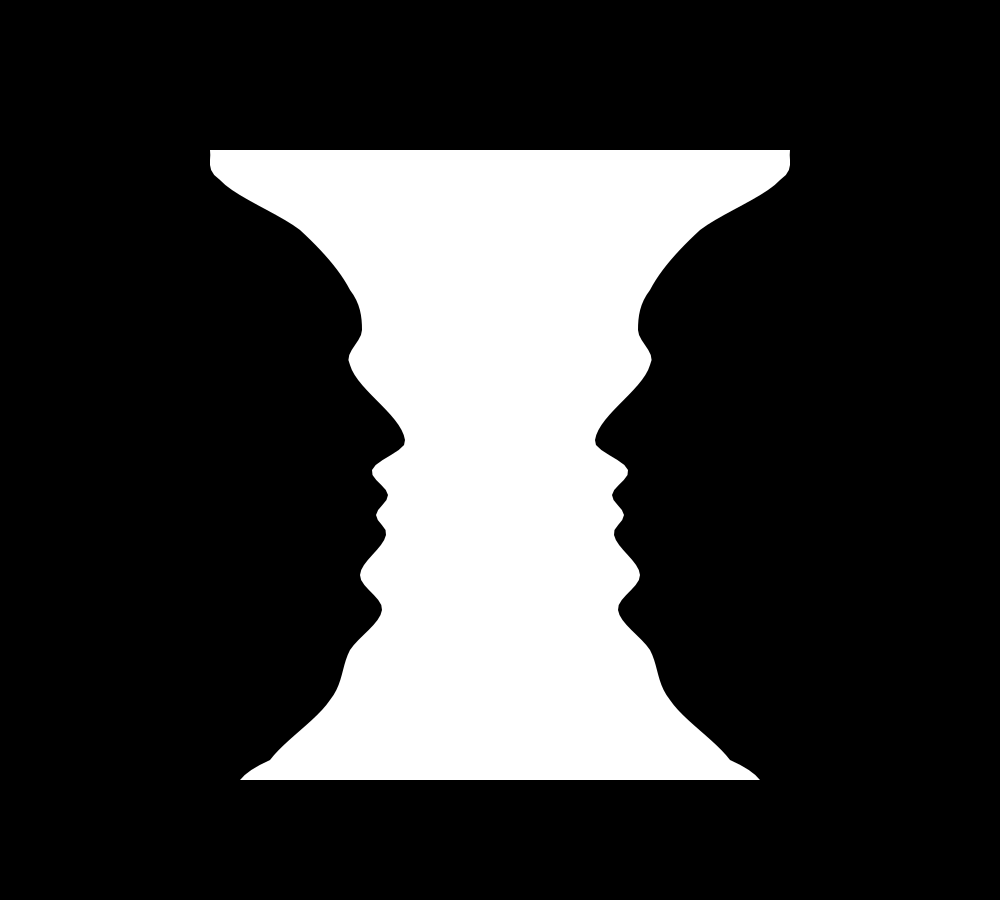
Try this next: Rubin vase — one outline shared by a vase and two faces, and the shape you see can swap like the cube.
Sources
- L. A. Necker, “Observations on some remarkable Optical Phænomena seen in Switzerland; and on an Optical Phænomenon which occurs on viewing a Figure of a Crystal or geometrical Solid. In a Letter to Sir David Brewster,” The London and Edinburgh Philosophical Magazine and Journal of Science, 3rd series, 1, no. 5 (November 1832): 329–337. https://archive.org/details/s2id11853710/page/n349Read: pages 329, 336 and 337, checked against the page images
- Edward Bradford Titchener, Experimental Psychology: A Manual of Laboratory Practice, vol. 1, part 1 (New York and London: Macmillan, 1901). https://archive.org/details/experimentalpsyc11titcRead: pages 155–156 and 166–169, checked against the page images
- Lisa Scocchia, Matteo Valsecchi and Jochen Triesch, “Top-down influences on ambiguous perception: the role of stable and transient states of the observer,” Frontiers in Human Neuroscience 8 (2014): 979, doi:10.3389/fnhum.2014.00979. https://pmc.ncbi.nlm.nih.gov/articles/PMC4259127/Read: full textText license: Creative Commons Attribution License (CC BY; version not stated on the article page)
- Jürgen Kornmeier, Rike Wörner, Andreas Riedel and Ludger Tebartz van Elst, “A different view on the Necker cube—Differences in multistable perception dynamics between Asperger and non-Asperger observers,” PLoS ONE 12, no. 12 (2017): e0189197, doi:10.1371/journal.pone.0189197. https://pmc.ncbi.nlm.nih.gov/articles/PMC5731733/Read: abstract, introduction and the Fig. 1 captionText license: Creative Commons Attribution License (CC BY; version not stated on the article page)
Cite this page
Explorable Illusions. (2026). Necker Cube: Necker Drew a Rhomboid, Not a Cube. Explorable Illusions. Published 2026-11-13. https://explorableillusions.com/look-again/necker-cube/
Add the date you read it. Figures and CSV files on this page are CC BY 4.0 unless their credit line says otherwise.
How pages here are checked Corrections log Report an error: contact@explorableillusions.com
More in Look Again
 Look Again
Hermann Grid: In This Figure, the Crossings Are Pure White
Every crossing in this Hermann grid has the same white fill as the streets. Check the fill table, then see why the textbook retina account is disputed.
Picture credit
"Hermann grid, larger squares" by Explorable Illusions — https://explorableillusions.com/look-again/hermann-grid/ — CC BY 4.0 (https://creativecommons.org/licenses/by/4.0/)
 Look Again
Ebbinghaus Illusion: In These Figures, Centers Are Equal
Both center circles in this Ebbinghaus illusion are 120 units across, and the coordinates are here to check. Grasp studies still disagree about the hand.
Picture credit
"Ebbinghaus figure: equal discs, large ring and small ring" by Explorable Illusions — https://explorableillusions.com/look-again/ebbinghaus-illusion/ — CC BY 4.0 (https://creativecommons.org/licenses/by/4.0/)
 Look Again
Rubin Vase: Royal Profiles Hid in Urns Before Rubin
The Rubin vase shares one edge between a white vase and two black faces. Rubin called it a lopsided goblet; urns hiding royal profiles came a century earlier.
Picture credit
"Rubin vase, mirror-image profiles" by Explorable Illusions — https://explorableillusions.com/look-again/rubin-vase/ — CC BY 4.0 (https://creativecommons.org/licenses/by/4.0/)