Monty Hall Problem: Standard Rules Make Switching Win 2 in 3
Explorable Illusions · Published
Switching doors wins the car twice as often as staying. Under the standard rules of the Monty Hall problem, a player who switches wins 2 games in 3 (exact), and a player who stays wins 1 in 3. Marilyn vos Savant gave that answer in Parade in 1990 and drew thousands of letters, according to Jeffrey Rosenthal's 2008 account [1]. The edge rests on the rules, above all this one: the host knows where the car is.
Protocol · 6 parts
At a glance
- Name
- Monty Hall problem
- Also called
- Monty Hall dilemma, the name used in the psychology papers cited here
- First recorded
- 1975: letters to The American Statistician, credited to Steve Selvin in the reference lists of two later papers (publication records only); 1990: Marilyn vos Savant's Parade column of September 9, as recounted by Rosenthal (2008)
- Type
- Conditional probability puzzle
- Main explanations
- One accepted solution: under the standard rules, with the car placed and the first door picked at random, the count of nine equally likely starts (2/3 for switching, exact); the simulation only checks it
- On this page
- Static figures, exact values, six seeded simulation runs, a classroom planner and recomputable data (CSV)
monty-hall-problem-glance.csv (CSV) · what the file holds and its license
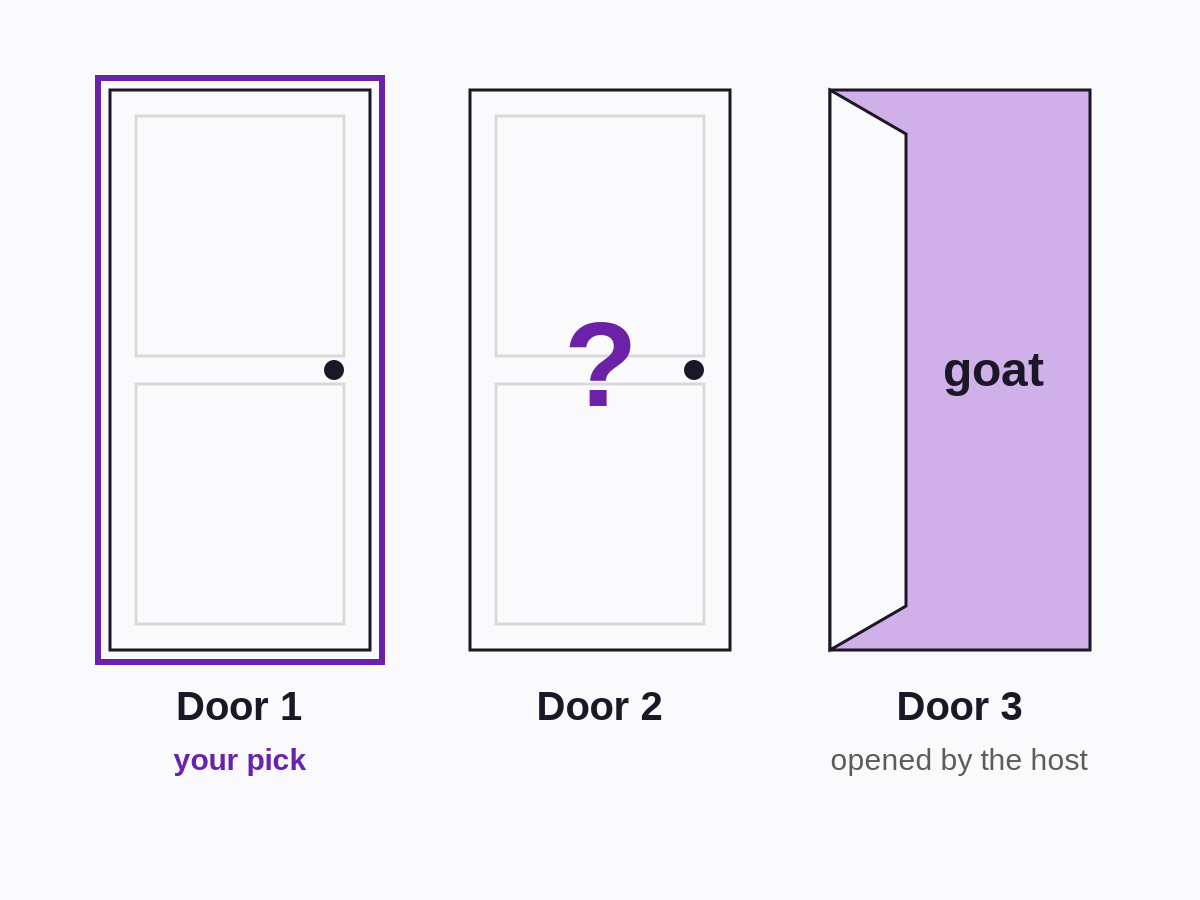
With only two doors left closed, door 2 can look like an even bet. The rest of this page tests the two-in-three answer in ways you can check yourself.
What are the exact rules?
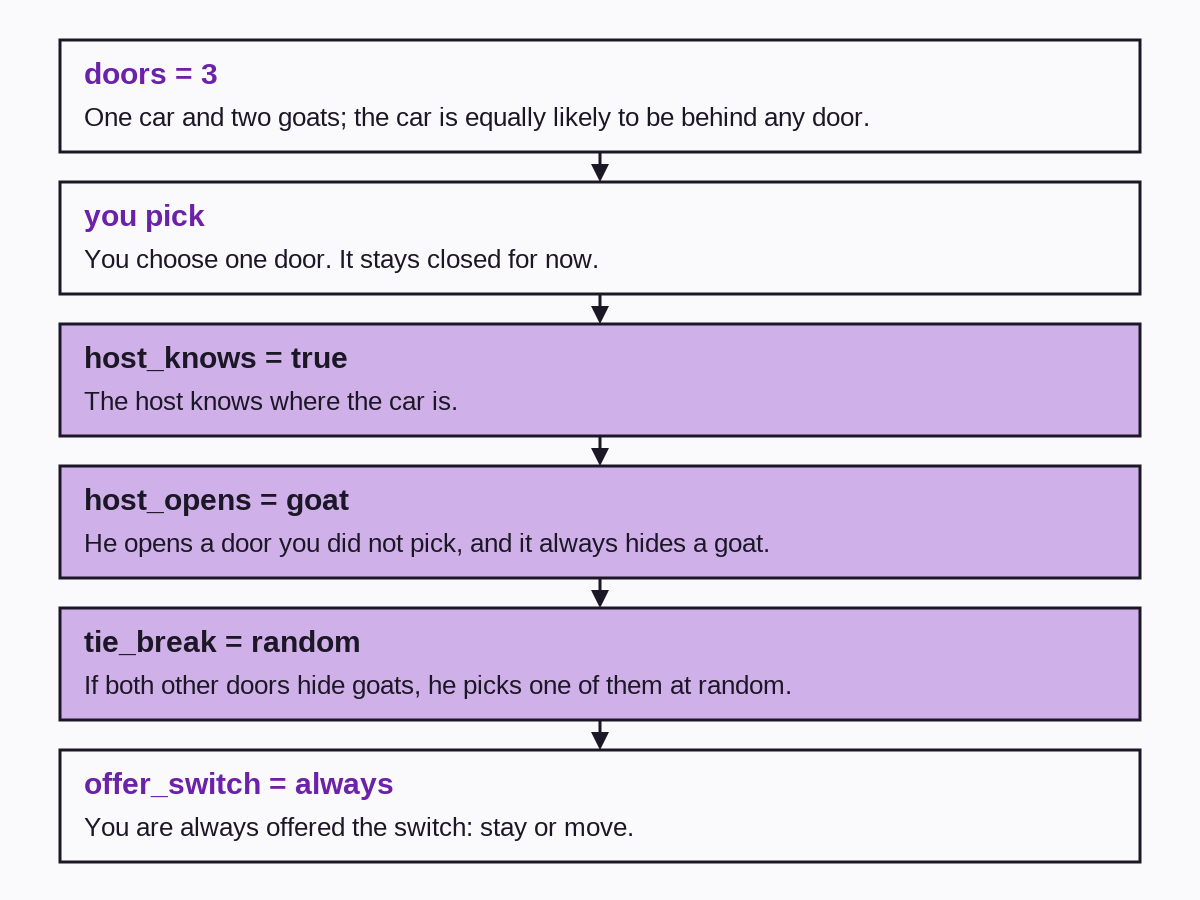
The answer depends on the rules, so here they are as parameters, following Rosenthal's statement of the problem [1]:
doors = 3: one car and two goats, the car equally likely to be behind any door.host_knows = true: the host knows where the car is.host_opens = goat: every game, he opens a door you did not pick, and it hides a goat.tie_break = random: if both other doors hide goats, he picks one at random.offer_switch = always: you are always offered the switch.
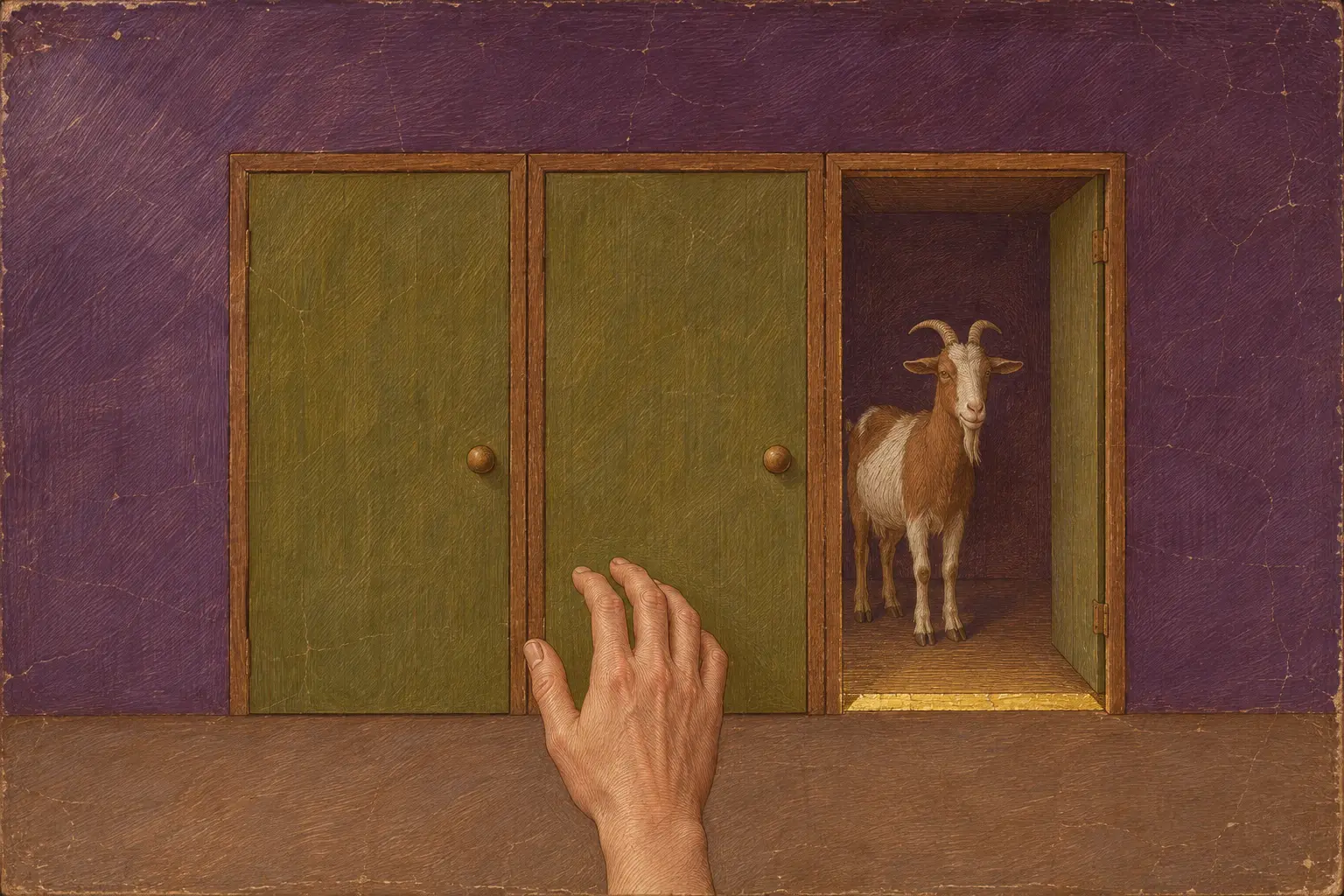
As with the 15 puzzle, the answer turns on a rule the picture does not show.
Why does switching win two times out of three?
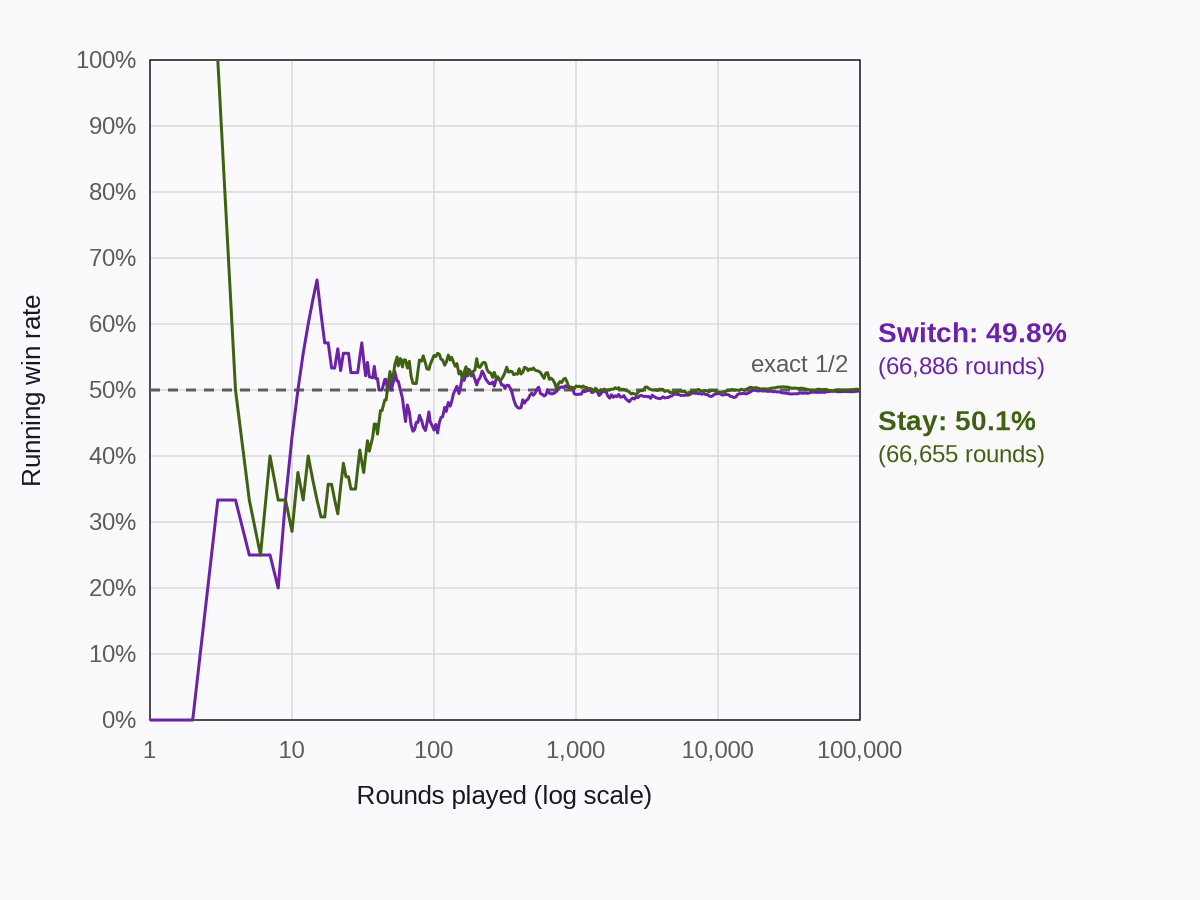
Run it first: over 100,000 simulated rounds per strategy, switching won 66.3% and staying won 33.1%.
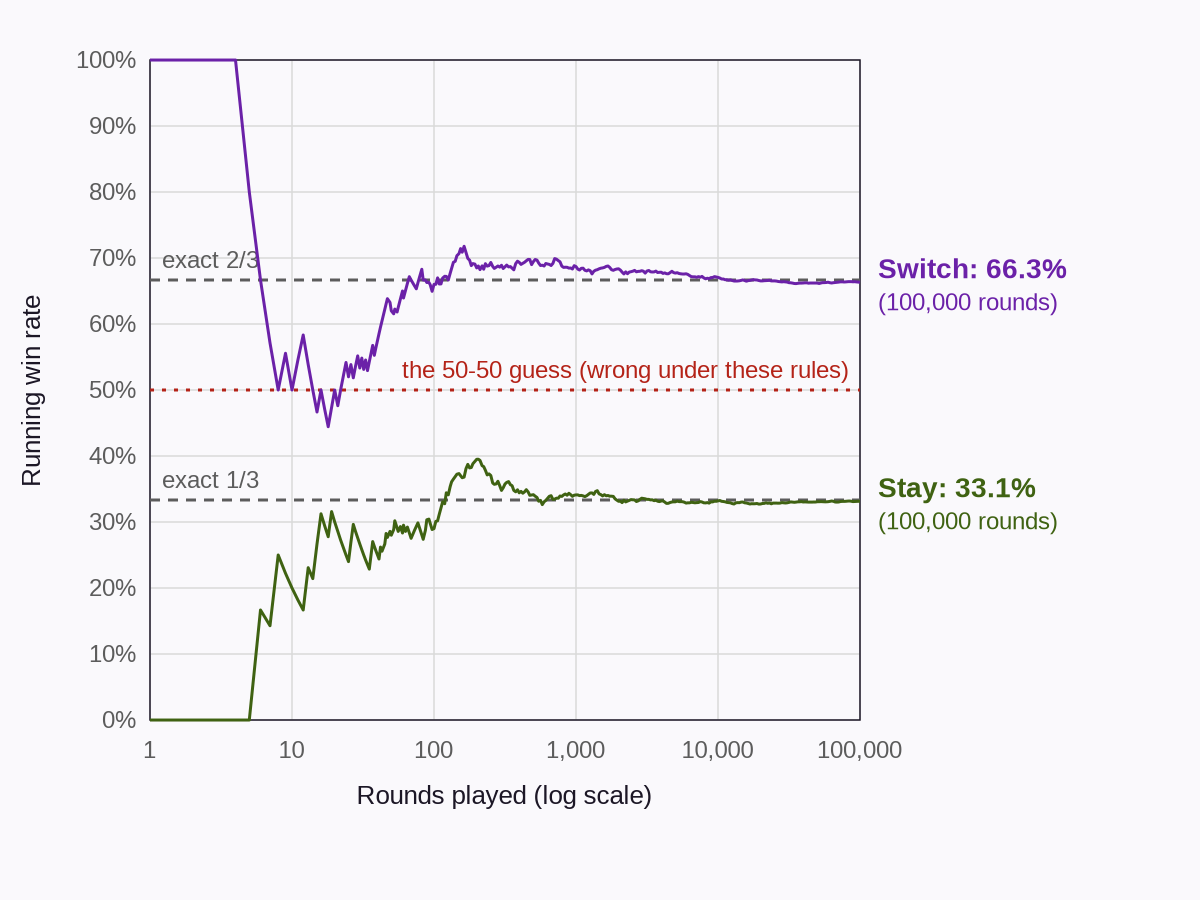
The running rates swing early, then settle as rounds pile up, much as balls falling through a Galton board pile up into a predictable shape. Both final rates are consistent with the exact values at the 99% level, and those exact values come from a count.
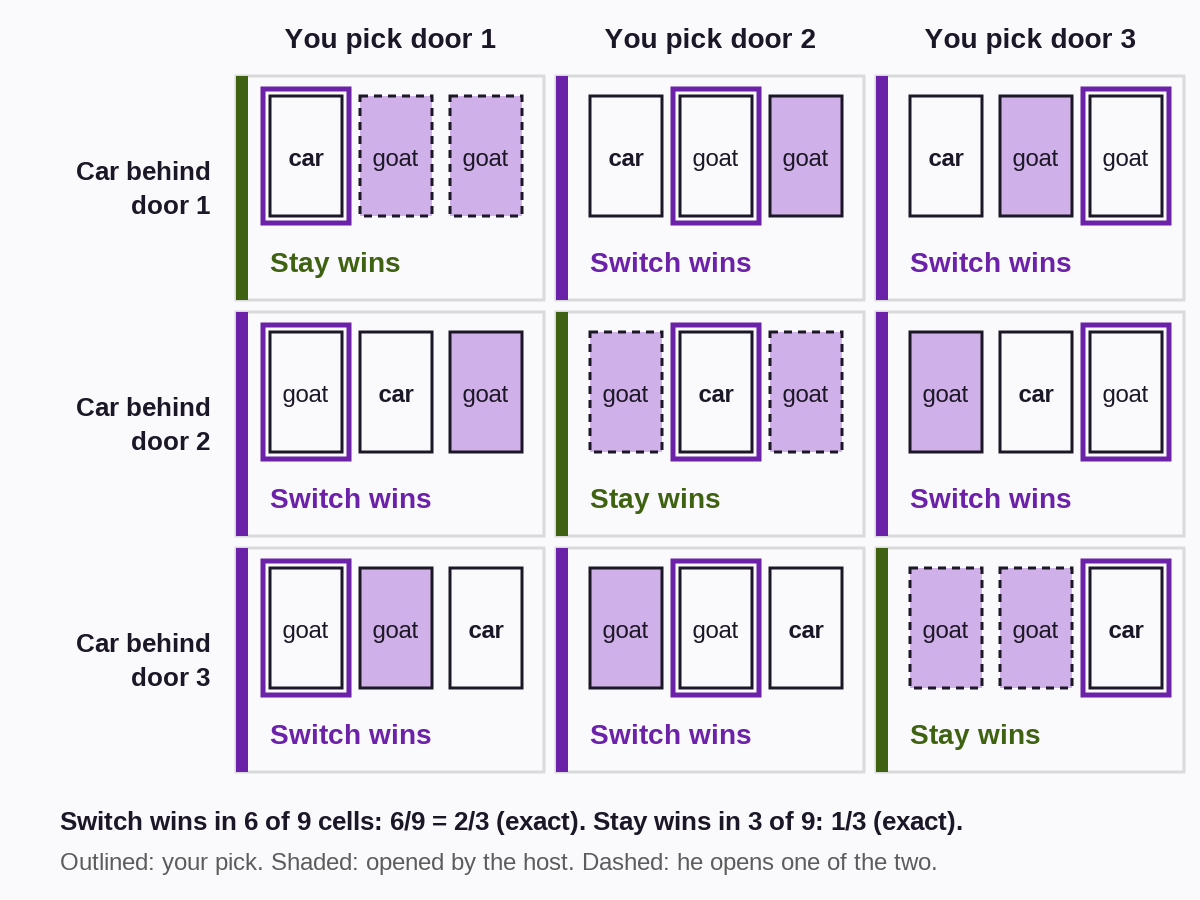
A game can begin in nine ways: three places for the car times three first picks. With a random first pick, each has probability 1/9 (exact). In the three starts where your first pick is the car, the host can open either goat door, and switching loses. In the other six, the rules leave him one door to open, so the door he keeps shut hides the car.
Switching wins in 6 of 9 starts, which is 2/3 (exact). The count is the proof; the run only shows it holding up.
Isn't it 50-50 once a door is open?
Not under the standard rules. Under others, such as a host who guesses, it can be. Jeffrey Rosenthal calls the usual argument, that your first pick keeps its 1/3 chance, correct but “shaky,” because it fails for slight changes to the rules [1, author's copy p. 2].
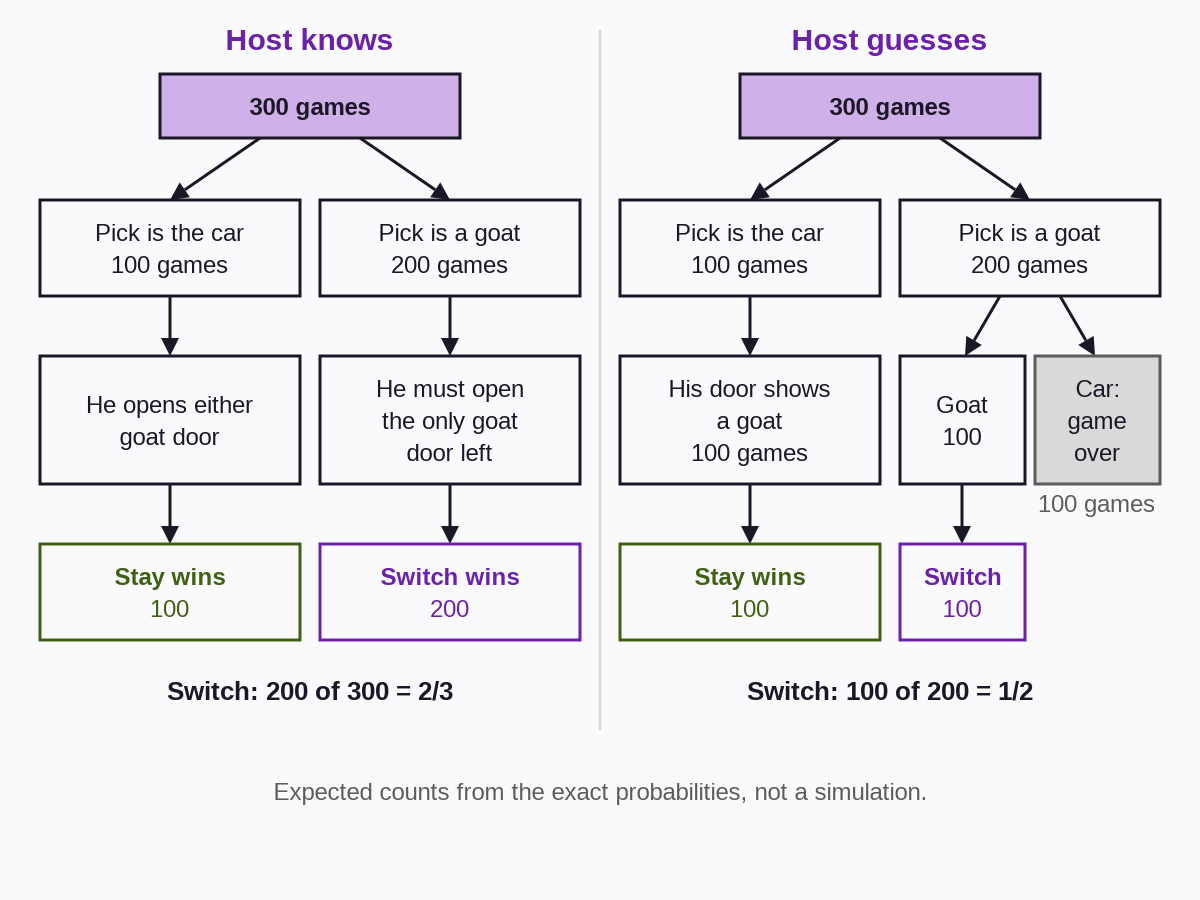
Picture 300 games with the standard host, on average: in 100 of them your first pick is the car. In the other 200 he must open the only goat door left to him, and switching wins all 200.
Now make the host a guesser: he opens one of the other two doors at random. When you picked the car, a goat still shows. In the 200 games where you picked a goat, his door shows the car about 100 times, and those games end there. In the 200 or so games left, the car is behind your door in half, so both choices win 1/2 (exact) [1].
The doors look the same, and so does the goat. Take the host's knowledge away, though, and switching drops from 2/3 to 1/2. That drop is the gasp point of this page: the moment “that can’t be right” turns into a number you can check.
What if there were 100 doors?
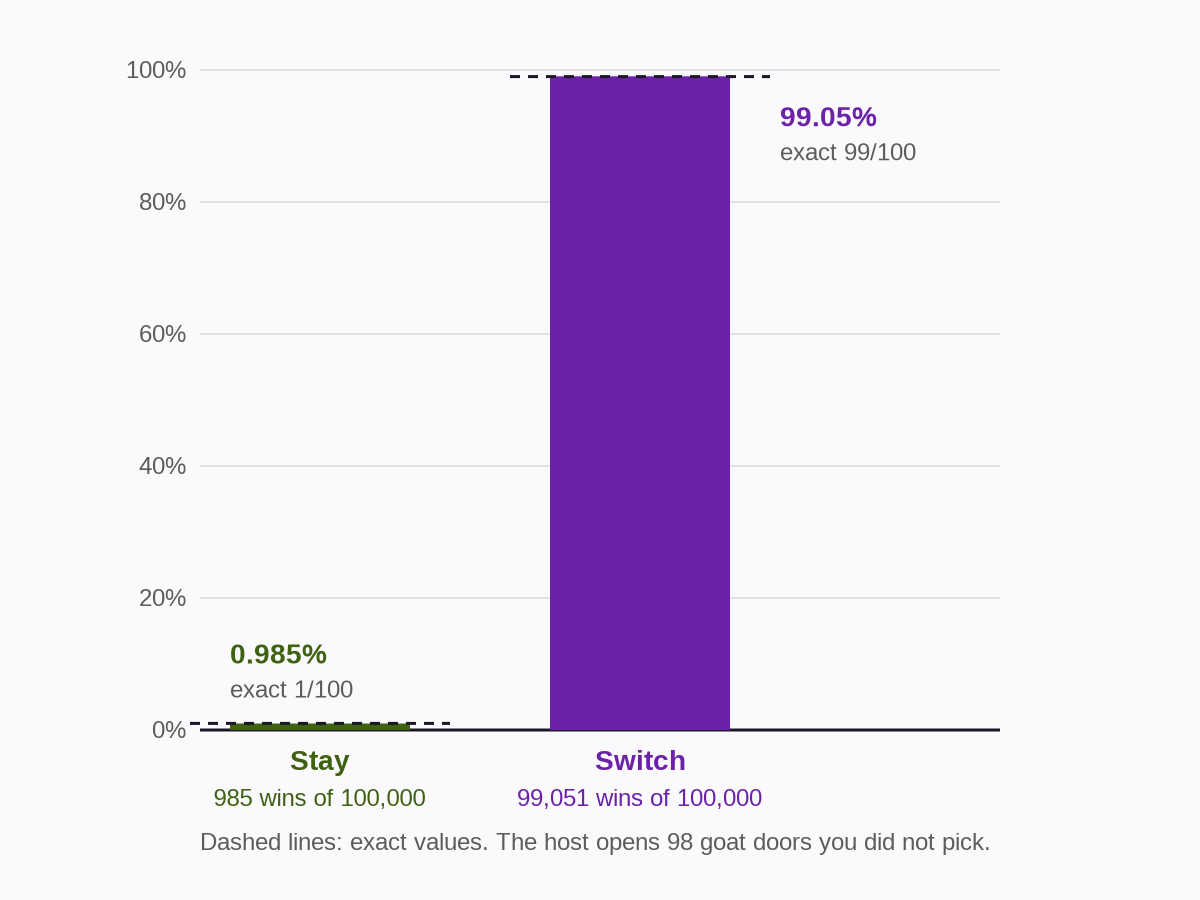
The simulator also ran a 100-door version, in which the host opens 98 goat doors. Over 100,000 rounds per strategy, staying won 985 times (0.985%) and switching won 99,051 times (99.05%), against exact values of 1/100 and 99/100.
Who came up with the Monty Hall problem?
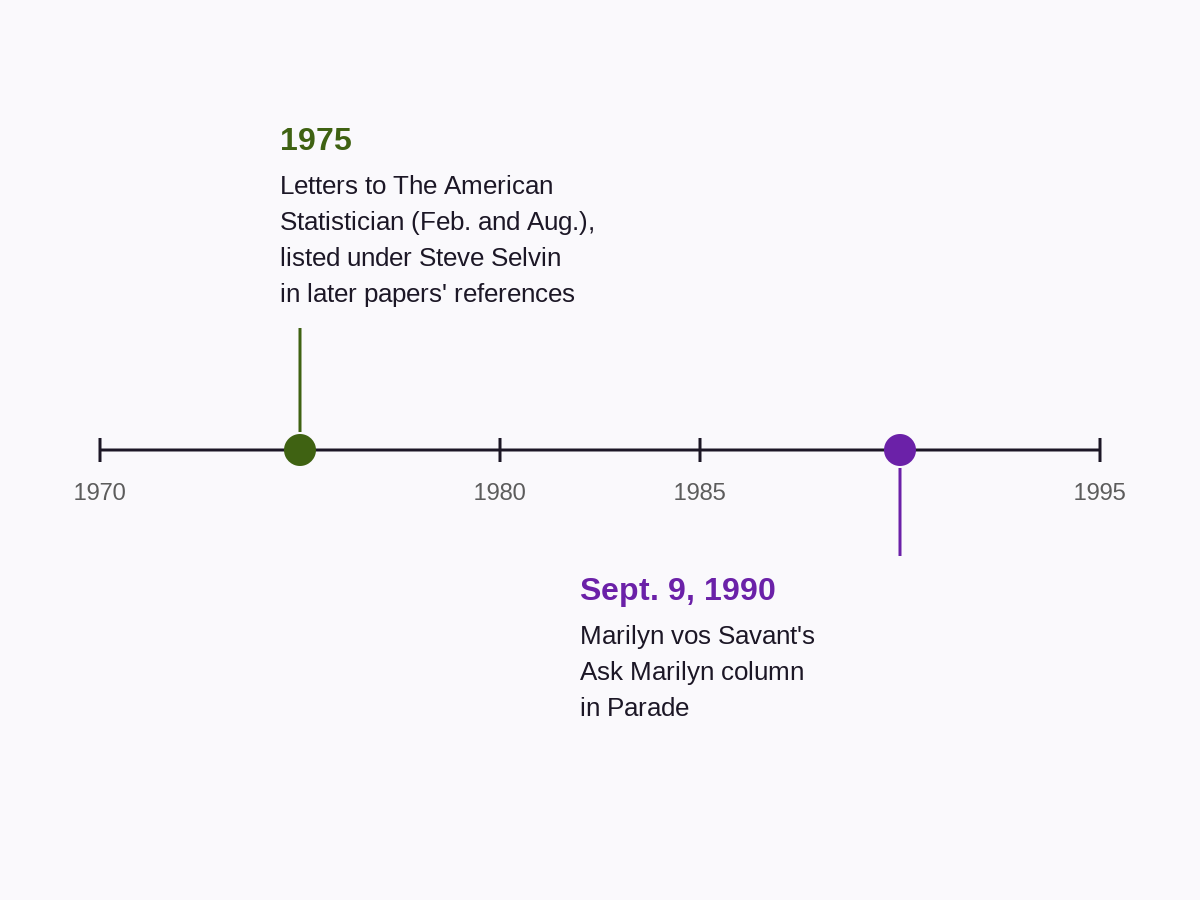
Two later papers on the problem, one by Burns and Wieth and one by Lucas, Rosenhouse and Schepler, credit letters to The American Statistician from February and August 1975 to Steve Selvin in their reference lists [2][4][5]. This page cites only those reference lists and the letters' publication records, not the letters' text. Rosenthal's 2008 account starts later, in 1990, when vos Savant introduced the problem to Parade readers [1][3].
How did Parade readers react?
vos Savant's Ask Marilyn column in Parade ran the problem on September 9, 1990 [3]. Her answer, switch, drew thousands of letters, and professional mathematicians were among those who insisted she was wrong, some in strong language [1].
She replied with an experiment, asking math classes across the country to estimate the odds with pennies and paper cups; in Rosenthal's account, the classes reported that she was right [1].
Why do people stick with their first door?
One explanation comes from Bruce Burns and Mareike Wieth, in a 2004 paper that names it in its title: the collider principle in causal reasoning [5]. A collider is an outcome with two causes. Here the causes are the car's place and your pick, which are independent of each other under the standard rules, and the outcome is the door the host opens.
Herbranson and Schroeder summarize one of Burns and Wieth's findings: puzzles with the same math but a different cover story were not solved equally often [6]. This is one explanation, not a settled one, and this page cites the 2004 paper from its publication record and that summary only.
Do pigeons do better?
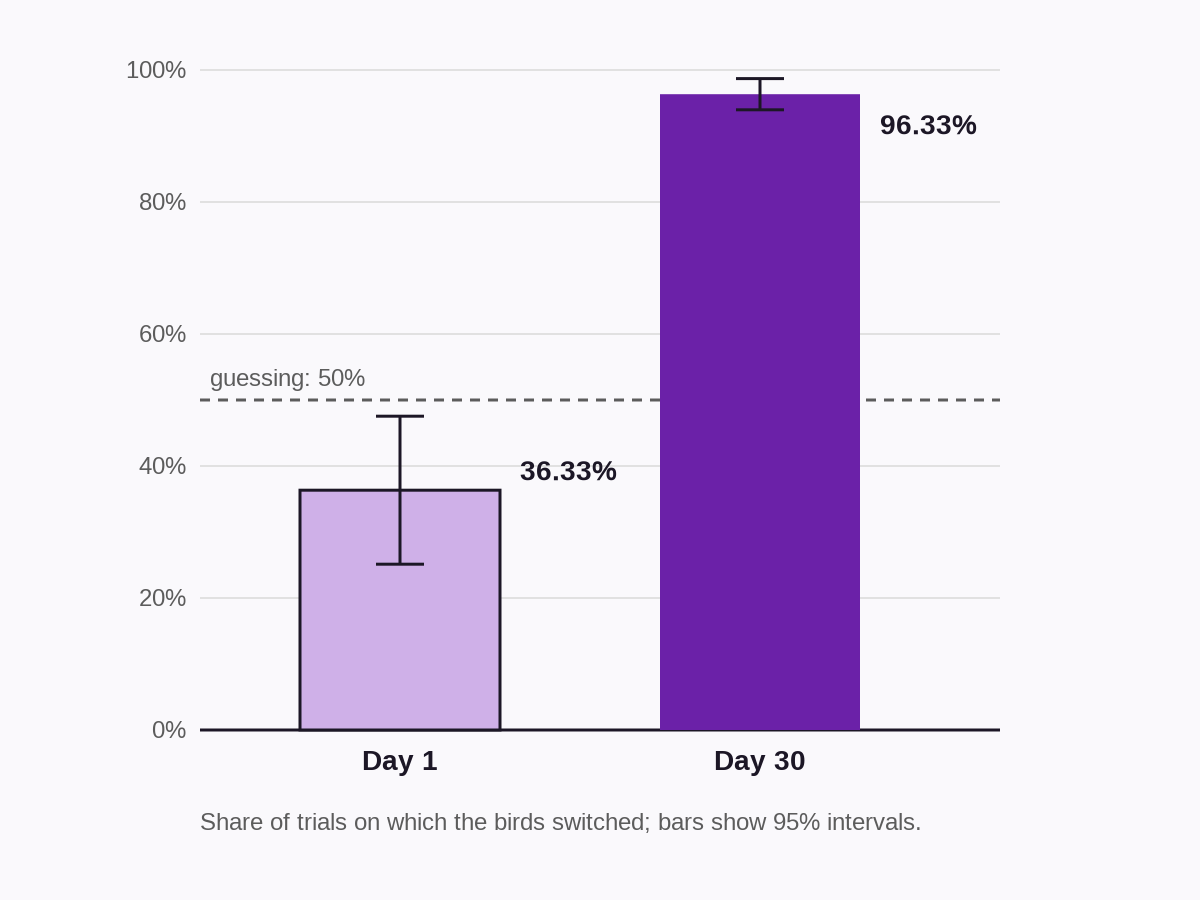
In one 2010 study, they did: six pigeons played a version with three response keys and grain as the prize, at up to 100 trials a day [6]. They switched on 36.33% of trials on day 1 and on 96.33% by day 30. Undergraduates given 200 trials in a matching setup did not settle on the best strategy [6].
Questions people ask
Should you always switch in the Monty Hall problem?
Under the standard rules, yes. If the host knows where the car is, always opens a goat door you did not pick, and always offers the switch, switchers win 2/3 (exact) and stayers 1/3. Change any rule and the odds must be worked out again: with a host who opens a door at random and shows a goat, both choices win 1/2.
How many games does a class need to see the effect?
With 10 games of each strategy, played as separate sessions, the switch tally beats the stay tally about 90.8% of the time. With 200 games of each, the chance that staying ties or wins is about 4.6 in a trillion. Pinning the switch rate to within 1 percentage point at 99% confidence takes about 14,800 games.
Check it yourself
Exact values come from counting every equally likely case in exact fractions. Each run has its own fixed seed, so the same program gives the same counts. A run is consistent when the exact value falls inside its 99% interval (normal approximation, z = 2.5758).
| Rules | Strategy | Rounds counted | Simulated | Exact | 99% interval | Verdict |
|---|---|---|---|---|---|---|
| Standard, 3 doors | Stay | 100,000 | 33.14% | 1/3 | 32.76–33.52% | consistent |
| Standard, 3 doors | Switch | 100,000 | 66.32% | 2/3 | 65.94–66.71% | consistent |
| Random host | Stay | 66,655 of 100,000 | 50.09% | 1/2 | 49.59–50.59% | consistent |
| Random host | Switch | 66,886 of 100,000 | 49.82% | 1/2 | 49.32–50.32% | consistent |
| 100 doors | Stay | 100,000 | 0.985% | 1/100 | 0.905–1.065% | consistent |
| 100 doors | Switch | 100,000 | 99.05% | 99/100 | 98.97–99.13% | consistent |
In the random-host runs, the host showed the car in 33,345 and 33,114 of 100,000 rounds (exact share: 1/3). Data: simulation results (CSV) · what the file holds and its license and running win rates (CSV) · what the file holds and its license.
Classroom planner
One session per strategy; exact binomial sums, no simulation. Margins are n/a where the normal approximation does not apply (under 10 expected switch losses).
| Games per strategy | Stay tally ties or beats switch | 99% margin, switch rate |
|---|---|---|
| 10 | 9.2% | n/a |
| 50 | 0.042% | ±17.2 points |
| 100 | 8.4 in 10 million | ±12.1 points |
| 200 | 4.6 in a trillion | ±8.6 points |
| 1,000 | 2.5 × 10⁻⁵³ | ±3.8 points |
The ±1 point figure: n ≥ (2.58/e)² × p(1 − p), p = 2/3, e = 0.01, gives 14,792 games. Data: classroom planner (CSV) · what the file holds and its license.
Now break it
Change a setting and watch the answer move.
host_knows = false. The host opens one of the two other doors at random; rounds that show the car are thrown out. Switching falls to 1/2 (exact) [1]. The simulator's 49.8% (66,886 counted rounds) is consistent with it.tie_break = lowest_door. When he has a choice, the host opens the lower-numbered goat door. Pick door 1: if he opens door 3, switching wins with probability 1; if he opens door 2, it is 1/2 (both exact) [1]. Across both cases, switching still wins 2/3 (exact, recomputed by the generator).doors = 100. The host opens 98 goat doors, and switching rises to 99/100 (exact).
The host's choice carries information; the earlier flips of a fair coin carry none, which is the trap in the gambler's fallacy.
Try this next: birthday paradox — count how many people a room needs before a shared birthday is more likely than not.
Sources
- Jeffrey S. Rosenthal, "Monty Hall, Monty Fall, Monty Crawl," Math Horizons, September 2008, pp. 5–7. https://probability.ca/jeff/writing/montyfall.pdfRead: full text (author's copy)
- "Letters to the Editor," The American Statistician 29(1), February 1975, pp. 67–71, doi:10.1080/00031305.1975.10479121; and 29(3), August 1975, pp. 131–134, doi:10.1080/00031305.1975.10477398. Letters in these issues are credited to Steve Selvin in the reference lists of Burns and Wieth (2004) and of Lucas, Rosenhouse and Schepler (2009). https://doi.org/10.1080/00031305.1975.10479121Read: bibliography only
- Marilyn vos Savant, "Ask Marilyn," Parade, September 9, 1990, p. 22; follow-up columns December 2, 1990, p. 26; February 7, 1991, p. 12; July 7, 1991, pp. 28–29. Cited through Rosenthal (2008): the dates are those in his reference list, the reactions described on this page are his account, and the link goes to his paper; the columns themselves were not consulted. https://probability.ca/jeff/writing/montyfall.pdfRead: bibliography only
- Stephen Lucas, Jason Rosenhouse and Andrew Schepler, "The Monty Hall Problem, Reconsidered," Mathematics Magazine 82(5), 2009, pp. 332–342, doi:10.4169/002557009X478355. https://doi.org/10.4169/002557009X478355Read: bibliography only
- Bruce D. Burns and Mareike Wieth, "The Collider Principle in Causal Reasoning: Why the Monty Hall Dilemma Is So Hard," Journal of Experimental Psychology: General 133(3), 2004, pp. 434–449, doi:10.1037/0096-3445.133.3.434. https://doi.org/10.1037/0096-3445.133.3.434Read: bibliography only
- Walter T. Herbranson and Julia Schroeder, "Are Birds Smarter Than Mathematicians? Pigeons (Columba livia) Perform Optimally on a Version of the Monty Hall Dilemma," Journal of Comparative Psychology 124(1), 2010, pp. 1–13, doi:10.1037/a0017703. https://pmc.ncbi.nlm.nih.gov/articles/PMC3086893/Read: full text (author manuscript)
Cite this page
Explorable Illusions. (2026). Monty Hall Problem: Standard Rules Make Switching Win 2 in 3. Explorable Illusions. Published 2026-11-13. https://explorableillusions.com/probability/monty-hall-problem/
Add the date you read it. Figures and CSV files on this page are CC BY 4.0 unless their credit line says otherwise.
How pages here are checked Corrections log Report an error: contact@explorableillusions.com
More in Probability Playground
 Probability Playground
Birthday Paradox: 23 People Make 253 Pairs That Can Match
In a room of 23 people, a shared birthday is slightly more likely than not: 50.7%, exact, under the standard 365-day model. Count the 253 pairs and see why.
Picture credit (illustration)
Illustration: Explorable Illusions. Generated schematic image — not a photograph, historical record, or test stimulus. Reuse: CC BY 4.0 (https://creativecommons.org/licenses/by/4.0/), to the extent any rights exist.
 Probability Playground
Galton Board: On a Fair Board, the Bell Is a Count of Paths
On a fair 12-row Galton board, exactly 2,508 of 4,096 paths, about 61.2%, end in the middle three bins. Run the board and see where the bell comes from.
Picture credit
"Galton Quincunx, 1933 – Museum of Science and Industry (Chicago)" by Daderot — https://commons.wikimedia.org/wiki/File:Galton_Quincunx,_1933_-_Museum_of_Science_and_Industry_(Chicago)_-_DSC06712.JPG — CC0 1.0 (https://creativecommons.org/publicdomain/zero/1.0/); modified: cropped to a 4:3 frame on the lower half of the board (lower pin triangle, bead columns, Normal Frequency Curve), removing the upper half, the museum placard and the stand; a strip of a neighbouring crate remains at the right edge; scaled to 1600 x 1200 px
 Probability Playground
Benford’s Law: Why 1 Beats 9 as a Leading Digit
Of the first 1,000 powers of 2, 301 start with 1 and only 45 with 9. See the rule Newcomb printed in 1881, why powers of 2 obey it, and where it fails.
Picture credit
"Simon Newcomb (Popular Science Monthly, vol. 11, 1877)" by Unknown author — https://commons.wikimedia.org/wiki/File:PSM_V11_D530_Simon_Newcomb.jpg — Public domain (US: published 1877 in Popular Science Monthly, vol. 11; EU: presumed, as an anonymous engraving published in 1877, more than 70 years ago (no engraver named on the file page))