Gambler’s Fallacy: Independent Fair Flips Stay 50-50
Explorable Illusions · Published
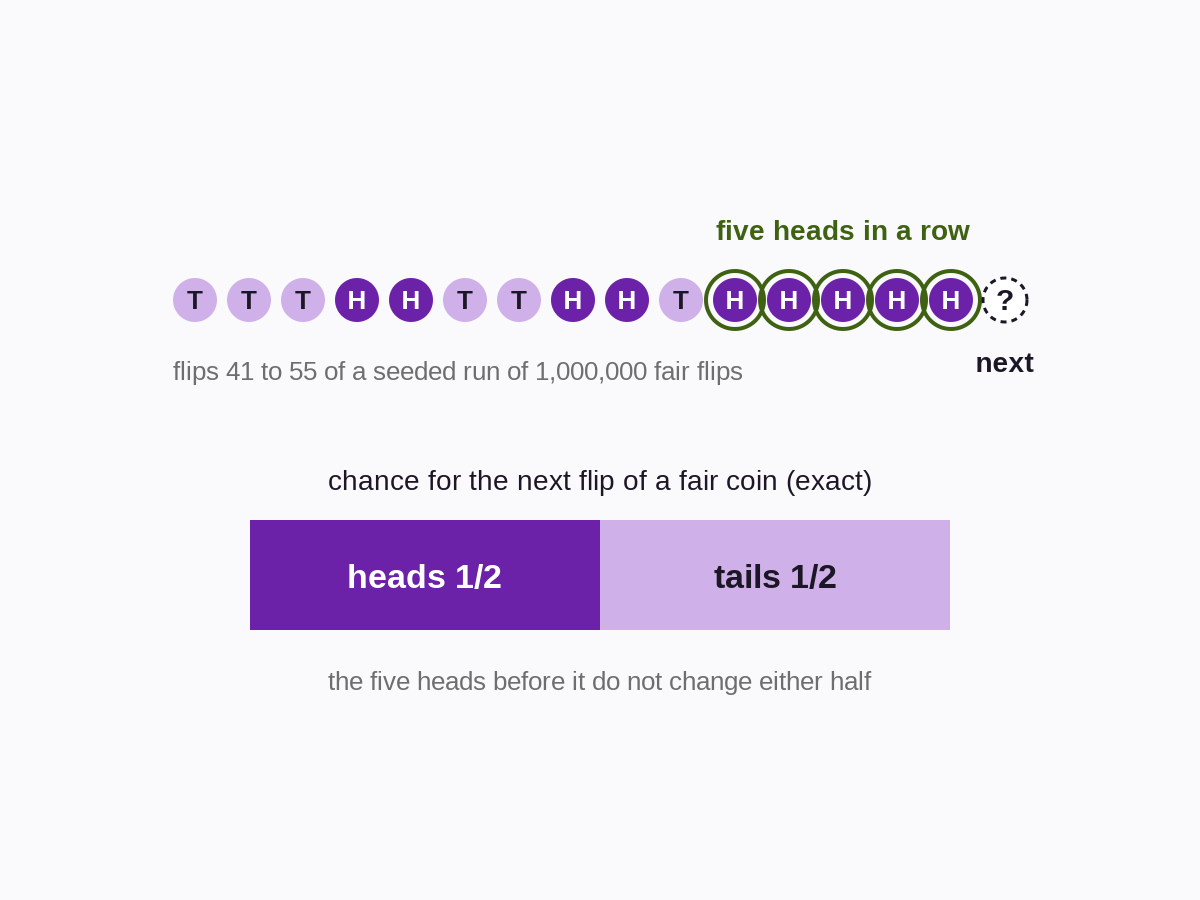
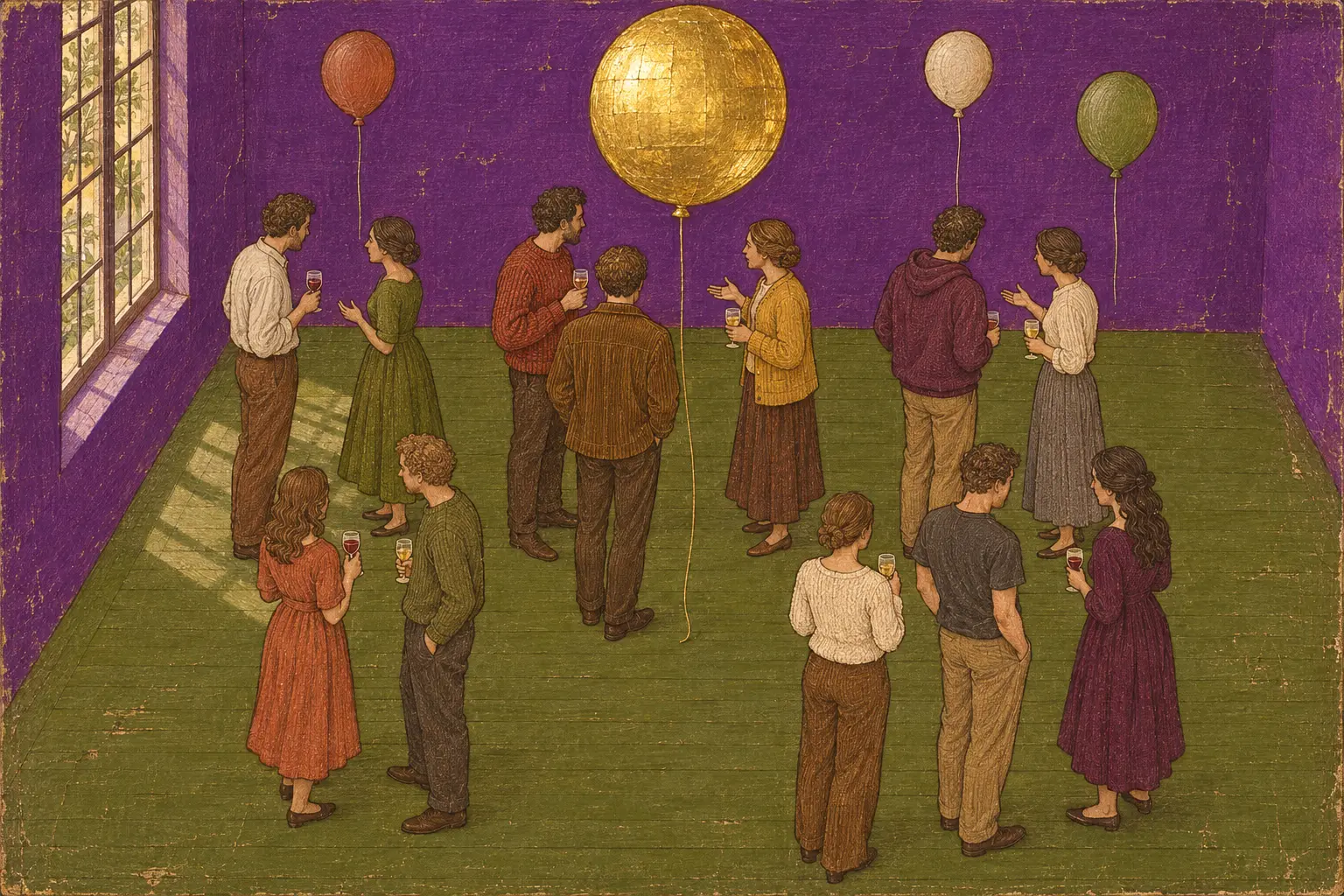
This simulated fair coin just landed heads five times; the next flip is still 50-50. A 2012 study in PLoS ONE by Gui Xue and colleagues defines the gambler’s fallacy as “the belief that the occurrence of a certain random event is less likely after a series of the same event.” For a fair coin whose flips are independent, heads after five heads has a chance of exactly 1/2. Long runs are also more common than they feel: 100 fair flips contain a run of six or more of one side 80.7% of the time, exact.
At a glance
- Name
- Gambler’s fallacy
- First recorded
- No first source was traced for this page. Xue and colleagues tie the usual account to the law of small numbers, citing Tversky and Kahneman 1971
- Type
- Probability error: the belief that a random event is less likely after a run of the same event
- Main explanations
- Exact result: with a fair coin and independent flips, the next flip is heads with chance 1/2 whatever came before. Why a break feels due: the traditional account is a belief that a short stretch of a random sequence should look like the whole. Xue and colleagues propose weak feeling-based and strong reasoning-based decision making, from correlations in one study of 438 students.
- On this page
- Static figures and recomputable data: next-flip shares after 1 to 8 heads in 1,000,000 seeded flips, and the longest run in 100 flips, exact and over 100,000 seeded sequences
gamblers-fallacy-glance.csv (CSV) · what the file holds and its license
If tails still feels due on the flip marked with a question mark, hold on to that feeling. On this page, the gasp point is one row of the check table below: after five heads, the next flip came up heads 50.2% of 31,338 times.
After five heads, what comes next?
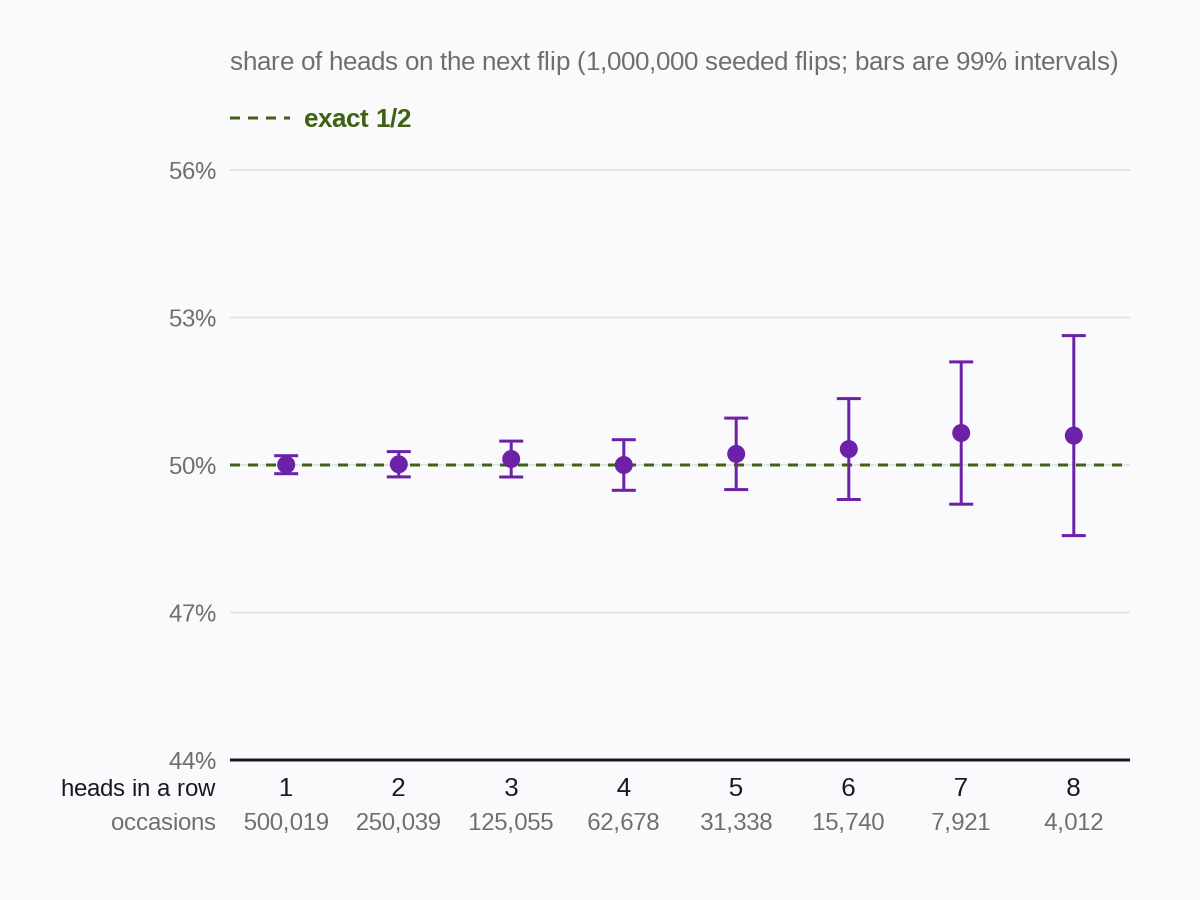
Xue and colleagues describe a typical pattern: people guided by the fallacy predict the break of a streak more often as the streak gets longer. The chart tests that idea on a fair coin. The program flipped 1,000,000 times with a fixed seed and stopped at every spot where the previous flips were all heads. After five heads, it stopped 31,338 times, and the next flip was heads on 15,740 of them: 50.2%.
The answer does not need the run. Independence means the coin, not the flips before it, sets each flip’s chance. Five heads followed by heads and five heads followed by tails are two six-flip sequences, and each has the same chance, 1/64. So after five heads the next flip is heads with chance 1/2, exact, and the seeded run is consistent with that.
The bars widen to the right because long runs are rarer: only 4,012 of the 1,000,000 flips came right after eight heads in a row, so that row pins the share down less tightly.
Long runs are more common than they feel
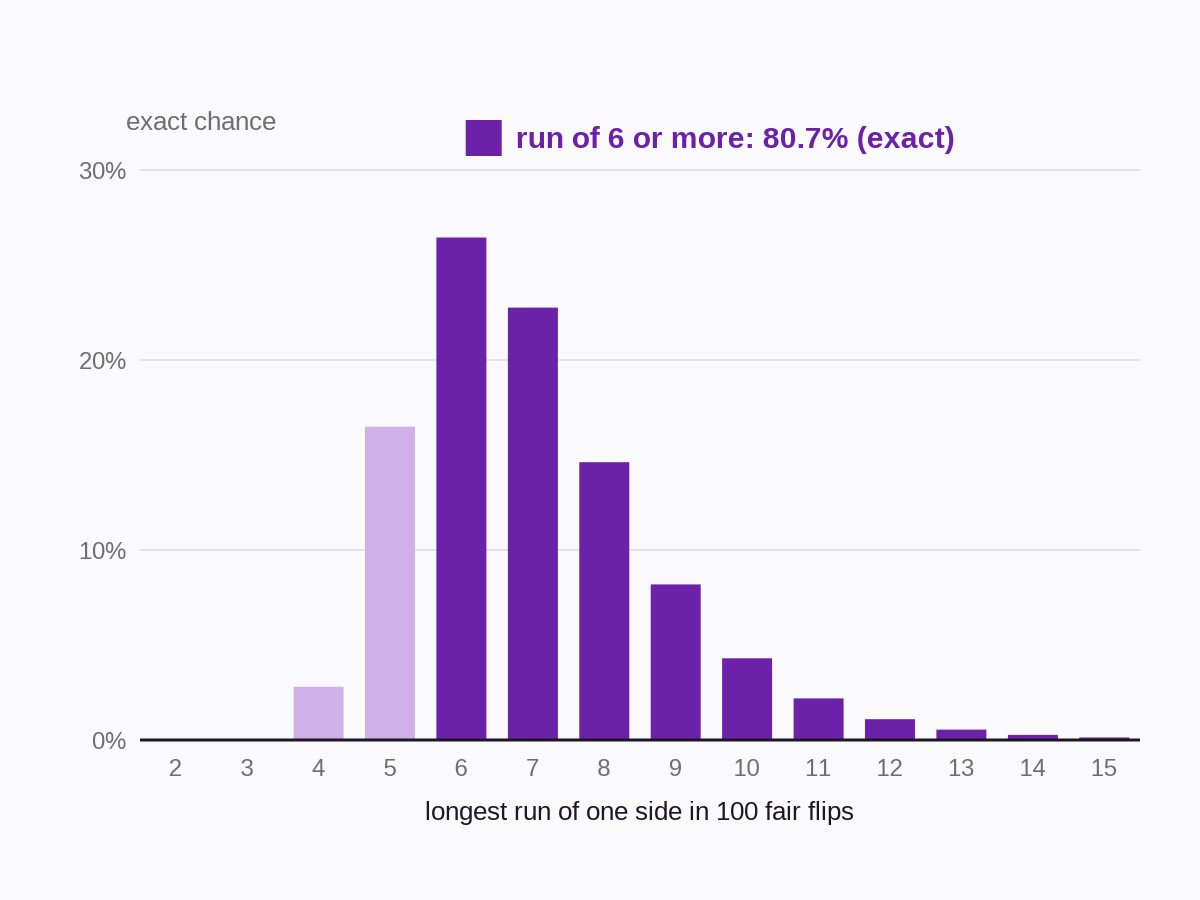
Six heads in a row, or six tails, can feel like a sign that something is off. In 100 fair flips, though, the chance of at least one run of six or more of the same side is 80.7%, exact. The most likely longest run is 6, at 26.4%, and the median longest run is 7.
The reason is a counting move much like the one in the birthday paradox. In 100 flips, a run of six can start at any of 95 places, and each start is one more chance. The program also flipped 100,000 seeded sequences of 100, and 80,780 of them held a run of six or more: 80.8%, consistent with the exact value.
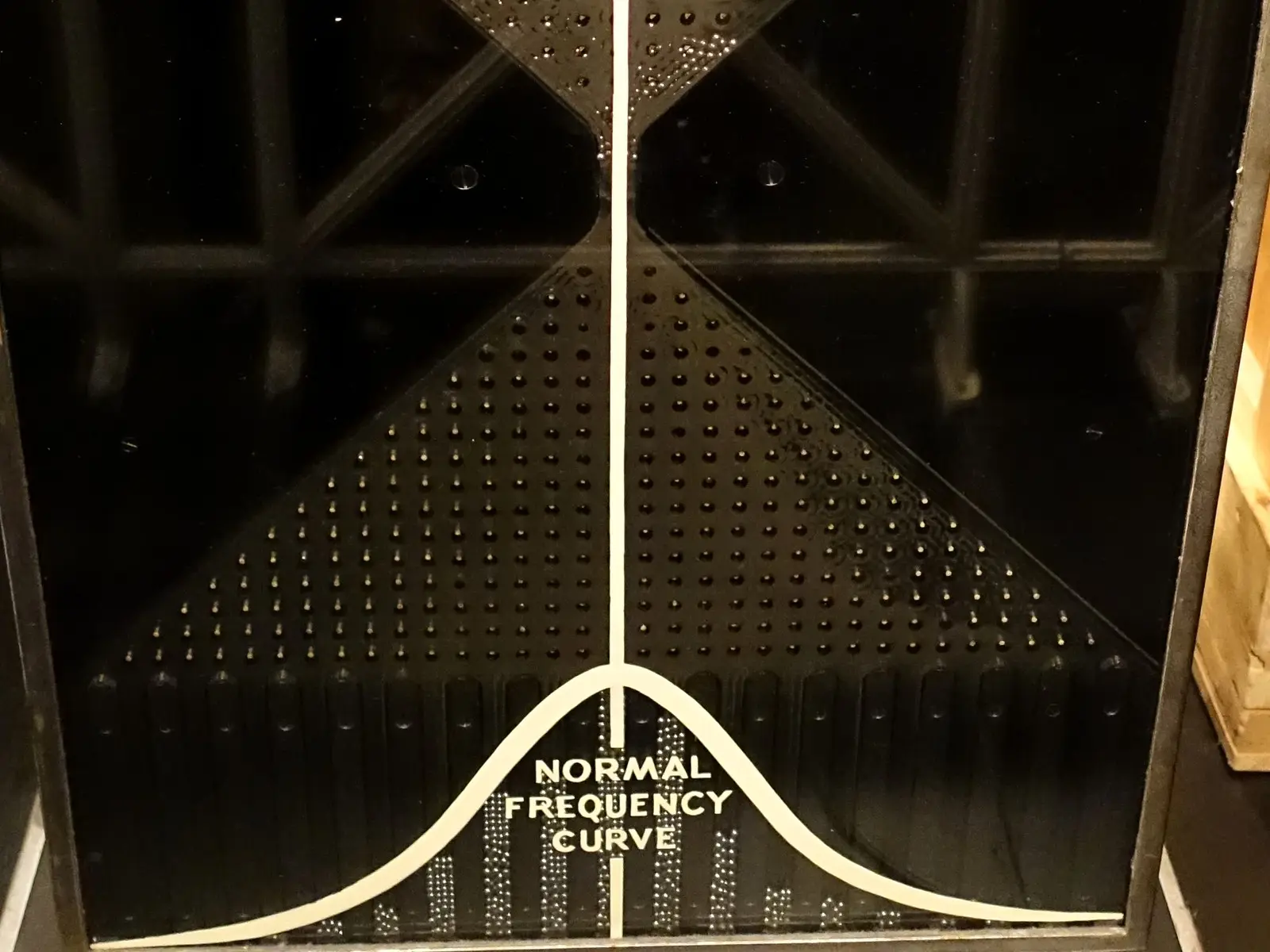
The same independence sits under the usual model of a Galton board, where each pin sends a bead left or right with no memory of the pin above it.
Why a break feels due
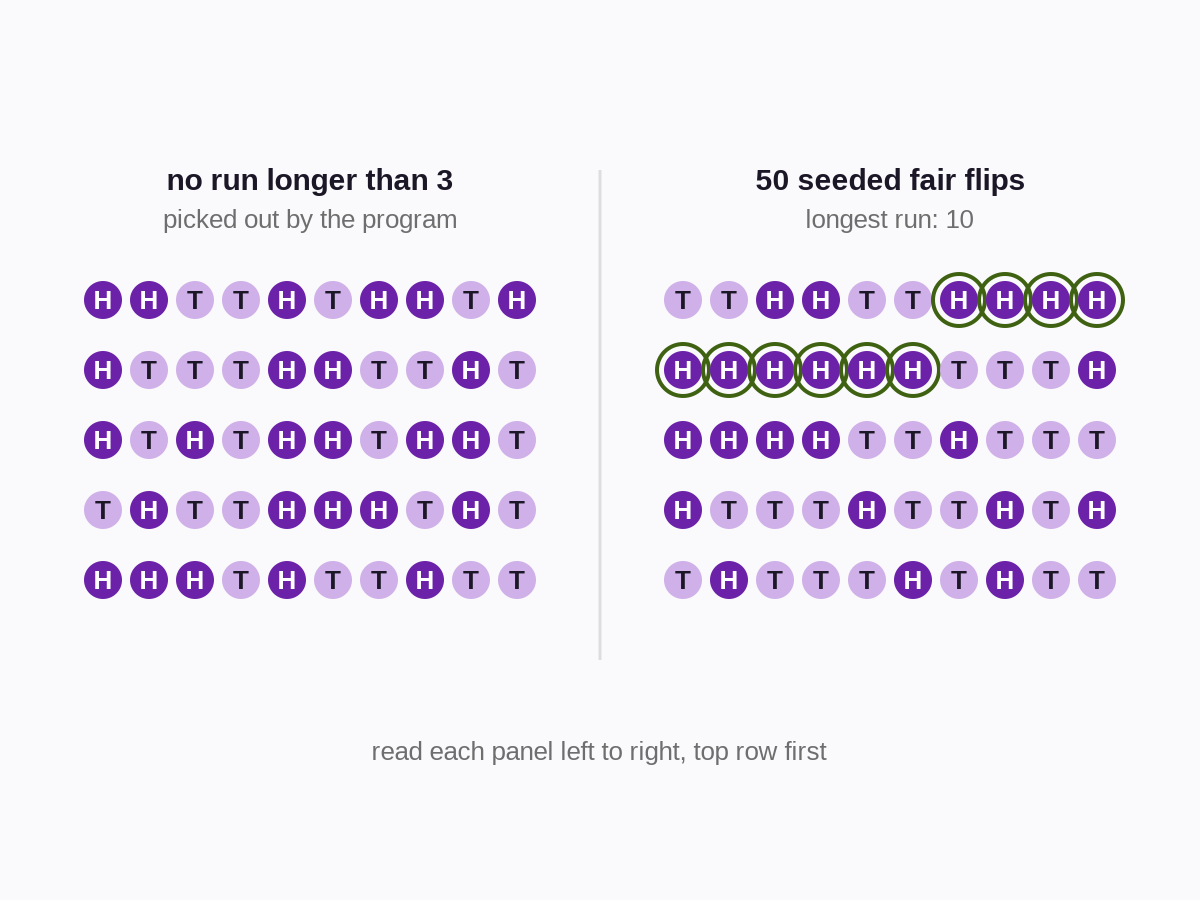
Look at the two panels and ask which one seems more random. Fifty fair flips with no run longer than three have a chance of only 1.9%, exact. The right panel happens to hold a run of ten heads. A run of ten or more of one side turns up in just 4.1% of 50 fair flips; a run of five or more, in 82.1%.
One account, which Xue and colleagues call the traditional view, treats the fallacy as a fast, intuitive shortcut: a belief in the “law of small numbers,” the idea that a short stretch of a random sequence should look like the whole. They cite a 1971 paper by Amos Tversky and Daniel Kahneman for that idea. On that view, the left panel should look more random than the right.
A second account comes from Xue’s own study of 438 college students in China. In a card-guessing game, the computer picked red or black at random, and the students were told so. Students who used the fallacy more tended to score higher on tests of intelligence and working memory, and lower on the Iowa Gambling Task, which the authors use to measure decision making guided by feelings. This is a correlation from one sample at one university, which the authors read as support for their hypothesis; a correlation alone does not settle the cause.
A story often told about the fallacy is set at the Monte Carlo casino in 1913. The story goes that a roulette wheel landed on black in a very long run while players piled onto red. No contemporary report of the event could be traced for this page, so it appears here as a story, not as a record.
Check it yourself
Each row below counts every spot in the seeded run of 1,000,000 flips where the previous flips were all heads. To pin a share within 1 percentage point at 99% confidence takes (2.58/0.01)² × 0.25 = 16,641 occasions. The rows for 1 to 5 heads clear that bar; the rows for 6 to 8 carry wider intervals. The 1/2 comes from the independence argument, not from these counts; the counts only fail to contradict it.
| Heads in a row | Occasions | Next flip heads | Share | 99% interval |
|---|---|---|---|---|
| 1 | 500,019 | 250,040 | 50.01% | 49.82% to 50.19% |
| 2 | 250,039 | 125,056 | 50.01% | 49.76% to 50.27% |
| 3 | 125,055 | 62,679 | 50.12% | 49.76% to 50.49% |
| 4 | 62,678 | 31,339 | 50.00% | 49.49% to 50.51% |
| 5 | 31,338 | 15,740 | 50.23% | 49.50% to 50.95% |
| 6 | 15,740 | 7,921 | 50.32% | 49.30% to 51.35% |
| 7 | 7,921 | 4,012 | 50.65% | 49.20% to 52.10% |
| 8 | 4,012 | 2,030 | 50.60% | 48.56% to 52.63% |
Next-flip counts after 1 to 8 heads, with seed and intervals (CSV) · what the file holds and its license
The longest-run file lists, for runs of 5 to 15, the exact chance that 100 fair flips contain one, and how many of 100,000 seeded sequences did. Every exact value falls inside its run’s 99% interval.
Longest runs in 100 flips, exact and simulated (CSV) · what the file holds and its license
None of this is a guide to betting. The numbers describe a fair coin with independent flips, and they carry over to a real device only as far as it behaves like one.
Now break it
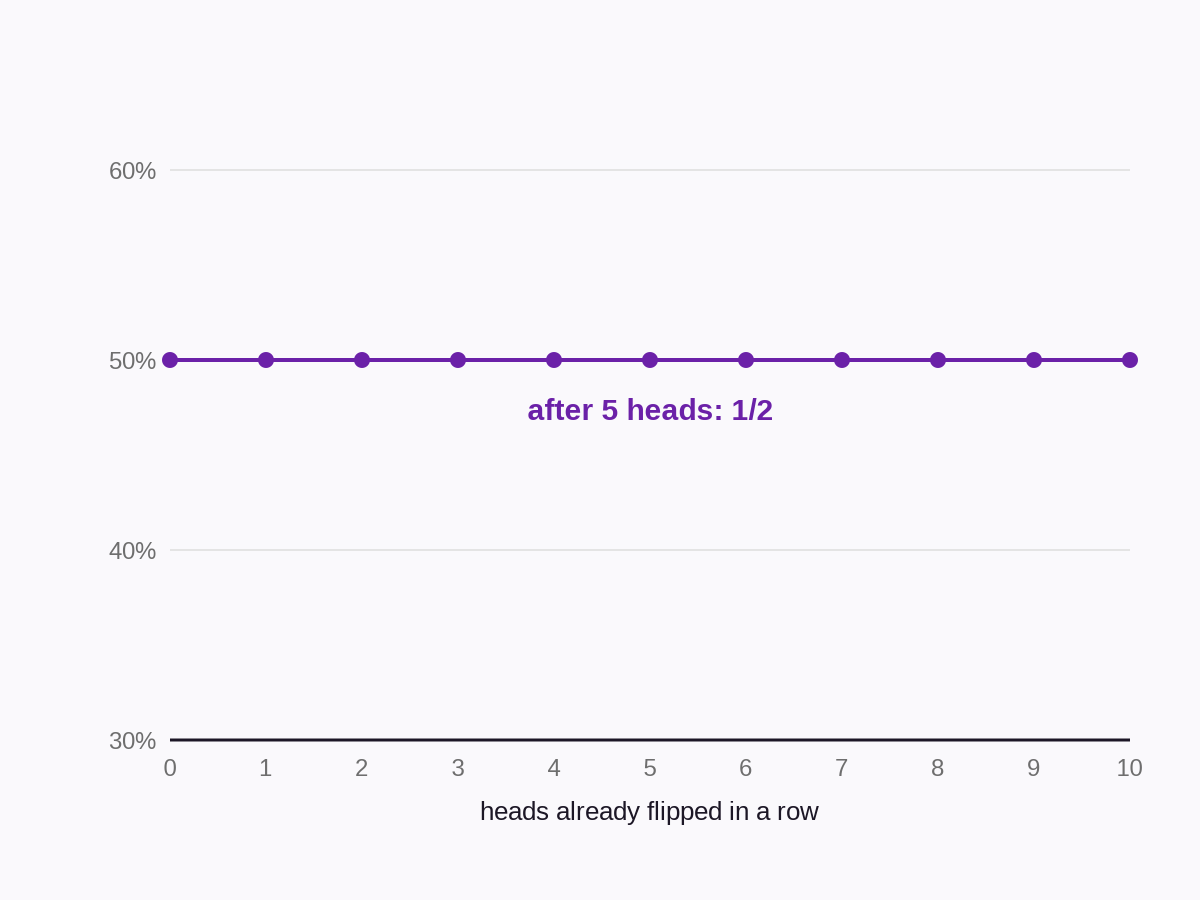
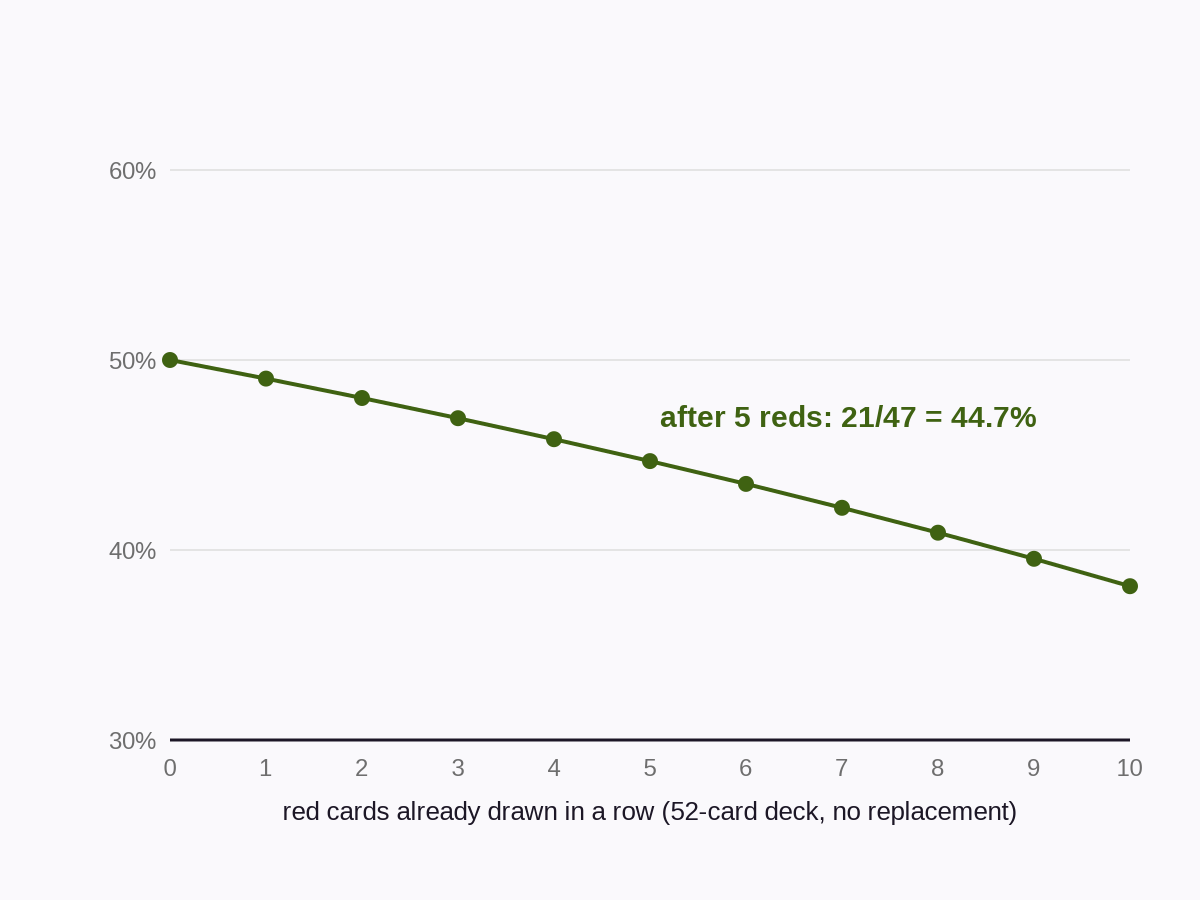
Remove the independence and the past starts to count. Swap the coin for a shuffled deck of 26 red and 26 black cards, then deal without putting any back. After five reds, 21 of the 47 cards left are red, so the next card is red with chance 21/47, or 44.7%, exact. After ten reds the chance is 16/42, or 38.1%.
For the deck, a break really does grow more likely, because each red card dealt leaves one fewer red behind. The coin keeps nothing, so its line stays flat at 1/2. A double pendulum fails in the other direction: each swing follows exactly from the one before, yet it is hard to predict far ahead.
Try this next: Monty Hall problem — a game where the host’s choice of door does carry information about what comes next.
Sources
- Gui Xue, Qinghua He, Xuemei Lei, Chunhui Chen, Yuyun Liu, Chuansheng Chen, Zhong-Lin Lu, Qi Dong and Antoine Bechara, “The Gambler’s Fallacy Is Associated with Weak Affective Decision Making but Strong Cognitive Ability,” PLoS ONE 7, no. 10 (2012): e47019, doi:10.1371/journal.pone.0047019. https://pmc.ncbi.nlm.nih.gov/articles/PMC3465297/Read: full textText license: Creative Commons Attribution License (version not stated on the article page)
- Amos Tversky and Daniel Kahneman, “Belief in the Law of Small Numbers,” Psychological Bulletin 76, no. 2 (1971): 105–110, doi:10.1037/h0031322. https://doi.org/10.1037/h0031322Read: bibliography only
Cite this page
Explorable Illusions. (2026). Gambler’s Fallacy: Independent Fair Flips Stay 50-50. Explorable Illusions. Published 2026-11-13. https://explorableillusions.com/probability/gamblers-fallacy/
Add the date you read it. Figures and CSV files on this page are CC BY 4.0 unless their credit line says otherwise.
How pages here are checked Corrections log Report an error: contact@explorableillusions.com
More in Probability Playground
 Probability Playground
Monty Hall Problem: Standard Rules Make Switching Win 2 in 3
Under the standard rules, switching wins the Monty Hall problem 2 times in 3, because the host knows where the car is. See the count and 100,000-round runs.
Picture credit (illustration)
Illustration: Explorable Illusions. Generated schematic image — not a photograph, historical record, or test stimulus. Reuse: CC BY 4.0 (https://creativecommons.org/licenses/by/4.0/), to the extent any rights exist.
 Probability Playground
Birthday Paradox: 23 People Make 253 Pairs That Can Match
In a room of 23 people, a shared birthday is slightly more likely than not: 50.7%, exact, under the standard 365-day model. Count the 253 pairs and see why.
Picture credit (illustration)
Illustration: Explorable Illusions. Generated schematic image — not a photograph, historical record, or test stimulus. Reuse: CC BY 4.0 (https://creativecommons.org/licenses/by/4.0/), to the extent any rights exist.
 Probability Playground
Galton Board: On a Fair Board, the Bell Is a Count of Paths
On a fair 12-row Galton board, exactly 2,508 of 4,096 paths, about 61.2%, end in the middle three bins. Run the board and see where the bell comes from.
Picture credit
"Galton Quincunx, 1933 – Museum of Science and Industry (Chicago)" by Daderot — https://commons.wikimedia.org/wiki/File:Galton_Quincunx,_1933_-_Museum_of_Science_and_Industry_(Chicago)_-_DSC06712.JPG — CC0 1.0 (https://creativecommons.org/publicdomain/zero/1.0/); modified: cropped to a 4:3 frame on the lower half of the board (lower pin triangle, bead columns, Normal Frequency Curve), removing the upper half, the museum placard and the stand; a strip of a neighbouring crate remains at the right edge; scaled to 1600 x 1200 px