Birthday Paradox: 23 People Make 253 Pairs That Can Match
Explorable Illusions · Published
In a room of 23 people, a shared birthday is slightly more likely than not. That is the birthday paradox under the standard model: each birthday is one of 365 equally likely days, February 29 is left out, and no birthday depends on another. This page's program puts the exact chance at 50.7% for 23 people and 47.6% for 22, the same cutoff of 23 that Chijul Tripathy's 2025 paper gives. The reason is pairs: 23 people make 253 of them.
Birthday paradox calculator
- Two or more share a birthday
- 50.7% CSV
0.5072972343 - At least one of the other 22 shares your birthday
- 5.9% CSV
0.0585713253 - Pairs to compare
- 253
- Random rerun
- 50.5% in 100,000 random rooms (seed 20261113)
Every percentage here is read from the CSV below, where each value is an exact fraction rounded to 10 decimal places.
With 365 equally likely days: the chance that two or more of n people share a birthday (n up to 70), and the chance that at least one of the other n − 1 shares yours (n up to 300).
365 days, exact values; row 254 is the first where someone shares yours more often than not
| People (n) | Pairs | Two or more share | CSV value | Someone shares yours | CSV value |
|---|---|---|---|---|---|
| 10 | 45 | 11.7% | 0.1169481777 | 2.4% | 0.0243890350 |
| 20 | 190 | 41.1% | 0.4114383836 | 5.1% | 0.0507909622 |
| 23 | 253 | 50.7% | 0.5072972343 | 5.9% | 0.0585713253 |
| 30 | 435 | 70.6% | 0.7063162427 | 7.6% | 0.0764784019 |
| 40 | 780 | 89.1% | 0.8912318098 | 10.1% | 0.1014706897 |
| 50 | 1,225 | 97.0% | 0.9703735796 | 12.6% | 0.1257866376 |
| 57 | 1,596 | 99.0% | 0.9901224593 | 14.2% | 0.1424152002 |
| 70 | 2,415 | 99.9% | 0.9991595760 | 17.2% | 0.1724622308 |
| 254 | 32,131 | >99.9% | 1.0000000000 | 50.0% | 0.5004771540 |
Random rerun against the exact value
| Calendar | People (n) | Exact, two or more share | Rerun result | Rooms drawn | Seed |
|---|---|---|---|---|---|
| 365 days | 22 | 0.4756953077 | 0.47542 | 100,000 | 20261112 |
| 365 days | 23 | 0.5072972343 | 0.50488 | 100,000 | 20261113 |
| 365 days | 57 | 0.9901224593 | 0.99005 | 100,000 | 20261114 |
| 12 months | 5 | 0.6180555556 | 0.61809 | 100,000 | 20261117 |
birthday-paradox-table.csv (every row for 365 days and 12 months, CSV)
"Birthday paradox calculator" by Explorable Illusions — https://explorableillusions.com/probability/birthday-paradox/ — CC BY 4.0 (https://creativecommons.org/licenses/by/4.0/)
Type any room size into the calculator and read off its chance of a match. It holds exact values for 1 to 366 people, and for a few room sizes it adds a seeded run of 100,000 rooms. On this page, the gasp point is the moment the number tips past 50% as you go from 22 people to 23.
Who first posed the question is not settled. Tripathy's paper says the problem was first published by Richard von Mises in 1939 but is generally credited to Harold Davenport, who thought of it about 12 years earlier and did not publish it at the time. A 2019 paper by Rob Burns and Jen McKenzie calls the history unclear and says both von Mises, with the year 1932, and Davenport have been named as its originators.
Why 23 people are enough
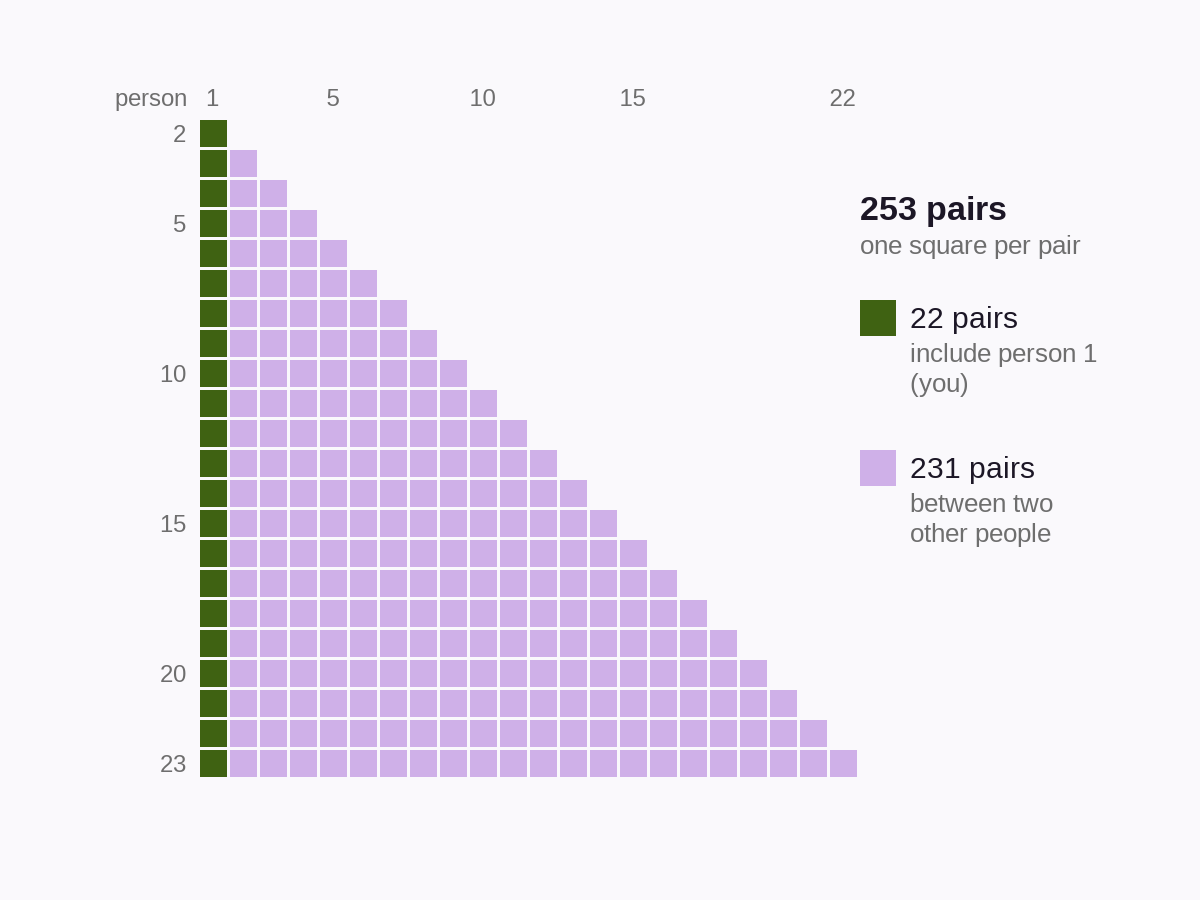
In the triangle, each square stands for one pair of people, and 23 people fill 253 squares because 23 × 22 / 2 = 253. Any pair can be the match, not only the pairs that include you. Pairs grow much faster than people: 10 people make 45 pairs, and 70 people make 2,415.
Each pair shares a birthday with a chance of 1 in 365. Across 253 pairs, that adds up to 253/365, or about 0.69 matching pairs on average. But the pairs overlap. So the exact chance comes from the other direction: the chance that all 23 birthdays differ.
That no-match chance is a product of 23 fractions: 365/365, 364/365, 363/365, and on down to 343/365. It comes to 49.3%, which leaves a match at 50.7%, exact. With 22 people the match chance is 47.6%, so 23 is the smallest room that tips past even odds; by 57 people the chance reaches 99.0%, exact.
Your own birthday is a different question
The green column in the triangle holds only 22 squares, the pairs that include you. So the chance that one of the 22 other people shares your birthday is 1 − (364/365)²², which is 5.9%, exact.
A match with you needs a much bigger room before it becomes more likely than not.
How many others share your birthday?
It takes 253 other people, a room of 254 counting you. There the chance is 50.05%, exact, against 49.9% with 252 others. The same number turns up twice because both rooms hold 253 chances at a 1-in-365 match. In a room of 23 those chances are pairs; in a room of 254 they are the other people, each checked only against you.
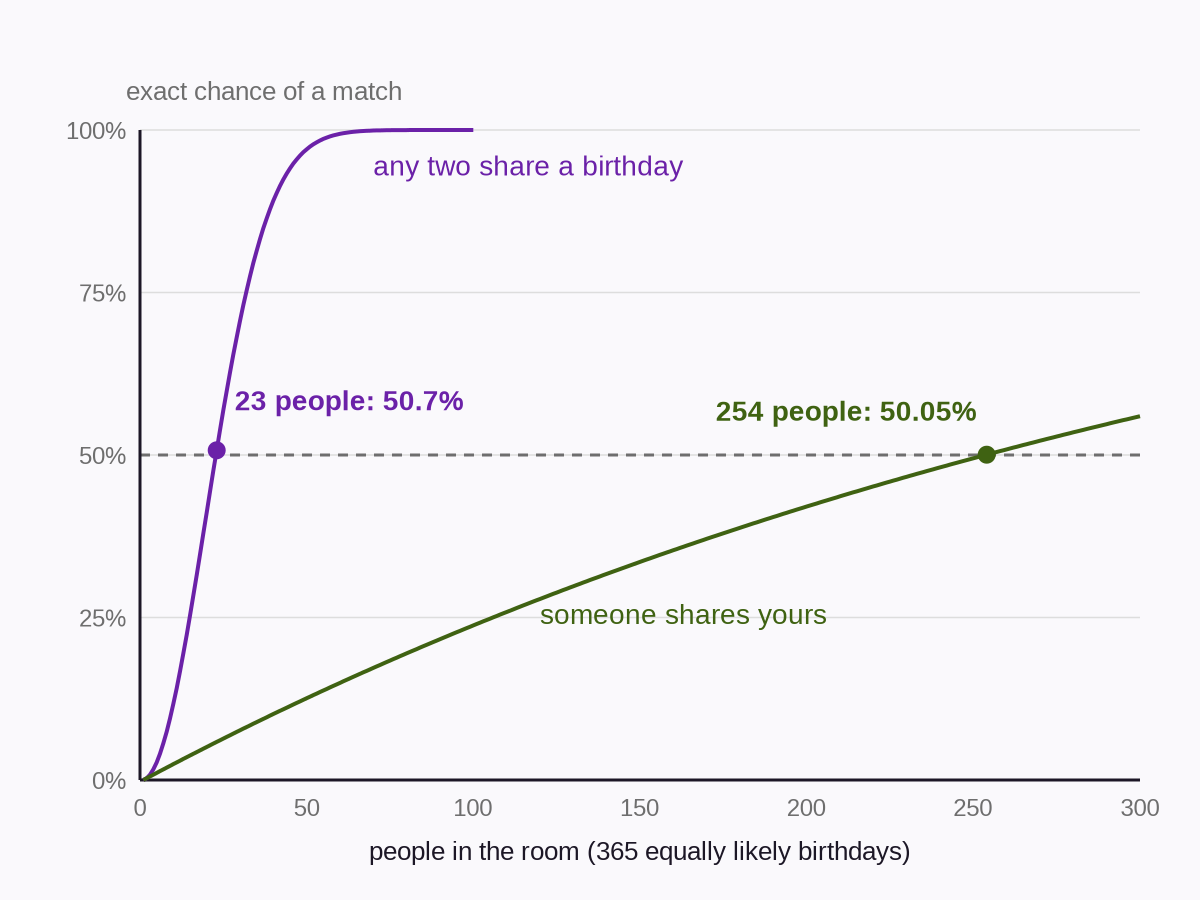
The purple curve climbs fast because each new person adds a pair with each person already in the room. The green curve climbs slowly because each new person adds just one pair that includes you. Every birthday here is independent of the others, the same independence that makes the gambler’s fallacy a mistake: earlier results say nothing about the next one.
Check it yourself
Each row below is one seeded run of 100,000 rooms. For an estimate within 0.5 percentage points at 99% confidence, a run needs at least (2.58/0.005)² × 0.25 = 66,564 rooms, so 100,000 is enough. Every exact value falls inside its run’s 99% interval, so the runs are consistent with the exact answers. The exact count settles each number; the runs check it.
| Room | Question | Exact | Matches in 100,000 rooms | 99% interval |
|---|---|---|---|---|
| 22 people, 365 days | any two share a day | 47.57% | 47,542 | 47.14% to 47.95% |
| 23 people, 365 days | any two share a day | 50.73% | 50,488 | 50.08% to 50.90% |
| 57 people, 365 days | any two share a day | 99.01% | 99,005 | 98.92% to 99.09% |
| 23 people, 365 days | someone shares yours | 5.86% | 5,860 | 5.67% to 6.05% |
| 254 people, 365 days | someone shares yours | 50.05% | 49,798 | 49.39% to 50.21% |
| 5 people, 12 months | any two share a month | 61.81% | 61,809 | 61.41% to 62.20% |
The six runs with seeds and intervals (CSV) · what the file holds and its license
The model sets aside some things that can bend real birthdays, such as twins and any preference for certain days or months. Tripathy's paper lists these as simplifying assumptions of the standard setup. The numbers on this page hold for that model only.
Now break it
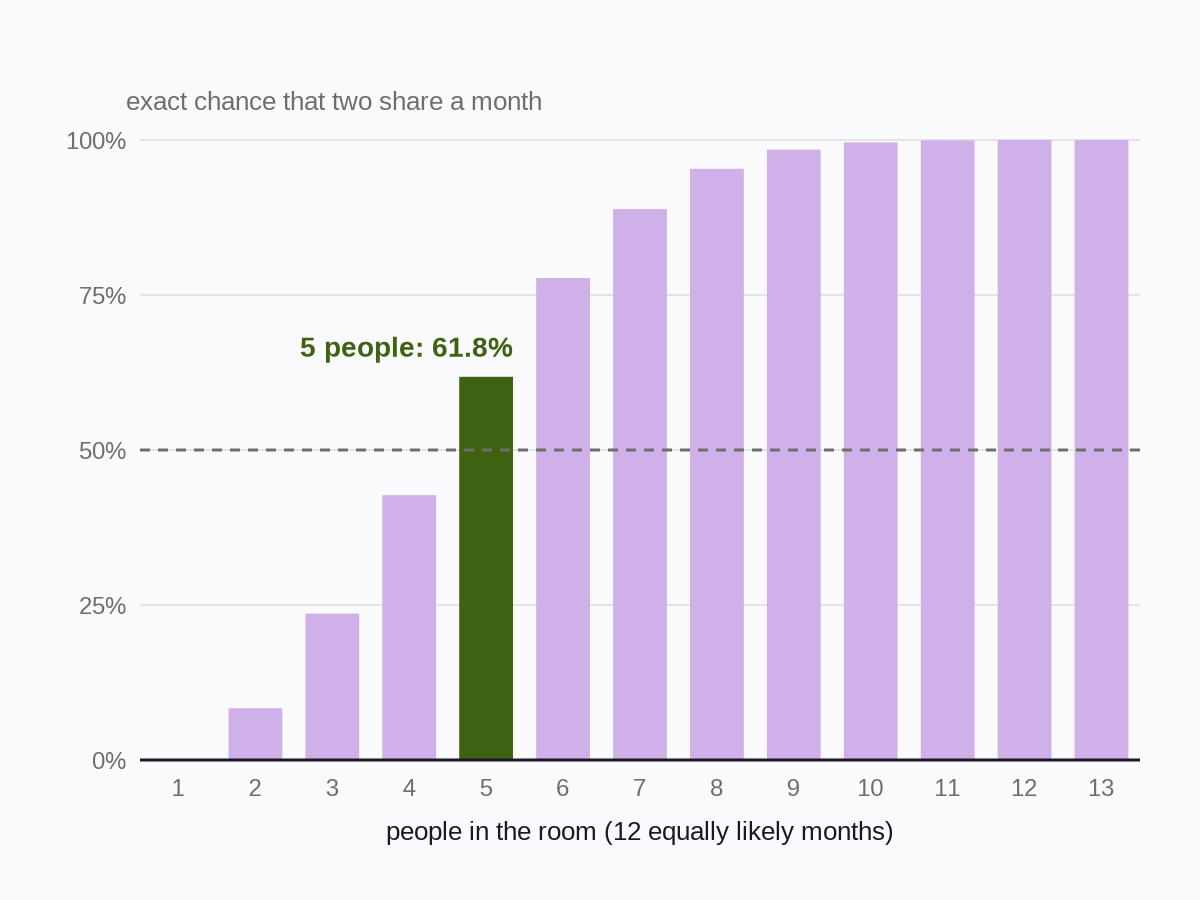
Switch the calculator from 365 days to 12 months. With 12 equally likely months, 4 people share a month with a chance of 42.7%, and 5 people with 61.8%, exact. Fewer slots means a smaller room for the same odds, and 13 people make a shared month certain. The magic square count also turns on counting groups instead of single items, and in the double pendulum gut feeling misjudges fast growth too.
Try this next: Monty Hall problem — another puzzle where counting every case beats the first guess.
Sources
- Chijul B. Tripathy, “The Strong Birthday Problem Revisited,” arXiv:2510.26056 (2025; version 2, 2026). https://arxiv.org/abs/2510.26056Read: abstract, introduction and references (versions 1 and 2)Text license: CC BY 4.0
- Rob Burns and Jen McKenzie, “Counting Birthday Collisions Using Partitions,” arXiv:1906.08671 (2019). https://arxiv.org/abs/1906.08671Read: abstract and introduction
Cite this page
Explorable Illusions. (2026). Birthday Paradox: 23 People Make 253 Pairs That Can Match. Explorable Illusions. Published 2026-11-13. https://explorableillusions.com/probability/birthday-paradox/
Add the date you read it. Figures and CSV files on this page are CC BY 4.0 unless their credit line says otherwise.
How pages here are checked Corrections log Report an error: contact@explorableillusions.com
More in Probability Playground
 Probability Playground
Monty Hall Problem: Standard Rules Make Switching Win 2 in 3
Under the standard rules, switching wins the Monty Hall problem 2 times in 3, because the host knows where the car is. See the count and 100,000-round runs.
Picture credit (illustration)
Illustration: Explorable Illusions. Generated schematic image — not a photograph, historical record, or test stimulus. Reuse: CC BY 4.0 (https://creativecommons.org/licenses/by/4.0/), to the extent any rights exist.
 Probability Playground
Galton Board: On a Fair Board, the Bell Is a Count of Paths
On a fair 12-row Galton board, exactly 2,508 of 4,096 paths, about 61.2%, end in the middle three bins. Run the board and see where the bell comes from.
Picture credit
"Galton Quincunx, 1933 – Museum of Science and Industry (Chicago)" by Daderot — https://commons.wikimedia.org/wiki/File:Galton_Quincunx,_1933_-_Museum_of_Science_and_Industry_(Chicago)_-_DSC06712.JPG — CC0 1.0 (https://creativecommons.org/publicdomain/zero/1.0/); modified: cropped to a 4:3 frame on the lower half of the board (lower pin triangle, bead columns, Normal Frequency Curve), removing the upper half, the museum placard and the stand; a strip of a neighbouring crate remains at the right edge; scaled to 1600 x 1200 px
 Probability Playground
Benford’s Law: Why 1 Beats 9 as a Leading Digit
Of the first 1,000 powers of 2, 301 start with 1 and only 45 with 9. See the rule Newcomb printed in 1881, why powers of 2 obey it, and where it fails.
Picture credit
"Simon Newcomb (Popular Science Monthly, vol. 11, 1877)" by Unknown author — https://commons.wikimedia.org/wiki/File:PSM_V11_D530_Simon_Newcomb.jpg — Public domain (US: published 1877 in Popular Science Monthly, vol. 11; EU: presumed, as an anonymous engraving published in 1877, more than 70 years ago (no engraver named on the file page))