Rubin Vase: Royal Profiles Hid in Urns Before Rubin
Explorable Illusions · Published
Look at the white shape first, then at the black one. The Rubin vase is a figure-ground picture: one outline is shared by a white vase and two black faces in profile, and either side can be seen as the shape. Edgar Rubin printed his version in Visuell wahrgenommene Figuren (1921), the German edition of a Danish book from 1915. In a footnote he mentioned an engraved vase that hides King Louis XVI, and urns with hidden royal profiles survive from about a century before him.
Protocol · 4 parts
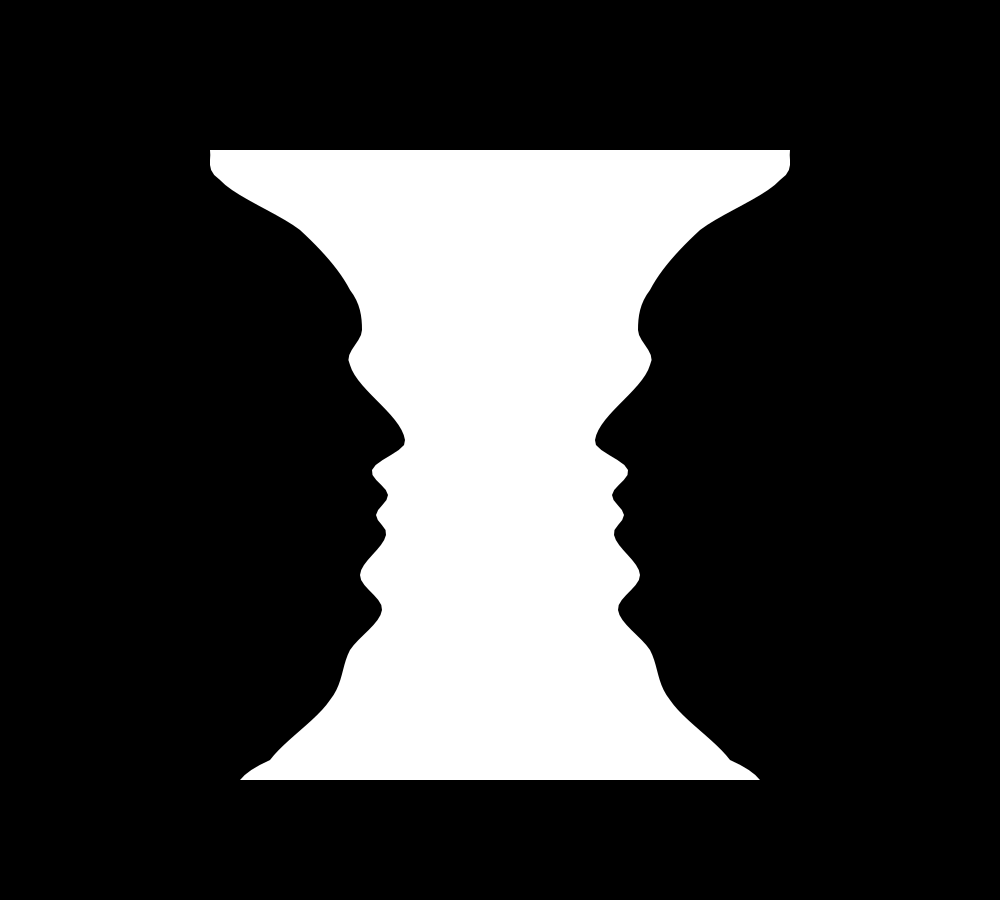
Shown at its working size, not shrunk: on a narrow screen, scroll the figure sideways.
At a glance
- Name
- Rubin vase
- Also called
- Rubin's goblet; Rubin himself said the figure comes closest to a somewhat lopsided goblet (einem etwas schiefen Pokal)
- First recorded
- Edgar Rubin, Synsoplevede Figurer (Copenhagen; preface dated May 1915), German edition 1921 with the figure as Abb. 3. Urns hiding royal profiles are older: a Met etching dated 1794–1815 and a porcelain dish at Winterthur described as 1793–1800
- Type
- Figure-ground figure: one outline is shared by a white vase and two black face profiles, and either side can be seen as the shape
- Effect note
- Effects vary from person to person; Rubin reported that his subjects usually saw nothing remarkable until asked to take the black field as the figure
- Main explanations
- Rubin's account (1921): the shared contour gives shape to one field, the figure, while the other, the ground, seems to continue behind it. Image-cue account: properties such as convexity and symmetry favor one side as figure. Competition account: several readings are formed and the best-fitting one is perceived, with context and a plain-background prior playing a part. How these combine is still being studied.
- On this page
- Static figures and recomputable data: contour coordinates for the vase and the lopsided goblet, with a mirror check for each point
rubin-vase-glance.csv (CSV) · what the file holds and its license
Give the figure a few seconds. If the vase came first, try to see the black areas as two heads facing each other, nose to nose. If the faces came first, look for the vase. Which shape arrives first is not a test of the viewer, and effects vary from person to person.
Which side owns the edge?
Rubin built his account on one idea, set out on page 37 of the 1921 book. Where two fields meet, the shared contour gives shape to one of them. The field it shapes most is the figure, and the other is the ground. His subjects quite often said that the ground seemed to run on behind the figure.
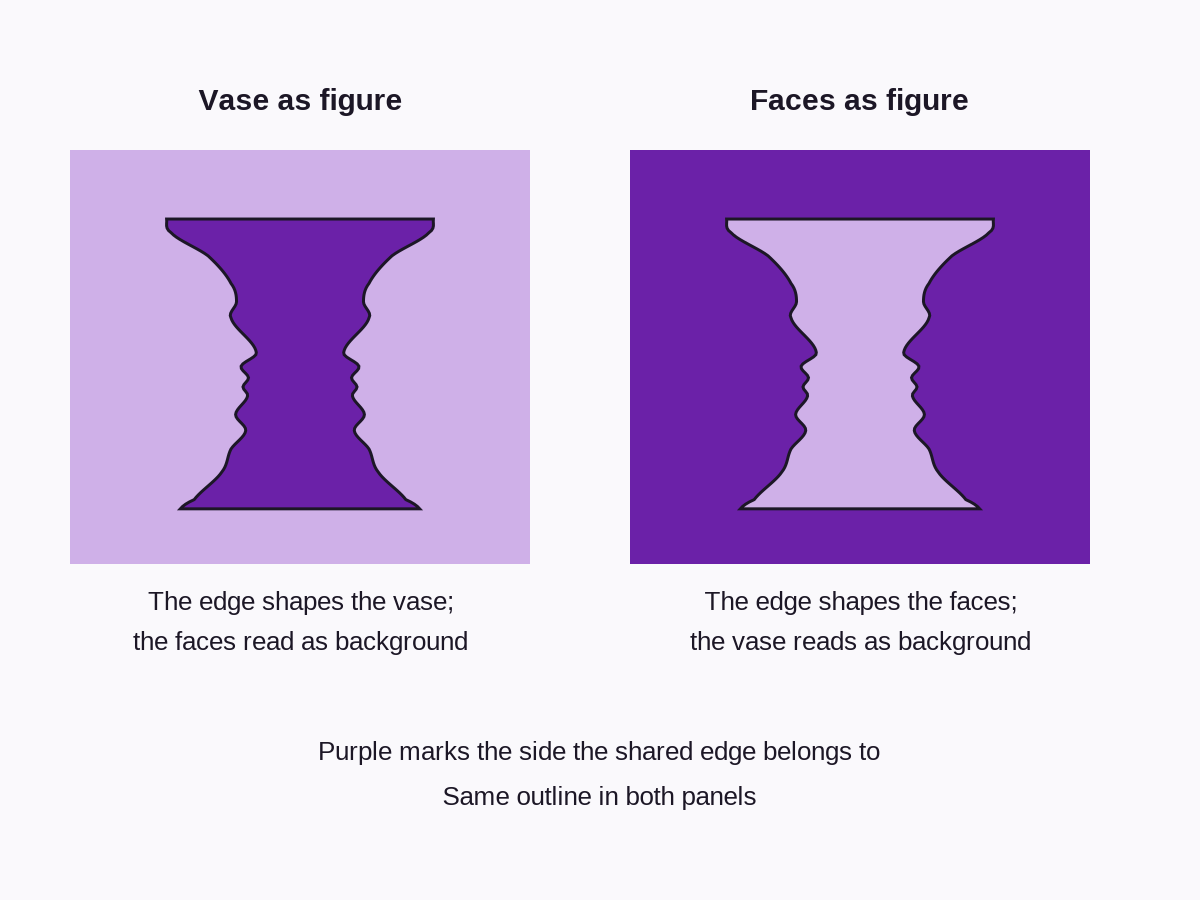
In principle, Rubin allowed two limiting cases: both fields standing out as figure at once, or neither. More often, on his account, the edge shapes only one side, so the vase and the faces take turns. A Möbius strip has a single edge that runs its whole length. Here a single edge has two possible owners.
Rubin’s lopsided goblet
Rubin's own version is Abb. 3, a plate at the back of the 1921 book: a white goblet on a black square. On page 32 he describes it as the figure that “einem etwas schiefen Pokal am nächsten kommt,” closest to a somewhat lopsided goblet. Shown the figure, a subject would as a rule say, “Es gibt nichts Merkwürdiges an der Figur”: there is nothing remarkable about it.
Then came the request to take the black field as the figure. When that worked, Rubin writes, the usual reply came with a small, surprised smile: “Es sind ja zwei Gesichter, die einander anblicken.” Why, it's two faces looking at each other. The English after each German quotation is this page's translation.
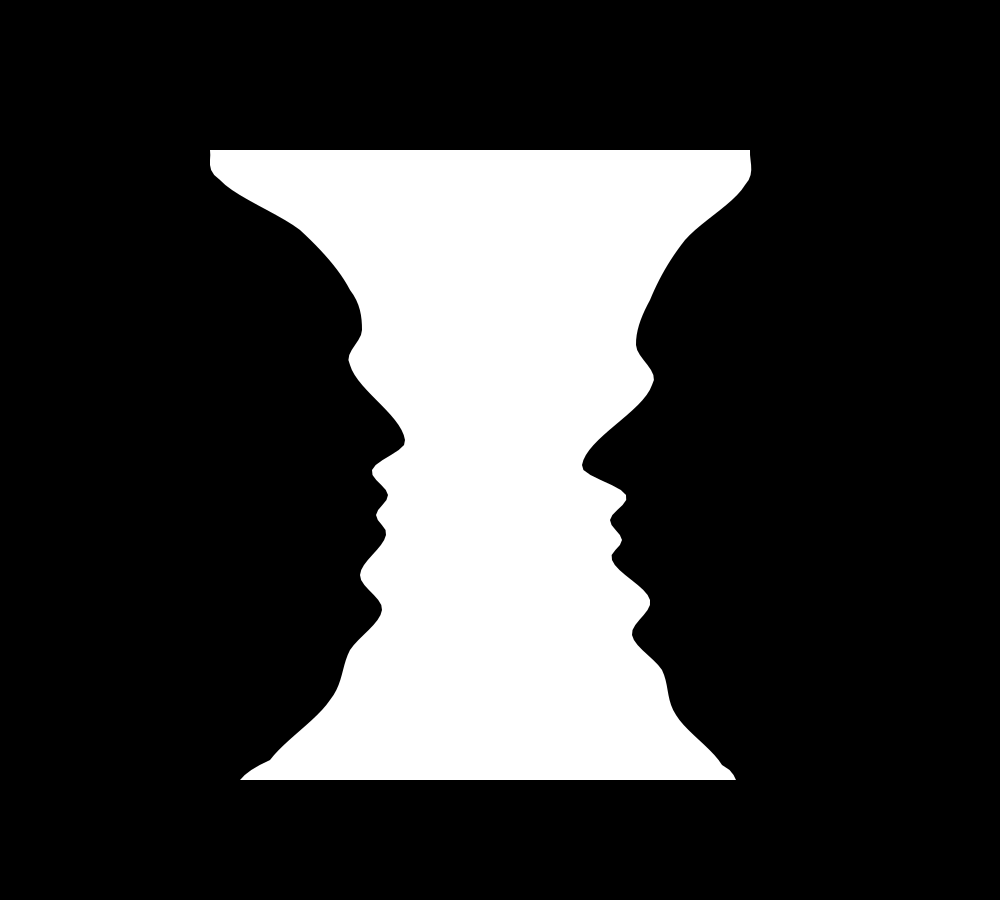
Shown at its working size, not shrunk: on a narrow screen, scroll the figure sideways.
The goblet on Rubin's plate is not mirror-symmetric, and neither is this one. Its right edge strays up to 44.57 units from the mirror image of the left. Rubin signed the preface in Copenhagen in May 1915. A note from June 1921 says the German edition of Synsoplevede Figurer was translated by Peter Collett.
The king hidden in an urn
Rubin's footnote on page 32 says he had once seen a vase in a cabinet of curiosities that used this very trick. He adds that a paper by Lillien J. Martin in the Zeitschrift für Psychologie, vol. 70, prints on page 214 an engraving of a vase. Take the field around its foot as the figure, he writes, and you see a portrait of King Louis XVI. As far as Rubin could follow her text, people who had memorized the picture without finding the king could not find him later in their mental image, even when told where to look.
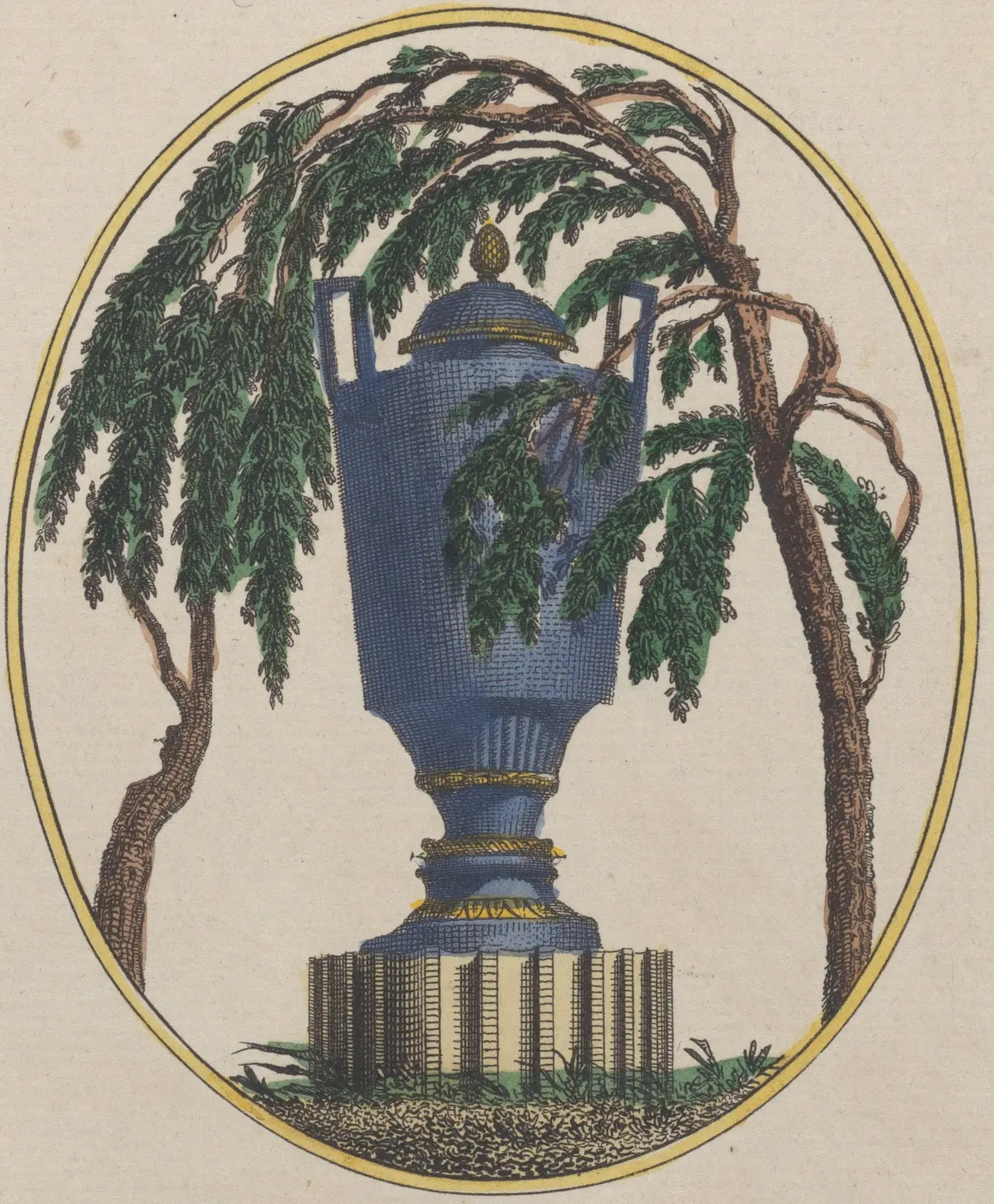
Urns like this were made long before Rubin. The Metropolitan Museum of Art lists this etching, accession number 50.602.211, as Weeping willow and urn with hidden silhouettes of the French royal family, and dates it 1794–1815. A photograph on Wikimedia Commons shows a Chinese porcelain dish at the Winterthur Museum with a willow arching over an urn in a small medallion. Its description dates the dish 1793–1800 and says it holds silhouettes of the executed Louis XVI and his family.
This page did not consult Martin's paper, so it cannot say whether her engraving matches the Met print. To hunt for the profiles, try Rubin's tip: treat the pale paper beside the urn's foot and stem as the shape, not the urn.
Why does one side win?
The cause is still being studied, and the accounts differ in what they stress. Rubin's own account is the one above: the shared contour shapes one field. On pages 75–76 he adds that the ground is not seen as shaped, and that a contour sometimes shapes both fields but often only one.
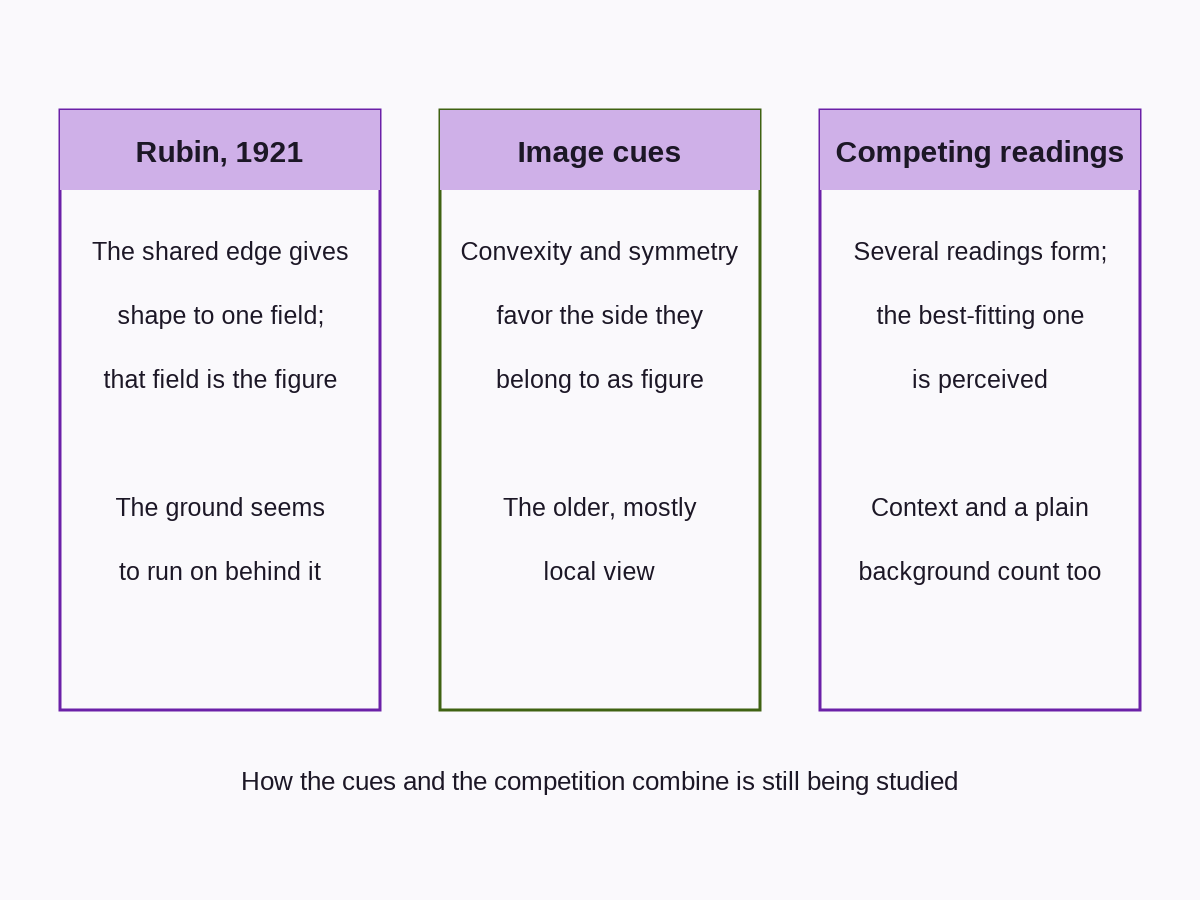
One account stresses image cues. A 2023 study by Mary Peterson and Elizabeth Salvagio Campbell describes the older view: figure assignment was taken to follow cues such as convexity, and in displays of alternating convex and concave regions, a large majority of perceivers reported the convex regions as figures. The same paper calls symmetry an object prior that may be weaker than convexity.
A second account stresses competition. The paper reports an earlier finding by Peterson and Salvagio (2008): with displays shown for 100 milliseconds, the probability of seeing convex regions as figures was only slightly above chance with two regions, rising to 85–90% with eight. Its authors conclude that “multiple interpretations are generated during perceptual organization and the best-fitting interpretation is perceived.”
| Account | What it says | Source |
|---|---|---|
| Rubin's own (1921) | The shared contour shapes one field, the figure; the ground seems to run on behind it | Rubin 1921, pp. 37 and 75–76 |
| Image cues | Convexity and symmetry favor one side as figure | Peterson and Campbell 2023, summarizing older work |
| Competing readings | Several readings form and the best-fitting one is perceived; context and a plain background play a part | Peterson and Campbell 2023 |
The Ebbinghaus illusion changes how big a circle looks. Here the question is which side counts as a thing at all. The Hermann grid page rests on a claim about brightness, so it gets a fill check. This page checks coordinates.
Check it yourself
The gasp point here, the one result that settles the question, is a column in the table below: the largest gap from the mirror. The vase at the top is 630 units tall, 580 units across at the rim and 190 units at its narrowest, where the two noses come closest. Each side is drawn through 127 points.
| Figure | Points per side | Largest gap from the mirror | What differs |
|---|---|---|---|
| Vase at the top | 127 | 0 units | Nothing: the left edge mirrors the right |
| Lopsided goblet | 127 | 44.57 units | The right side has its own key points |
| Change 1: shading | 127 | 0 units | Two flat gray bands on the right |
| Change 2: eyes | 127 | 0 units | A small white eye on each face |
A check reads every figure file and compares each point with the table. The two changed figures reuse the vase outline point for point. The page shows each vase figure at least 100 pixels wide so the finest detail stays visible, and on a narrower screen it scrolls sideways.
Download the contour coordinates (CSV) · what the file holds and its license
Now break it
Each change below adds one cue to the vase at the top. Look at each for a few seconds and note which shape comes first.
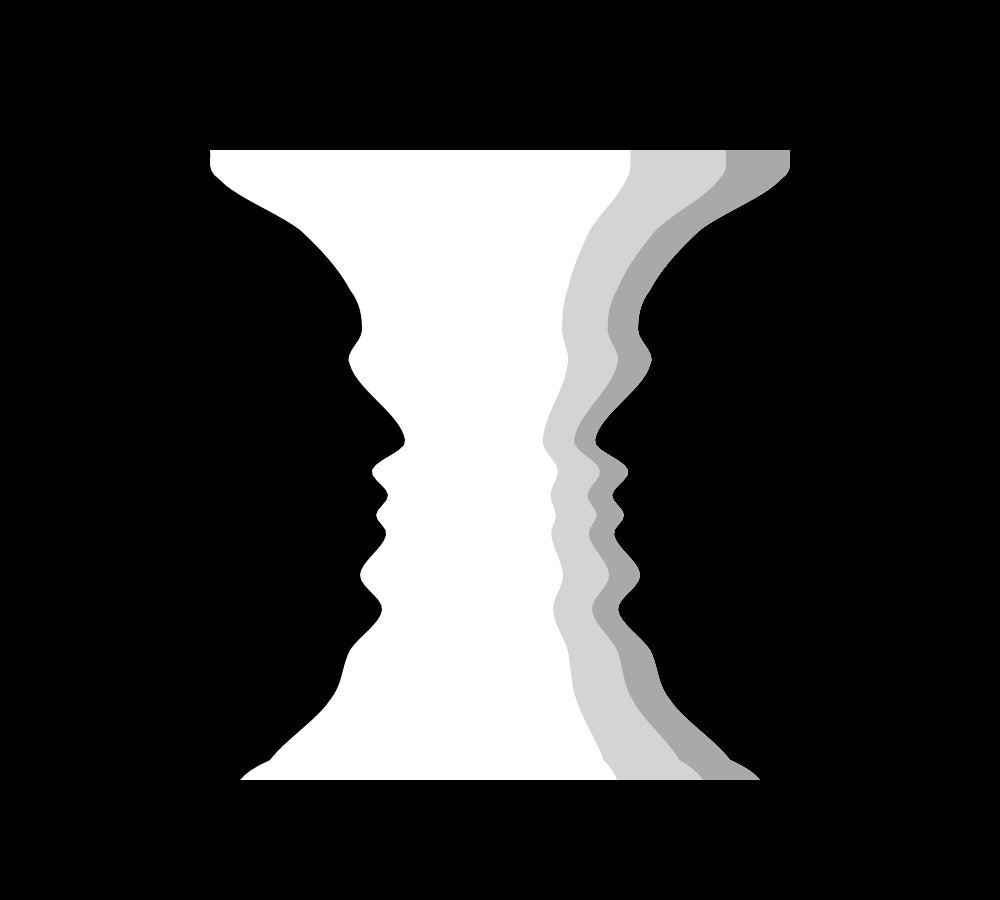
Shown at its working size, not shrunk: on a narrow screen, scroll the figure sideways.
The bands are flat fills, not a gradient. See whether the vase now holds as the shape, or whether the faces still come through.
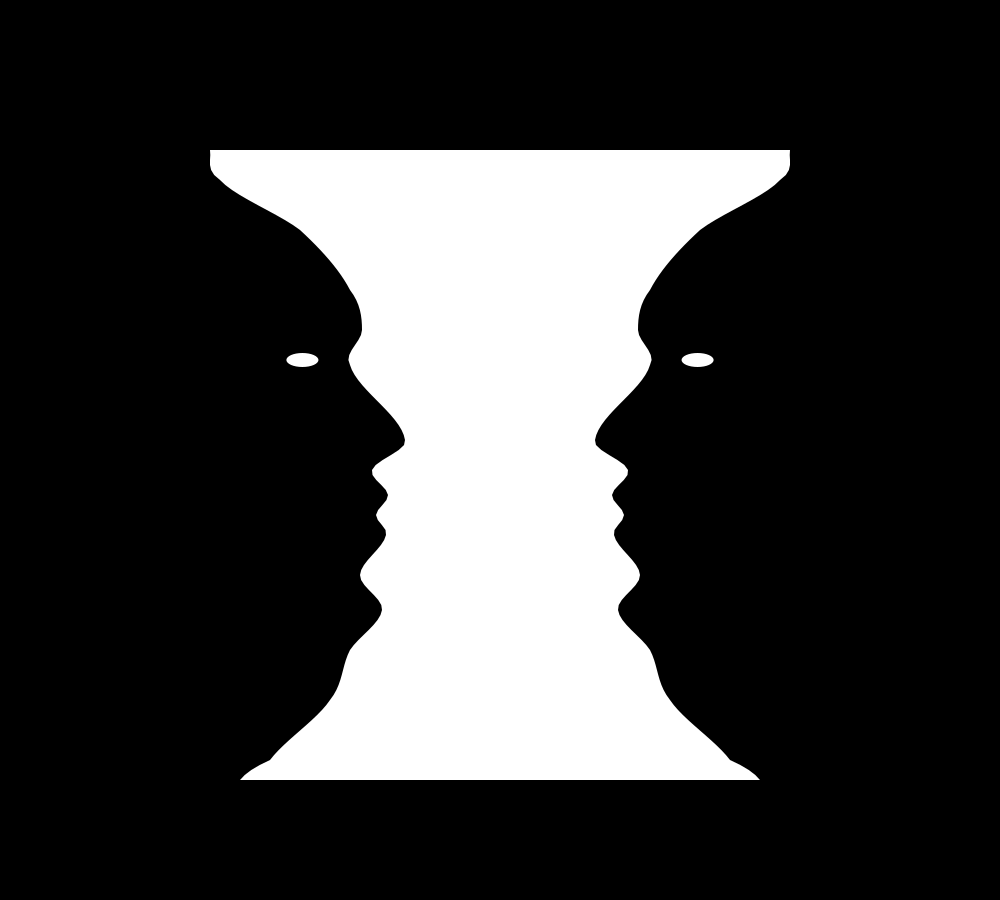
Shown at its working size, not shrunk: on a narrow screen, scroll the figure sideways.
An eye belongs to a face and to nothing else in the picture. Note whether the faces now arrive first, and whether the vase still appears when you look for it. A third change is already on the page: the lopsided goblet drops the mirror symmetry, so compare it with the vase at the top.
Try this next: Necker cube — one wire frame that flips between two depths, where this picture flips between two shapes.
Sources
- Edgar Rubin, Visuell wahrgenommene Figuren: Studien in psychologischer Analyse, part 1, translated from the Danish Synsoplevede Figurer by Peter Collett (Copenhagen: Gyldendal, 1921). https://archive.org/details/visuellwahrgenom01rubiuoft/page/n45Read: pages XII, 32, 37 and 75–76 and the plate Abb. 3, checked against the page images
- Anonymous, Weeping willow and urn with hidden silhouettes of the French royal family, hand-colored etching, 1794–1815, Metropolitan Museum of Art, accession number 50.602.211 (image DP886293), as given on its Wikimedia Commons file page. https://commons.wikimedia.org/wiki/File:Weeping_willow_and_urn_with_hidden_silhouettes_of_the_French_royal_family_Met_DP886293.jpgRead: file page with the museum's catalog data, and the full image
- Daderot, Dish with L'Urne Mysteriouse containing silhouettes of the executed Louis XVI and family, Chinese porcelain, 1793-1800 - Winterthur Museum, photograph, 8 May 2013, Wikimedia Commons. https://commons.wikimedia.org/wiki/File:Dish_with_L%27Urne_Mysteriouse_containing_silhouettes_of_the_executed_Louis_XVI_and_family,_Chinese_porcelain,_1793-1800_-_Winterthur_Museum_-_DSC01532.JPGRead: file page description and the full image
- Mary A. Peterson and Elizabeth Salvagio Campbell, “Backward masking implicates cortico-cortical recurrent processes in convex figure context effects and cortico-thalamic recurrent processes in resolving figure-ground ambiguity,” Frontiers in Psychology 14 (2023): 1243405, doi:10.3389/fpsyg.2023.1243405. https://pmc.ncbi.nlm.nih.gov/articles/PMC10552270/Read: full textText license: Creative Commons Attribution License (CC BY; version not stated on the article page)


Cite this page
Explorable Illusions. (2026). Rubin Vase: Royal Profiles Hid in Urns Before Rubin. Explorable Illusions. Published 2026-11-13. https://explorableillusions.com/look-again/rubin-vase/
Add the date you read it. Figures and CSV files on this page are CC BY 4.0 unless their credit line says otherwise.
How pages here are checked Corrections log Report an error: contact@explorableillusions.com
More in Look Again
 Look Again
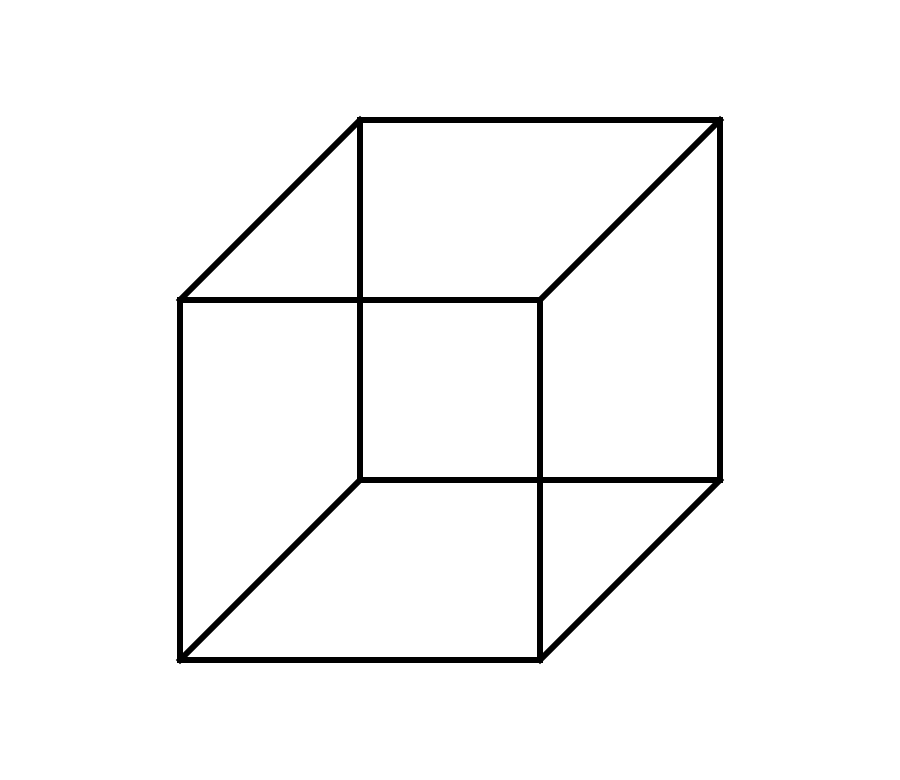
Necker Cube: Necker Drew a Rhomboid, Not a Cube
The Necker cube can flip between two 3D readings. Necker's 1832 drawing was a slanted rhomboid, not a cube. See his own explanation and why the cause is argued.
Picture credit
"Necker cube, wire frame with one line width" by Explorable Illusions — https://explorableillusions.com/look-again/necker-cube/ — CC BY 4.0 (https://creativecommons.org/licenses/by/4.0/)
 Look Again
Hermann Grid: In This Figure, the Crossings Are Pure White
Every crossing in this Hermann grid has the same white fill as the streets. Check the fill table, then see why the textbook retina account is disputed.
Picture credit
"Hermann grid, larger squares" by Explorable Illusions — https://explorableillusions.com/look-again/hermann-grid/ — CC BY 4.0 (https://creativecommons.org/licenses/by/4.0/)
 Look Again
Ebbinghaus Illusion: In These Figures, Centers Are Equal
Both center circles in this Ebbinghaus illusion are 120 units across, and the coordinates are here to check. Grasp studies still disagree about the hand.
Picture credit
"Ebbinghaus figure: equal discs, large ring and small ring" by Explorable Illusions — https://explorableillusions.com/look-again/ebbinghaus-illusion/ — CC BY 4.0 (https://creativecommons.org/licenses/by/4.0/)