Ebbinghaus Illusion: In These Figures, Centers Are Equal
Explorable Illusions · Published
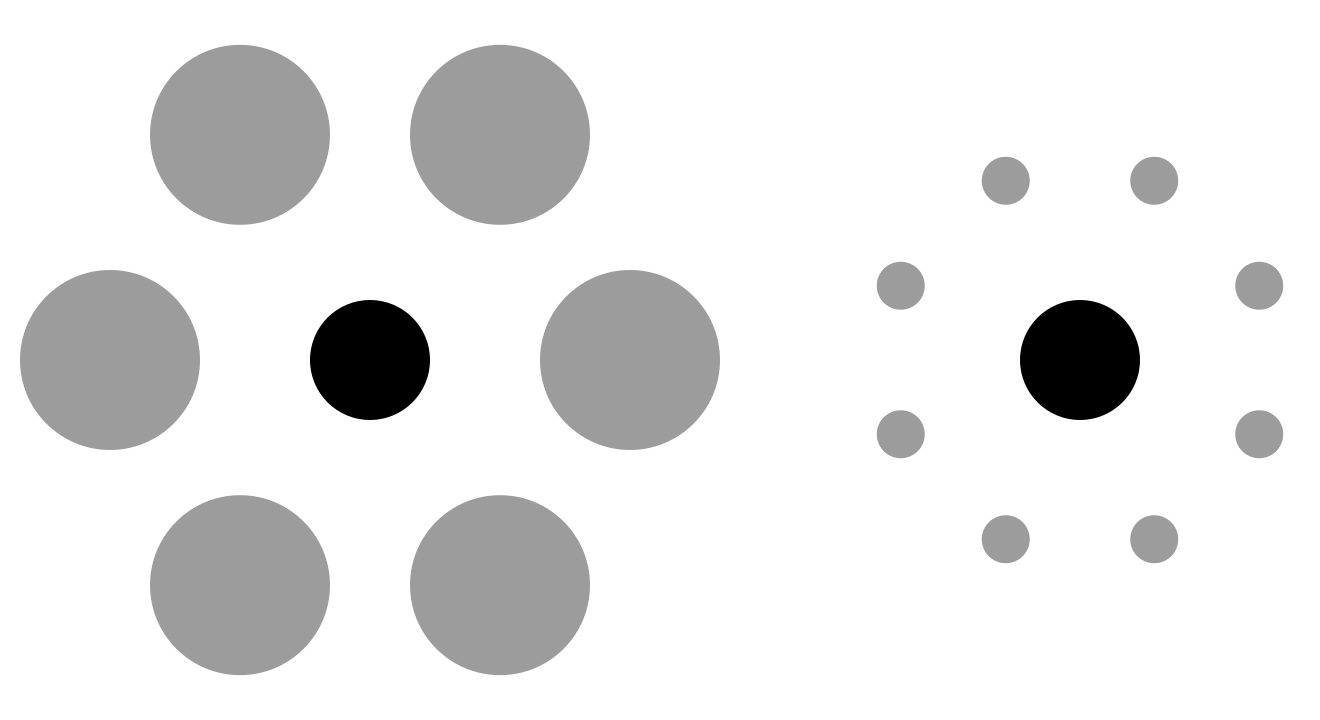
Both center circles below are 120 units across. In the Ebbinghaus illusion, also called Titchener circles, a circle ringed by large circles may look smaller than an equal circle ringed by small ones. The earliest printing this page has checked is in Edward Titchener's 1901 lab manual. Whether the illusion also changes how wide a hand opens to pick up a disc is still argued: a 2022 study found grip size followed the real disc, while other grasp studies report an effect.
Protocol · 4 parts

Shown at its working size, not shrunk: on a narrow screen, scroll the figure sideways.
At a glance
- Name
- Ebbinghaus illusion
- Also called
- Titchener circles; Titchener circles illusion
- First recorded
- Named for Hermann Ebbinghaus (1850–1909); this page did not trace the figure in his own writing. Earliest printing checked here: Titchener 1901, p. 169, Fig. 52 item 3, unnamed
- Type
- Geometric size illusion: a center circle may look larger among small circles and smaller among large ones
- Effect note
- Effects vary from person to person. In one 2022 study a second disc had to be 2.6 mm wider on average to look equal; the paper gives 1 to 4 mm alongside that average
- Main explanations
- Why the ring changes apparent size: not settled in the papers read here, which call it a size-contrast illusion. Whether grip is fooled is disputed: one account says grasping uses separate visual processing and follows real size; another says grip is affected, partly because the figure also shifts where the disc's edges seem to be
- On this page
- Static figures and recomputable data: a coordinate table for 66 circles in four ring figures, two of them changed versions of the first, and one scan
ebbinghaus-illusion-glance.csv (CSV) · what the file holds and its license
Before you read on, decide which black disc looks larger to you, and by about how much. A glance of a few seconds is enough. Then look at the coordinates in the next section.
Are the two center circles really the same size?
The figure is an SVG file: plain text that lists every circle by its center point (cx, cy) and its radius (r). In that file the two black discs are named center-left and center-right. Both have r = 60, so each one is 120 units across. A unit is one step on the figure's own grid, which is 1,200 units wide.
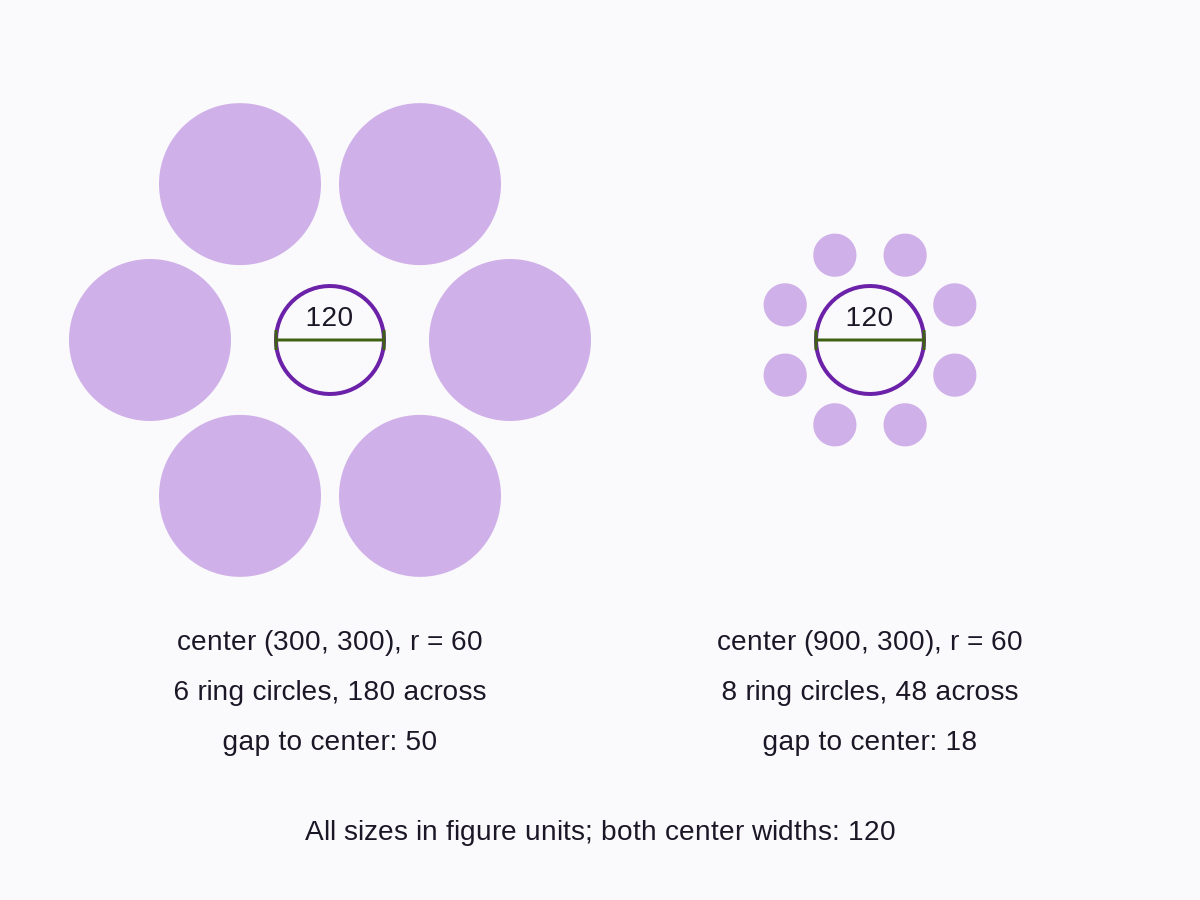
The rings are what differ. On the left, six circles 180 units across sit 50 units from the black disc. On the right, eight circles 48 units across sit 18 units from it. The program that draws the figure reads the file back and asserts three things: the two radii match exactly, no gray circle touches a black one, and every circle stays inside the frame.
Zooming scales every circle in the file by the same factor, so the two discs are drawn the same size at any zoom. Only the smoothed edge pixels on a screen can differ. The check covers coordinates, not color or brightness. The table under Check it yourself lists all 64 circles in this page's four ring figures, plus the two measured on a 1901 scan, and the method is on Proof first.
Where did the figure come from?
The figure carries the name of the German psychologist Hermann Ebbinghaus. Research papers call it the Ebbinghaus illusion, and a 1999 paper by Pavani and colleagues uses the name Titchener circles in its title. This page could not trace the figure to a page in Ebbinghaus's own writing, so his name is a credit, not a checked source.
Shown at its working size, not shrunk: on a narrow screen, scroll the figure sideways.
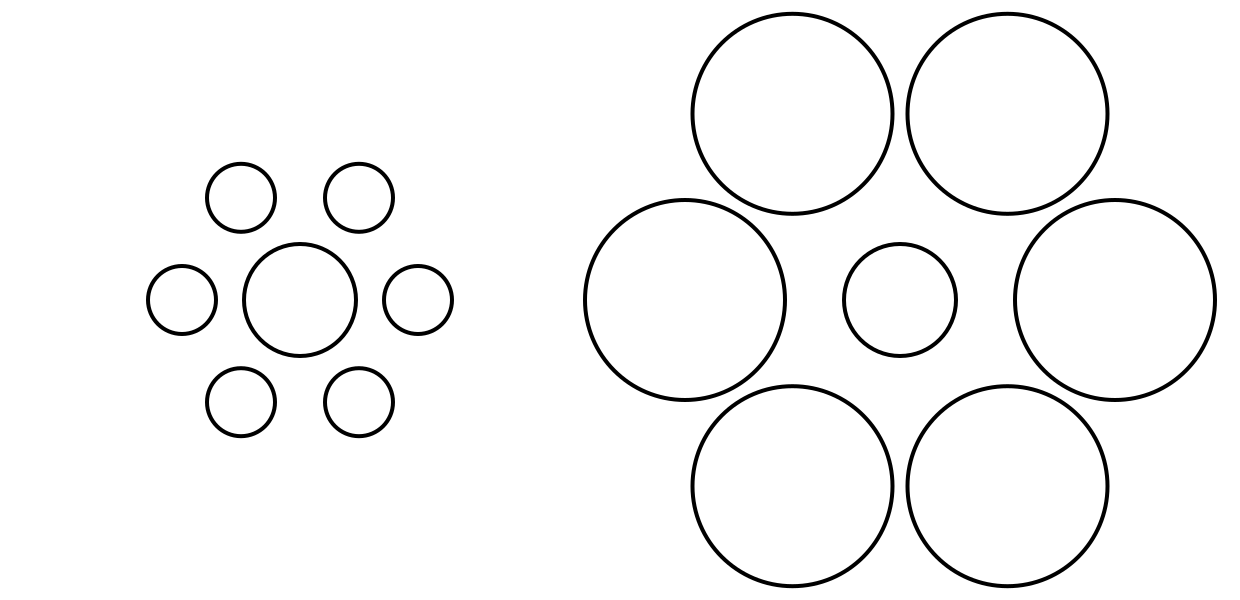
The earliest printing this page has checked is in Experimental Psychology, a laboratory manual by Edward Bradford Titchener published in 1901. On page 169, item 3 of Fig. 52 shows one circle ringed by six small circles beside one ringed by six large circles, all drawn in outline. Nothing next to it gives a name or an explanation. On page 166, Titchener leaves that work to the student: “Describe and explain the illusions of Figs. 49–53.”
This page measured the 1901 drawing on the Internet Archive's scan of page 169. The two center circles are 102 and 103 pixels wide on a page image 1,257 pixels across, so they differ by at most one pixel. As far as a scan can show, Titchener's two centers were drawn equal too. A different figure where the surroundings decide what you see is the Rubin vase, built around one border shared by two shapes.
Does the illusion fool a hand that reaches for the disc?
Grip aperture is the gap between thumb and index finger as the hand moves toward an object. It opens wider for bigger objects, so it can show what size the hand is preparing for.
A grasping test set out in 1995 by Aglioti and colleagues put real discs inside an Ebbinghaus display. As Whitwell and colleagues describe it, the choice of disc followed the illusion. “Yet at the same time, the hand's in-flight grasp aperture remained tuned to the target's real size.”
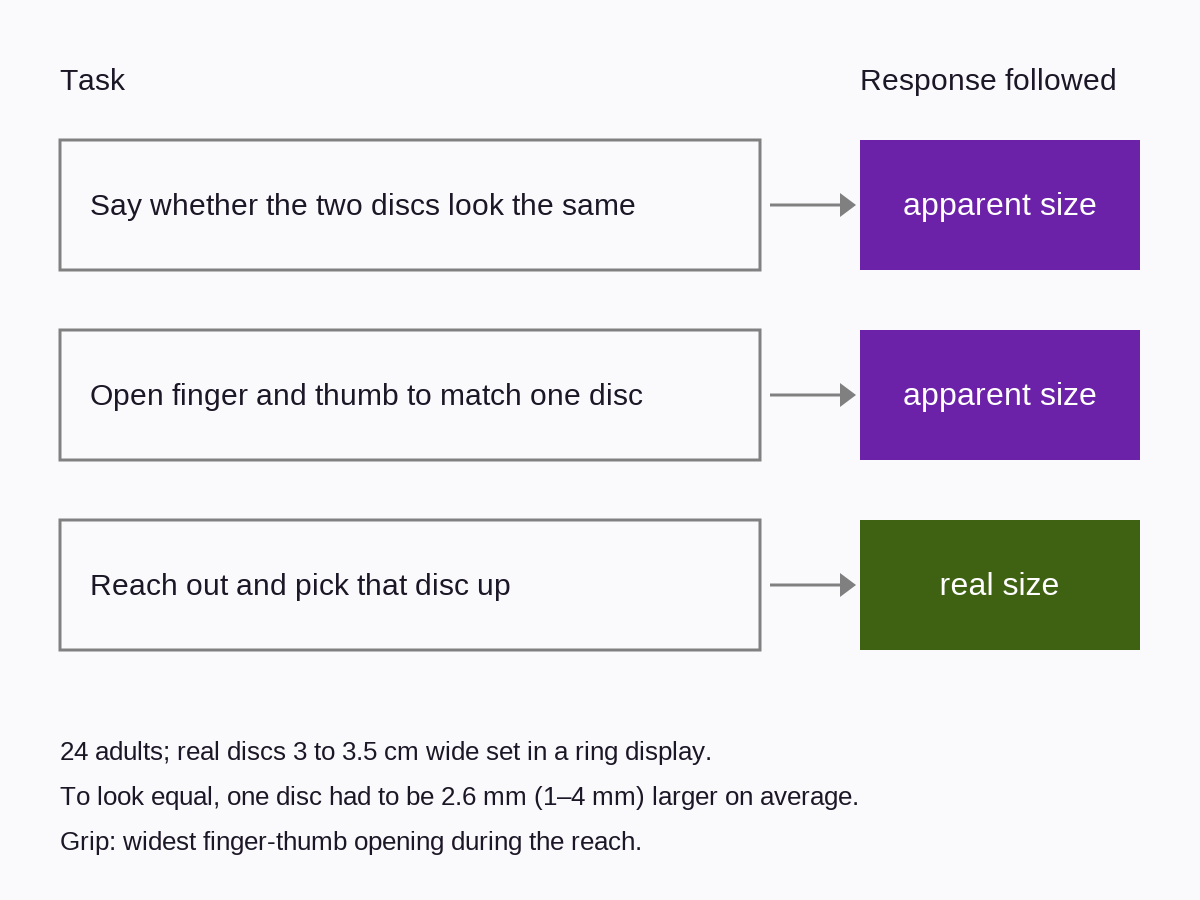
Whitwell, Garach, Goodale and Sperandio repeated that design in a 2022 paper with 24 adult volunteers. Real discs 3 to 3.5 cm wide sat inside a ring of 11 small black circles or a ring of six large ones. First, each person said “same” or “different” while the size of one disc was changed step by step. On average, one disc had to be 2.6 mm wider before the two looked the same, and the paper gives 1 to 4 mm alongside that average.
Then came three tasks: a keypress choice, a finger-and-thumb estimate of one disc's size without touching it, and a real grasp. The peak grip aperture is the widest opening during the reach. In their words, “both illusory arrangements consistently affected estimates of disc size but not the hand's grasp aperture.”
The team also tracked where people looked. One critique says that grasping draws the eyes to the target disc alone, which would weaken the illusion. The gaze measures did not line up with that idea: during the movement itself, eye patterns for grasping and for estimating were statistically alike. The authors conclude that the two tasks pose different problems for the visual system.
Why do grasp studies still disagree?
Smeets, Kleijn, van der Meijden and Brenner open a 2020 paper with one plain sentence. “There is extensive literature debating whether perceived size is used to guide grasping.” The two papers read for this page disagree even on the basic result.
Whitwell and colleagues found no effect on grip. Smeets and colleagues write that Ebbinghaus grasping studies report “a consistent effect of the illusion on grip aperture,” although whether it matches the effect on perception “is still under debate.”
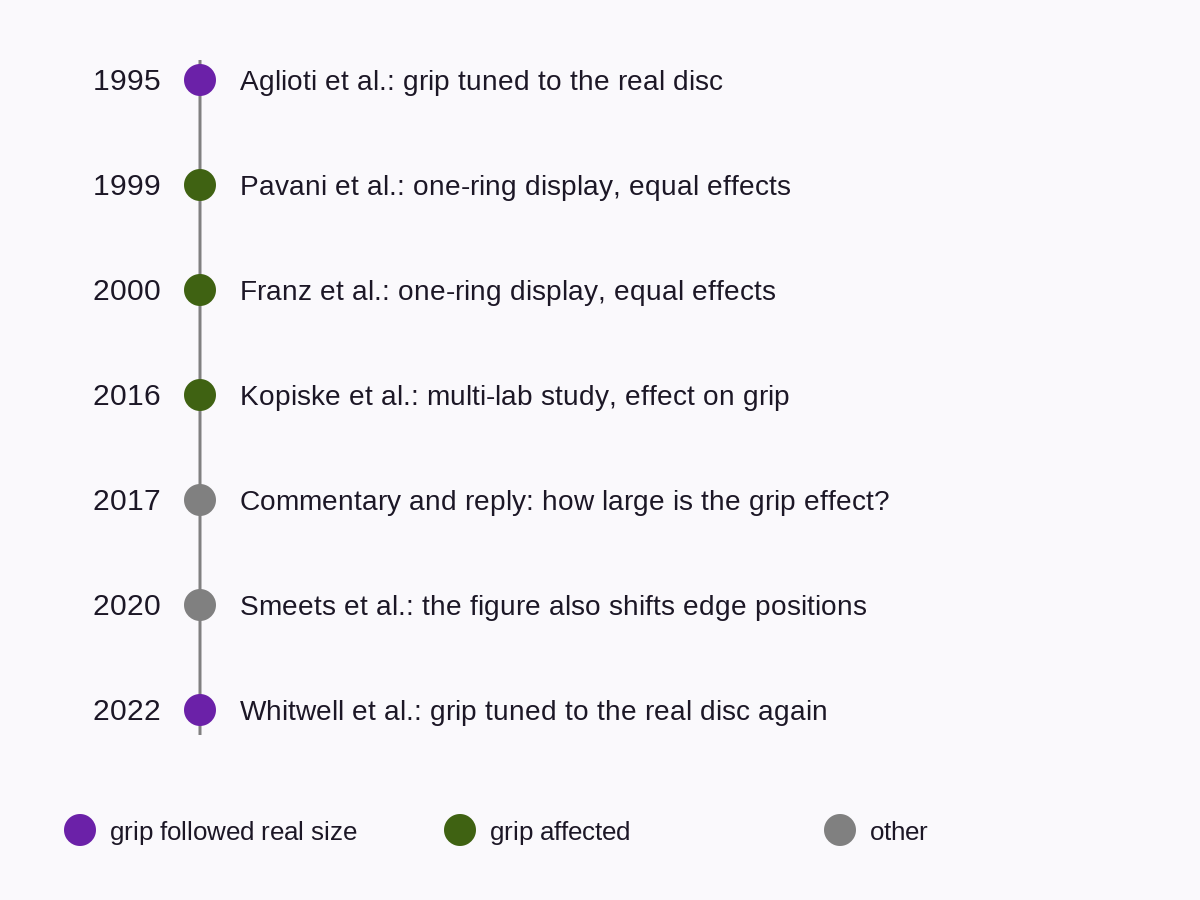
| Year | Study | What it reported, as described by the papers read here | Read here |
|---|---|---|---|
| 1995 | Aglioti et al. | Grip stayed tuned to the real disc size | catalog record only |
| 1999 | Pavani et al. | With one ring at a time, equal effects on judgment and grip | catalog record only |
| 2000 | Franz et al. | With one ring at a time, equal effects on judgment and grip | catalog record only |
| 2016 | Kopiske et al. | A multi-lab study found an effect on grip | catalog record only |
| 2017 | Whitwell and Goodale; Kopiske et al. | A commentary and a reply on how large the grip effect is | catalog records only |
| 2020 | Smeets et al. | The figure also shifts where edges seem to be | full text |
| 2022 | Whitwell et al. | Grip followed real size again; gaze did not explain it | full text |
One account says that seeing and grasping use different visual processing. Whitwell and colleagues hold that perception compares things, while a reaching hand needs exact sizes and distances, so the hand can follow the real disc. Their 2022 study is the strongest evidence read here for that side, though it tested only 24 people in one lab.
A second account says that grip is affected. Smeets and colleagues describe the 2016 multi-lab study by Kopiske and colleagues as showing “convincingly that grasping is affected by the Ebbinghaus illusion.” They add a point of their own: the fingers aim at points on the object's edges, and the Ebbinghaus figure, unlike most size illusions, also shifts where those edges seem to be. With a different size illusion that leaves edge positions alone, their 19 volunteers misjudged bar length by about 10%, but their grip showed no effect.
So the cause of the grip result is still debated, and this page does not pick a side. The Braess paradox is told with roads. In a starling murmuration, each bird's turn depends on its neighbors.
Questions about the Ebbinghaus illusion
Is the Ebbinghaus illusion the same as Titchener circles?
Yes. Both names refer to one figure: a circle ringed by large circles next to an equal circle ringed by small ones. Pavani and colleagues used “Titchener circles” in a 1999 paper title, and the 2020 and 2022 papers read here use “Ebbinghaus illusion.”
Which center circle looks bigger?
In the 2022 grasp study, a disc ringed by small circles was the one expected to look larger than its real size, and a disc ringed by large circles was expected to look smaller. Check the figure at the top against your own impression.
Is the size difference the same for every viewer?
No. Effects vary from person to person. The 2022 study reports an average: a second disc had to be 2.6 mm wider to look equal, and the paper gives 1 to 4 mm alongside that average.
Check it yourself
| Figure | Center circles | Left ring | Right ring | Gaps to center (left, right) |
|---|---|---|---|---|
| Figure at the top | 2, each r = 60 (120 across) | 6 circles, 180 across | 8 circles, 48 across | 50 and 18 units |
| Outline version | 2, each r = 56 (112 across) | 6 circles, 68 across | 6 circles, 200 across | 28 and 59 units |
| Rings pulled out | 2, each r = 60 (120 across) | 6 circles, 180 across | 8 circles, 48 across | 110 and 110 units |
| One ring design | 2, each r = 60 (120 across) | 8 circles, 80 across | 8 circles, 80 across | 34 and 34 units |
| Titchener 1901 scan | 2, 103 and 102 pixels wide | not measured | not measured | not measured |
Gaps are measured from the edge of a center circle to the edge of the nearest ring circle. In the outline version, sizes and gaps run to the middle of each 4-unit line. The table file lists every circle with its center and radius, read from the figure files.
Download the coordinate table (CSV) · what the file holds and its license
Now break it
Each figure below changes one thing about the rings in the figure at the top. Look at each one for a few seconds and compare the two black discs again.
Shown at its working size, not shrunk: on a narrow screen, scroll the figure sideways.
Pull the rings away. Both rings now sit 110 units from the black discs, instead of 50 and 18. The frame is larger and the discs sit farther apart to make room. Decide whether the difference you saw at the top shrinks, stays or grows.

Shown at its working size, not shrunk: on a narrow screen, scroll the figure sideways.
Give both discs the same ring, so their surroundings no longer differ. Note whether either disc still looks larger to you.
Try this next: Hermann grid — white crossings that may turn gray, with the fill values printed next to the figure.
Sources
- Robert L. Whitwell, Mehul A. Garach, Melvyn A. Goodale and Irene Sperandio, "Looking at the Ebbinghaus illusion: differences in neurocomputational requirements, not gaze-mediated attention, explain a classic perception-action dissociation," Philosophical Transactions of the Royal Society B 378, no. 1869 (2023): 20210459, published online 13 December 2022, doi:10.1098/rstb.2021.0459. https://pmc.ncbi.nlm.nih.gov/articles/PMC9745866/Read: full textText license: Creative Commons Attribution 4.0
- Jeroen B. J. Smeets, Erik Kleijn, Marlijn van der Meijden and Eli Brenner, "Why some size illusions affect grip aperture," Experimental Brain Research 238 (2020): 969–979, doi:10.1007/s00221-020-05775-1. https://pmc.ncbi.nlm.nih.gov/articles/PMC7181449/Read: full textText license: Creative Commons Attribution 4.0
- Edward Bradford Titchener, Experimental Psychology: A Manual of Laboratory Practice, vol. 1, part 1 (New York and London: Macmillan, 1901). https://archive.org/details/experimentalpsyc11titcRead: pages 155–156 and 166–169, checked against the page images
- S. Aglioti, J. F. X. DeSouza and M. A. Goodale, "Size-contrast illusions deceive the eye but not the hand," Current Biology 5 (1995): 679–685, doi:10.1016/S0960-9822(95)00133-3. https://doi.org/10.1016/S0960-9822(95)00133-3Read: bibliography only
- F. Pavani, I. Boscagli, F. Benvenuti, M. Rabuffetti and A. Farnè, "Are perception and action affected differently by the Titchener circles illusion?" Experimental Brain Research 127 (1999): 95–101, doi:10.1007/s002210050777. https://doi.org/10.1007/s002210050777Read: bibliography only
- V. H. Franz, K. R. Gegenfurtner, H. H. Bülthoff and M. Fahle, "Grasping visual illusions: no evidence for a dissociation between perception and action," Psychological Science 11 (2000): 20–25, doi:10.1111/1467-9280.00209. https://doi.org/10.1111/1467-9280.00209Read: bibliography only
- K. K. Kopiske, N. Bruno, C. Hesse, T. Schenk and V. H. Franz, "The functional subdivision of the visual brain: is there a real illusion effect on action? A multi-lab replication study," Cortex 79 (2016): 130–152, doi:10.1016/j.cortex.2016.03.020. https://doi.org/10.1016/j.cortex.2016.03.020Read: bibliography only
- R. L. Whitwell and M. A. Goodale, "Real and illusory issues in the illusion debate (why two things are sometimes better than one): commentary on Kopiske et al. (2016)," Cortex 88 (2017): 205–209, doi:10.1016/j.cortex.2016.06.019. https://doi.org/10.1016/j.cortex.2016.06.019Read: bibliography only
- K. K. Kopiske, N. Bruno, C. Hesse, T. Schenk and V. H. Franz, "Do visual illusions affect grasping? Considerable progress in a scientific debate. A reply to Whitwell & Goodale, 2016," Cortex 88 (2017): 210–215, doi:10.1016/j.cortex.2016.10.012. https://doi.org/10.1016/j.cortex.2016.10.012Read: bibliography only
Cite this page
Explorable Illusions. (2026). Ebbinghaus Illusion: In These Figures, Centers Are Equal. Explorable Illusions. Published 2026-11-13. https://explorableillusions.com/look-again/ebbinghaus-illusion/
Add the date you read it. Figures and CSV files on this page are CC BY 4.0 unless their credit line says otherwise.
How pages here are checked Corrections log Report an error: contact@explorableillusions.com
More in Look Again
 Look Again
Necker Cube: Necker Drew a Rhomboid, Not a Cube
The Necker cube can flip between two 3D readings. Necker's 1832 drawing was a slanted rhomboid, not a cube. See his own explanation and why the cause is argued.
Picture credit
"Necker cube, wire frame with one line width" by Explorable Illusions — https://explorableillusions.com/look-again/necker-cube/ — CC BY 4.0 (https://creativecommons.org/licenses/by/4.0/)
 Look Again
Hermann Grid: In This Figure, the Crossings Are Pure White
Every crossing in this Hermann grid has the same white fill as the streets. Check the fill table, then see why the textbook retina account is disputed.
Picture credit
"Hermann grid, larger squares" by Explorable Illusions — https://explorableillusions.com/look-again/hermann-grid/ — CC BY 4.0 (https://creativecommons.org/licenses/by/4.0/)
 Look Again
Rubin Vase: Royal Profiles Hid in Urns Before Rubin
The Rubin vase shares one edge between a white vase and two black faces. Rubin called it a lopsided goblet; urns hiding royal profiles came a century earlier.
Picture credit
"Rubin vase, mirror-image profiles" by Explorable Illusions — https://explorableillusions.com/look-again/rubin-vase/ — CC BY 4.0 (https://creativecommons.org/licenses/by/4.0/)