Möbius Strip: One Half-Twist Leaves One Side and One Edge
Explorable Illusions · Published
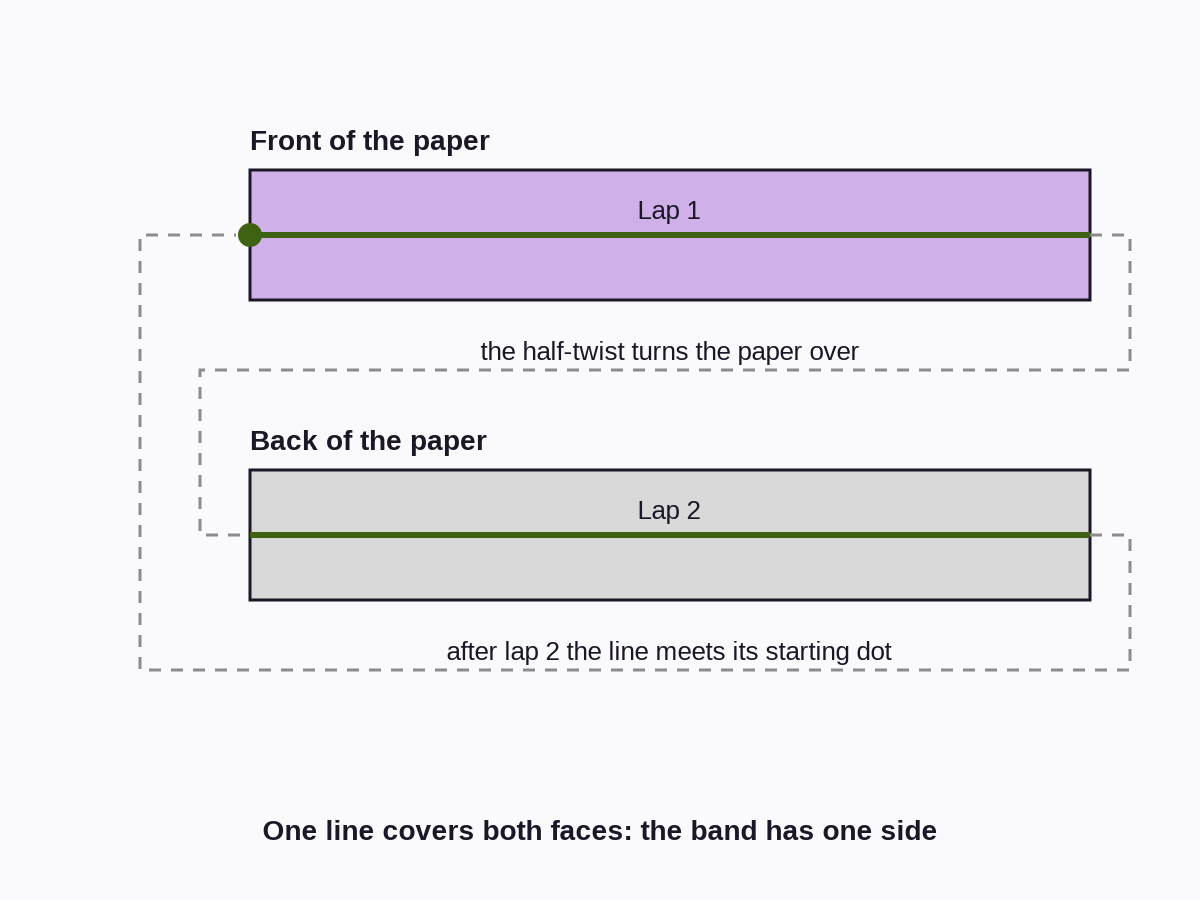
Give a paper strip one half-twist, tape the ends, and it has only one side. That loop is the Möbius strip, which August Ferdinand Möbius described with a paper strip in an 1860s paper on polyhedra, reprinted in his collected works: turn one end half round before joining it, and the surface has one edge and one side. To check, run a pencil down the middle of the strip. The line returns to its start after two laps, and both faces of the paper carry it.
Protocol · 4 parts
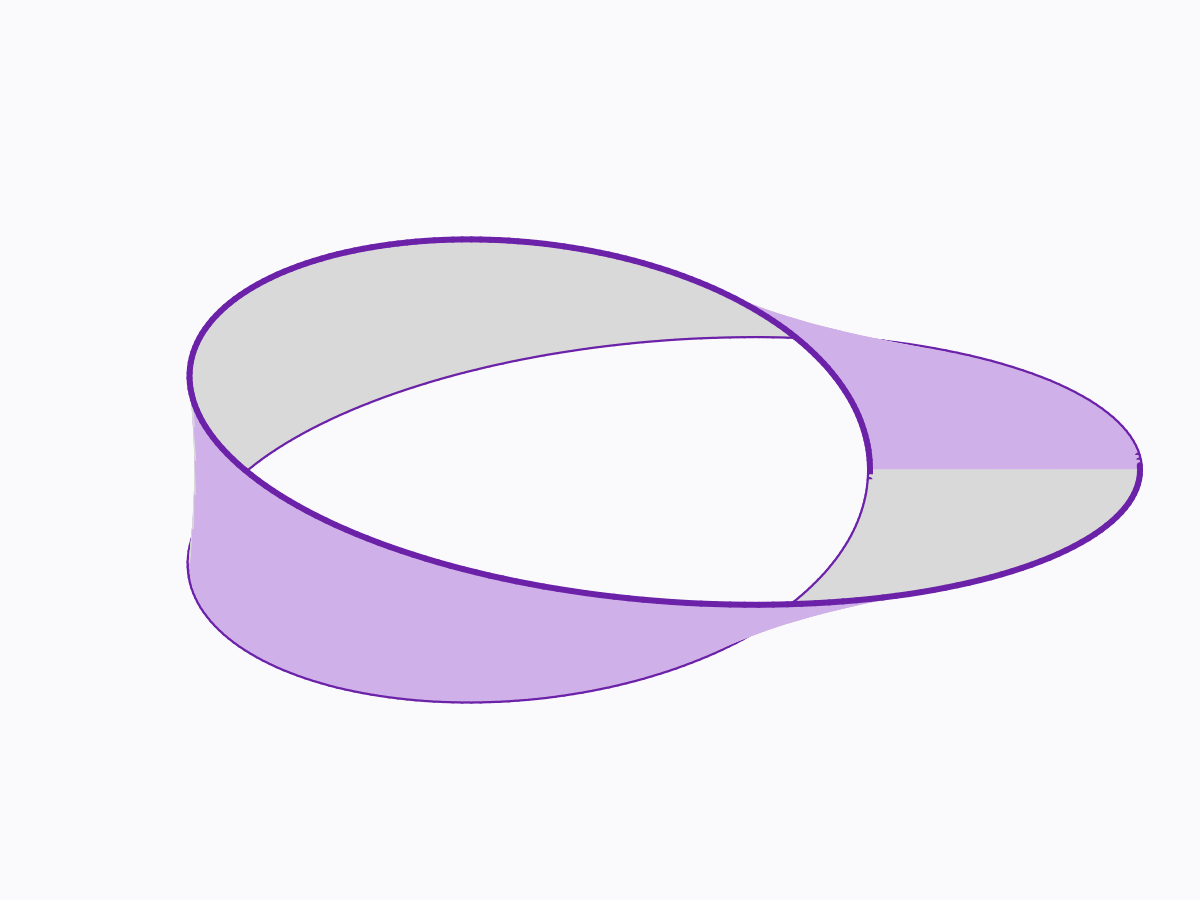
At a glance
- Name
- Möbius strip
- Also called
- Möbius band; Möbius'sches Blatt (Möbius sheet) in the 1886 edition of his collected works
- First recorded
- Earliest source read for this page: Möbius's paper Ueber die Bestimmung des Inhaltes eines Polyëders, section 11, reprinted in his collected works; its opening page dates it to the Leipzig society's Berichte for 1865, vol. 17, while the volume's contents list says 1867. The editor of his unpublished notes dates the find to late 1858. According to Cartwright and González (2016), Johann Benedict Listing found the same band almost at the same time.
- Type
- Surface in topology; a paper model you can make
- Main explanations
- One half-twist makes the far end meet the near end upside down, so a path along the middle comes back on the other face: one side and one edge. Möbius gave the same test with a paint brush, and noted that 3, 5, 7 half-twists also give one side and one edge, while an even number gives two of each.
- On this page
- Static figures and recomputable data: sides, edges and cut results for bands with 0 to 5 half-twists, counted on this site's band model
mobius-strip-glance.csv (CSV) · what the file holds and its license
Make one before you read on: a strip of paper about 3 cm wide and 30 cm long, one half-twist, and a piece of tape. On this page, the gasp point comes when the pencil line meets its own start with no edge crossed and both faces marked.
One side, one edge
Put a finger on the edge of the band and slide it along without lifting it. The finger goes round the loop twice and comes back to where it began, so the band has one edge, a single closed curve. A plain ring of paper has two separate edges, a top and a bottom, and a finger that starts on one of them stays on it.
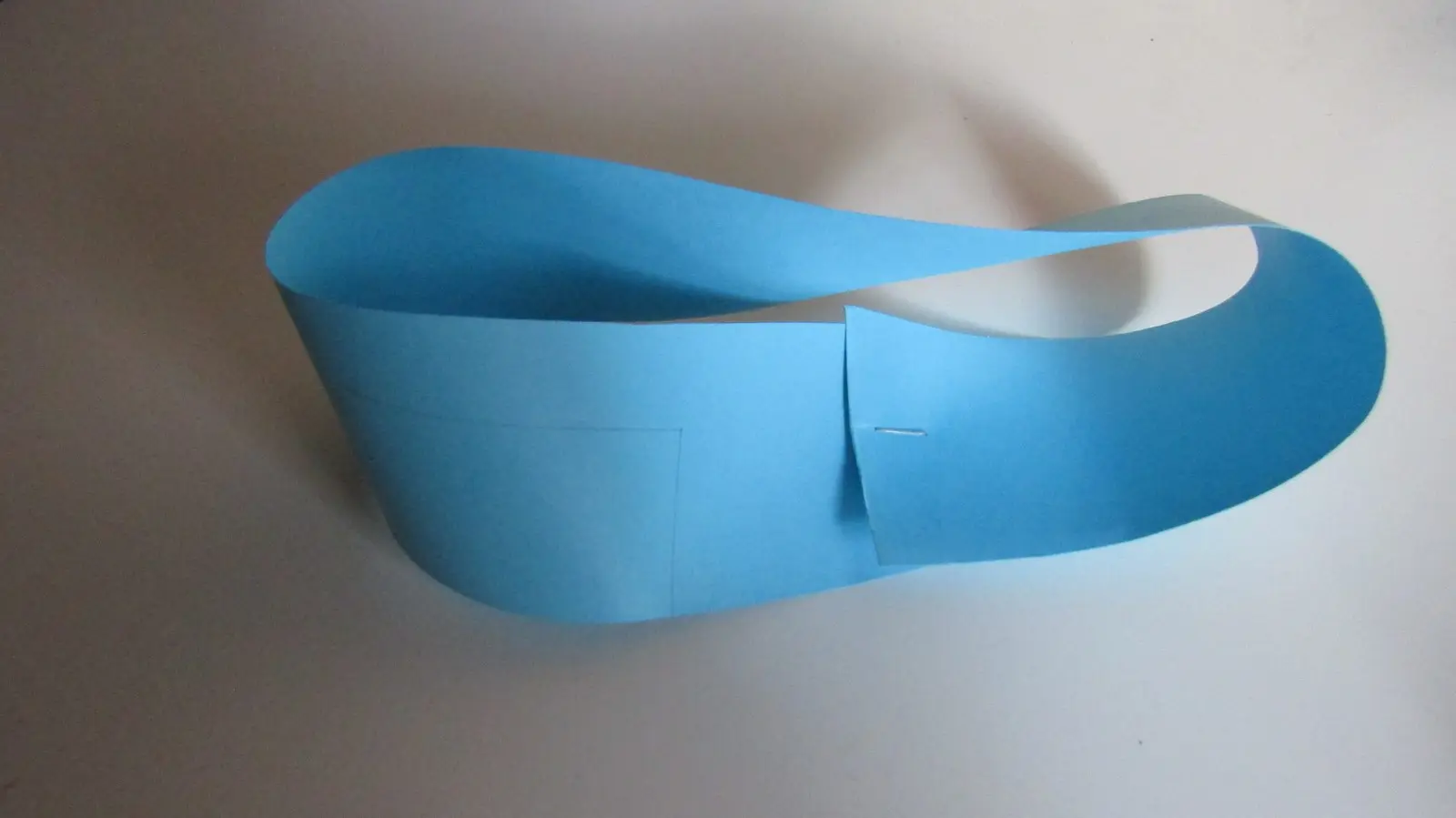
The side count works the same way. Möbius put it in terms of paint: start painting anywhere, never carry the brush over the edge, and in the end every spot is painted on both of its faces. In his words, “Auch hat diese Fläche nur eine Seite”: moreover, this surface has only one side. Which side owns an edge is also the question behind the Rubin vase, where a single outline can belong to the vase or to the two faces.
To run the pencil test on your own strip:
- Draw a dot on one face, next to the tape.
- From the dot, draw along the middle of the strip without lifting the pencil.
- Stop when you reach the dot again, and count how many times you went round.
- Look for any stretch of paper that is still blank on one face.
What happens with more half-twists?
Möbius also tried more twists. In notebook entries printed after his death, he wrote that 3, 5, 7 or any odd number of half-twists also gives “eine einseitige, von nur einer Linie begrenzte Fläche”, a one-sided surface bounded by only one line. An even number gives two boundary lines and two sides that can be told apart, just as a strip with no twist at all does. The English after each German quotation is this page's translation.
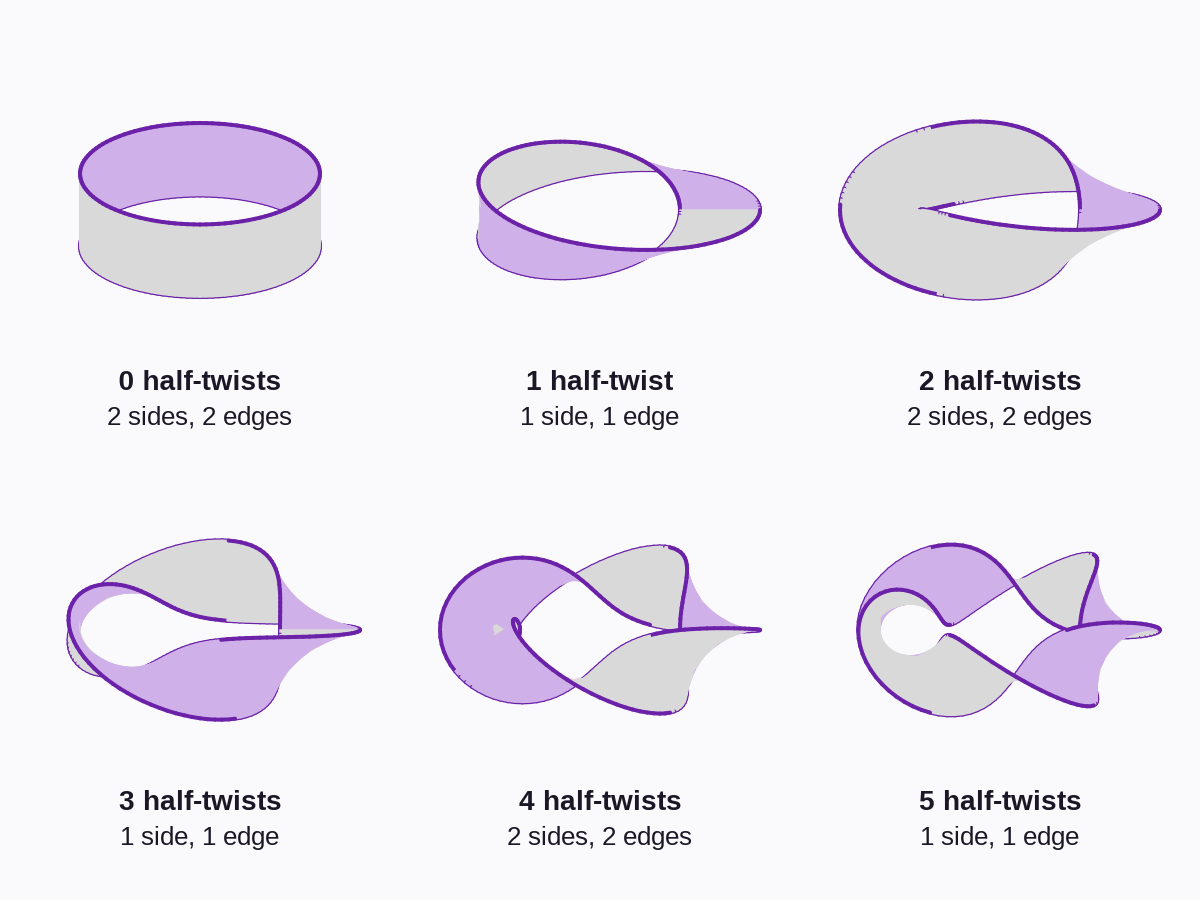
The program behind this page checks the rule on a model band for every count from 0 to 5. It carries the direction the surface faces once round the loop; for an odd count that direction comes back reversed, which is what having one side means. It also follows each edge until the edge closes on itself. Each drawing is a flat picture that the eye reads as a solid, the same kind of reading that makes the Necker cube seem to flip.
How did Möbius describe the paper strip?
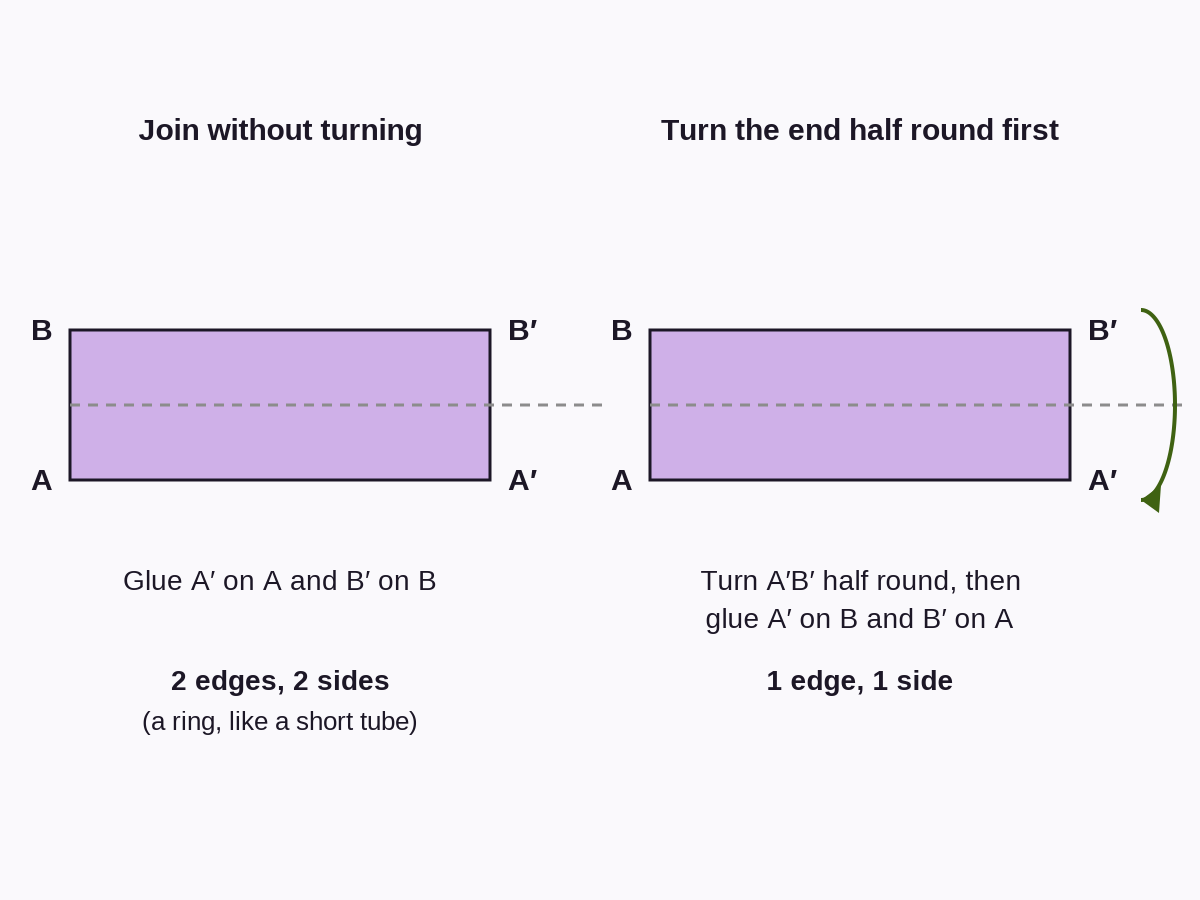
Möbius was writing about polyhedra, solids with flat faces, in a paper on how to find their volume. In section 11 he took a paper rectangle with corners A, B, B′ and A′; bending it so that the end A′B′ lands on AB without turning gives a cylinder with two edges. Turning A′B′ half round first, so that A′ meets B and B′ meets A, leaves one boundary line and one side.
The dates need care: in the 1886 collected edition, the paper's opening page gives the Leipzig society's Berichte for 1865, volume 17, pages 31 to 68, while the contents list of the same volume puts it under 1867. This page reports both and does not choose between them.
Curt Reinhardt, who edited Möbius's unpublished notes for that edition, used the notebooks to date the find to the last months of 1858. Möbius was then working on a prize question about polyhedra set by the Paris Academy, and he sent his essay to Paris in June 1861. According to a 2016 history by Julyan Cartwright and Diego González, Johann Benedict Listing found the same band almost at the same time. Listing's own text was not read for this page.
What happens when you cut it down the middle?
Before you open the answer, guess how many loops you get if you cut along the pencil line all the way round.
Guess first, then open the answer: One loop, twice as long
One loop, twice as long
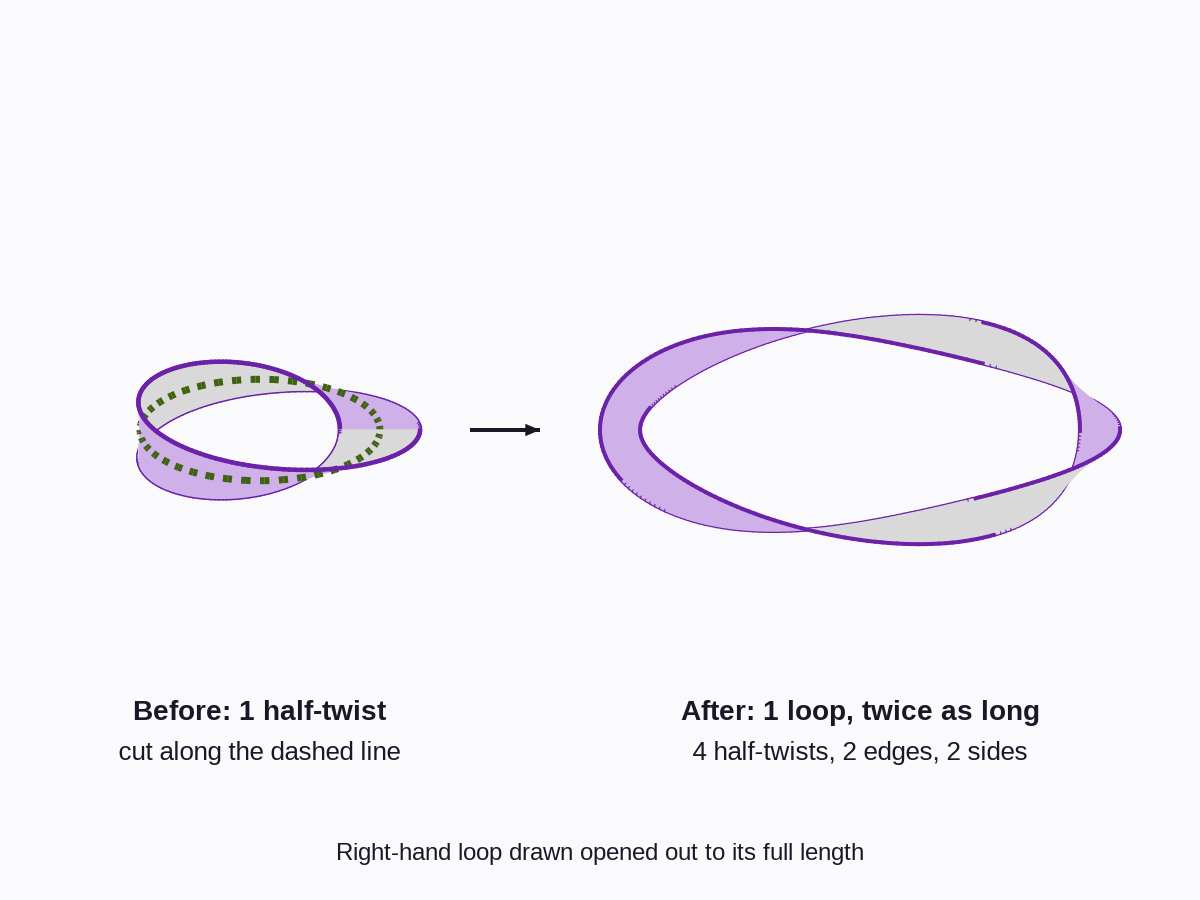
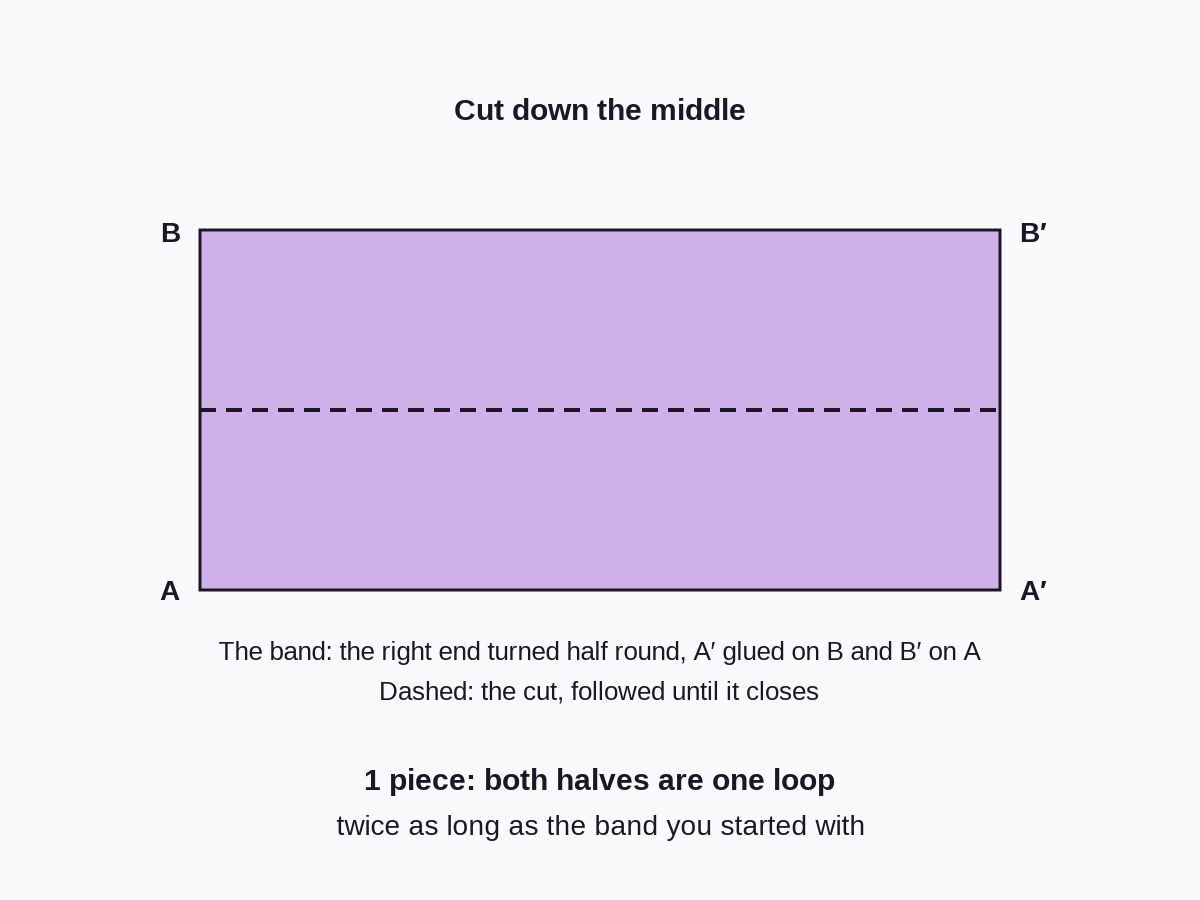
The scissors meet the start of the cut after one lap, not two as the pencil did, and the band stays in one piece. The new loop is twice as long as the band you started with, and it has two edges, two sides and 4 half-twists, which is two full turns. A plain ring cut the same way falls into two separate rings, and a band with 2 half-twists gives two rings linked like a chain.
Bands with 3 or 5 half-twists also stay in one piece when cut down the middle, as the table below shows. This page does not count the twists in those longer loops.
Check it yourself
Each row comes from the same model band: sides come from carrying the surface direction once round; edges and pieces come from following each edge or cut until it closes; half-twists and linking come from a standard linking count between closed curves. As with the point-by-point count in the Mandelbrot set, every number below can be computed again from the rule.
| Half-twists | Sides | Edges | Pieces after a cut down the middle | Those pieces linked? | Pieces after a cut one third in |
|---|---|---|---|---|---|
| 0 | 2 | 2 | 2 | no | 2 |
| 1 | 1 | 1 | 1 | one piece | 2 |
| 2 | 2 | 2 | 2 | yes | 2 |
| 3 | 1 | 1 | 1 | one piece | 2 |
| 4 | 2 | 2 | 2 | yes | 2 |
| 5 | 1 | 1 | 1 | one piece | 2 |
Download the half-twist counts (CSV) · what the file holds and its license
Now break it
Move the scissors. Instead of the middle, start a third of the way in from the edge, and keep cutting until you reach the start.
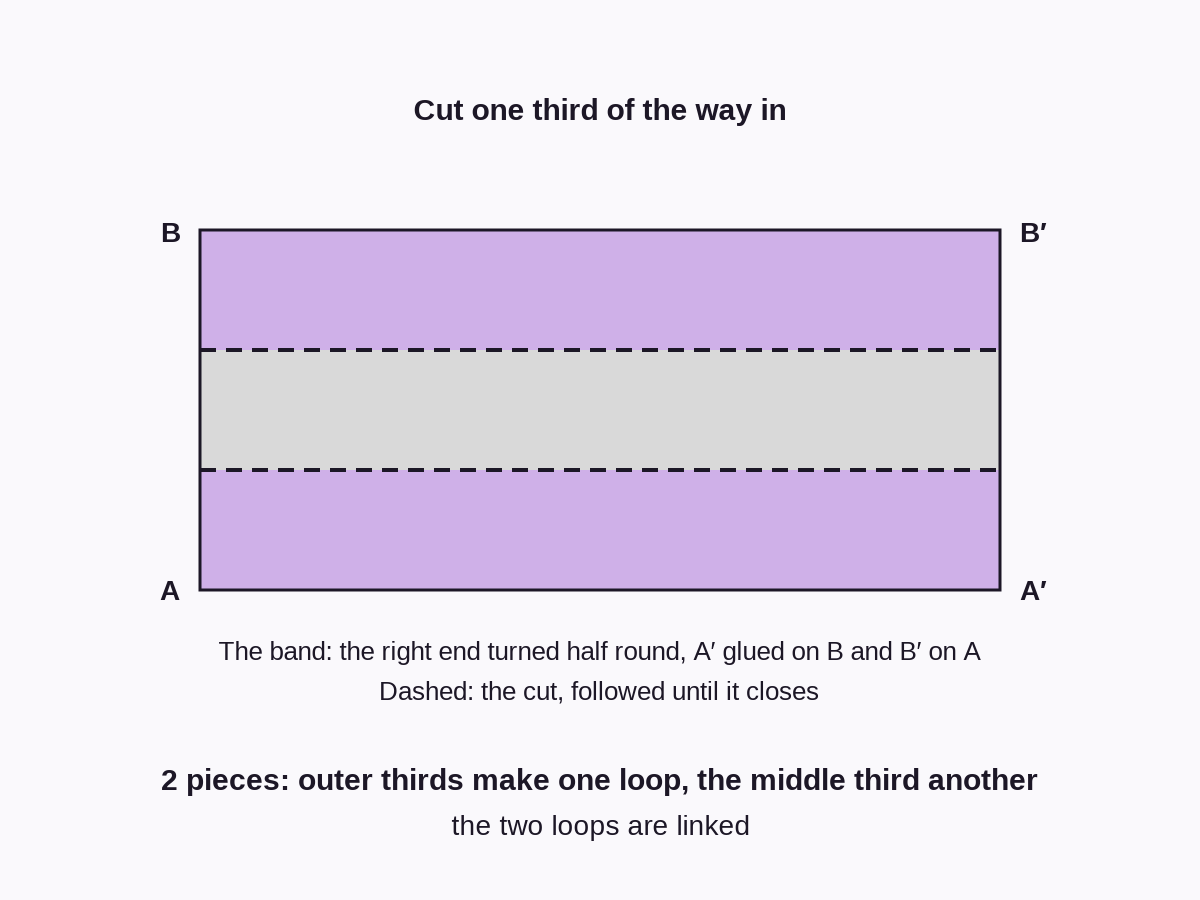
This time the scissors go round twice before they meet the start of the cut, and the band falls into two loops that hang linked together. The middle third is a thinner Möbius strip, as long as the original, with 1 half-twist and one edge. The outer thirds join into a loop twice as long, with 4 half-twists.
Try this next: Seven Bridges of Königsberg — another puzzle settled by counting what meets where, not by trying routes.
Sources
- August Ferdinand Möbius, Gesammelte Werke, vol. 2, ed. F. Klein (Leipzig: S. Hirzel, 1886). Includes Ueber die Bestimmung des Inhaltes eines Polyëders, pp. 473–512, and, from his unpublished papers, Zur Theorie der Polyëder und der Elementarverwandtschaft, ed. Curt Reinhardt, pp. 513–560. https://archive.org/details/gesammeltewerkeh02mbuoftRead: pages 473, 484–485 and 517–520, with the title page and contents page VI, checked against the page images
- Julyan H. E. Cartwright and Diego L. González, “Möbius strips before Möbius: Topological hints in ancient representations,” arXiv:1609.07779, version 1 (2016). https://arxiv.org/abs/1609.07779v1Read: abstract
Cite this page
Explorable Illusions. (2026). Möbius Strip: One Half-Twist Leaves One Side and One Edge. Explorable Illusions. Published 2026-11-13. https://explorableillusions.com/math-toys/mobius-strip/
Add the date you read it. Figures and CSV files on this page are CC BY 4.0 unless their credit line says otherwise.
How pages here are checked Corrections log Report an error: contact@explorableillusions.com
More in Puzzles, Fractals & Math Toys
 Puzzles, Fractals & Math Toys
Mandelbrot Set: Exact Area Still Unknown as of 2026
Square, add c, repeat: the Mandelbrot set is every point that never escapes. As of 2026 its exact area is unknown; grid counts put it near 1.51.
Picture credit
"The Mandelbrot set, full view" by Explorable Illusions — https://explorableillusions.com/math-toys/mandelbrot-set/ — CC BY 4.0 (https://creativecommons.org/licenses/by/4.0/)
 Puzzles, Fractals & Math Toys
Seven Bridges of Königsberg: No Walk Crosses Each Once
The seven bridges of Königsberg join four lands that touch 5, 3, 3 and 3 bridges. See why no walk crosses each bridge once, and why dropping any one fixes it.
Picture credit
"Topographia Practica – 3. Regiomontum (Königsberg)" by Fryderyk Getkant — https://commons.wikimedia.org/wiki/File:Topographia_Practica_-_3._Regiomontum.jpg — Public domain (US: hand-drawn map made 1634–39 by an author who died in 1666, public domain whether counted as published (before 1931) or unpublished (life plus 70 years); EU: author d. 1666, more than 70 years ago); modified: scaled from 7,544 to 1,600 px wide; no crop, no colour change
 Puzzles, Fractals & Math Toys
Magic Square: 1514 Sits in Dürer’s Bottom Row
Every row, column and diagonal of Dürer's 1514 magic square adds to 34, and its bottom row has 15 14 in the middle. See the 86 sets of four and the 880 count.
Picture credit
"Melencolia I (detail: the magic square)" by Albrecht Dürer — https://commons.wikimedia.org/wiki/File:Albrecht_D%C3%BCrer,_Melencolia_I,_1514,_NGA_6640.jpg — CC0 1.0 (https://creativecommons.org/publicdomain/zero/1.0/); modified: cropped to a 4:3 frame around the whole magic square with a strip of the wall, the foot of the bell, part of the rope and the edge of the hourglass frame; scaled to 1,200 x 900 px