Conway’s Game of Life: A Glider Gun Fires Every 30 Steps
Explorable Illusions · Published
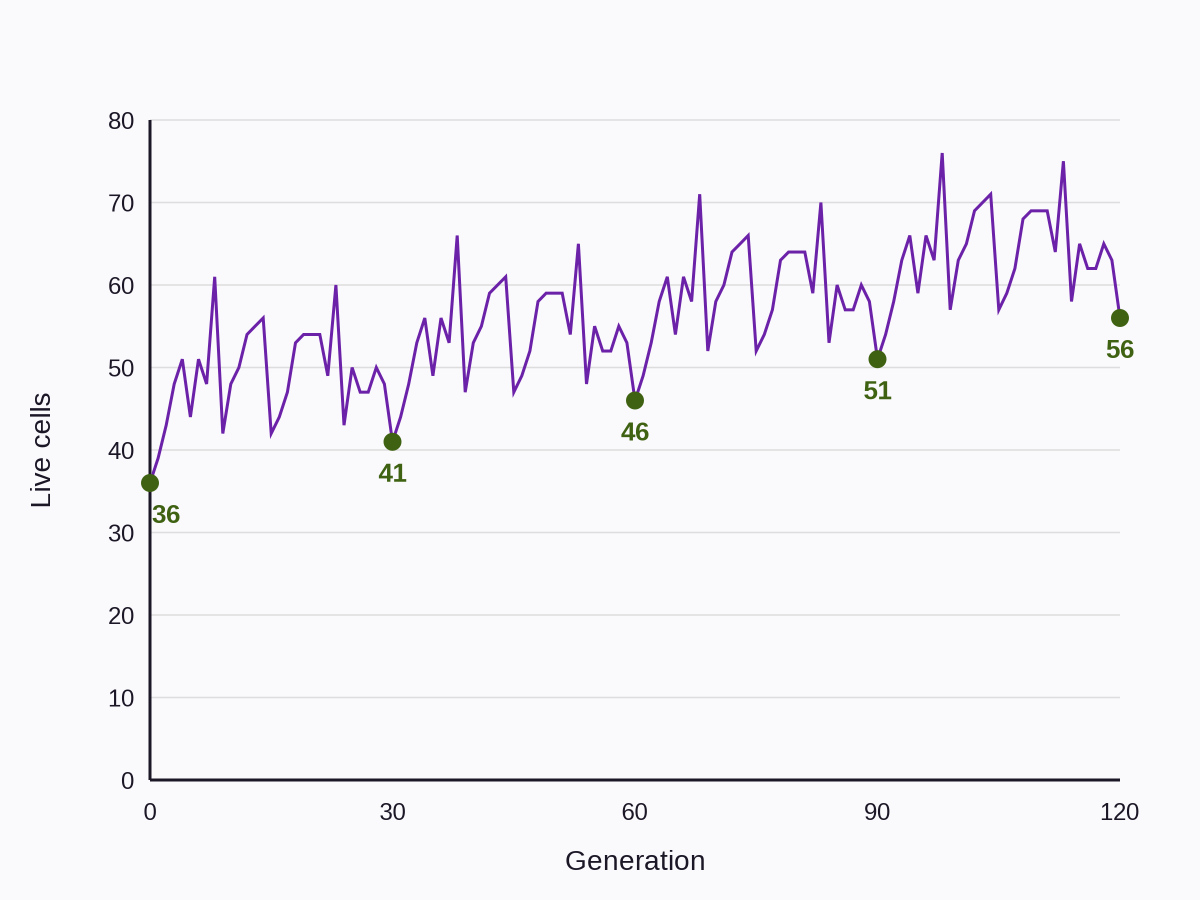
Five live cells, four rules, and the shape walks diagonally across the grid. That shape is the glider of Conway’s Game of Life, a grid where each cell lives or dies by counting its eight neighbors, as Brown and colleagues lay out the rules in a 2023 paper. Every 4 generations the glider is back in its first shape, one cell further along; press Step four times below to check. The Gosper glider gun adds a glider every 30 generations: 36, 41, 46, 51, then 56 live cells in this page’s run.
Protocol · 6 parts
A glider on a 20 by 20 wrap-around board
Your device asks for reduced motion, so the board does not play; the first four generations are drawn below.
The first four generations, 20 × 20 cells, edges wrapping around:
- Gen 0
- Gen 1
- Gen 2
- Gen 3
| Generation | Live cells |
|---|---|
| 0 | 5 |
| 1 | 5 |
| 2 | 5 |
| 3 | 5 |
game-of-life-glider.csv (the starting cells, CSV)
"A glider on a 20 by 20 wrap-around board" by Explorable Illusions — https://explorableillusions.com/simulations/game-of-life/ — CC BY 4.0 (https://creativecommons.org/licenses/by/4.0/)
At a glance
- Name
- Conway's Game of Life
- Also called
- Life; the rule B3/S23
- First recorded
- Described in Martin Gardner's Mathematical Games column, Scientific American, October 1970, the reference Brown et al. 2023 give for Life (cited from the bibliography only)
- Type
- Cellular automaton: a square grid, two states per cell, eight neighbors, every cell updated at once
- Main explanations
- Mathematical result, no rival accounts: the glider repeats every 4 generations one cell over diagonally; on an open grid the Gosper glider gun's own cells repeat every 30 generations and it releases one glider each time (checked by this page's program)
- On this page
- Two players (a glider and the Gosper glider gun) at up to 3 generations a second, still figures and a CSV of live-cell counts by pattern, rule, board and generation
game-of-life-glance.csv (CSV) · what the file holds and its license
The board above wraps around, so a glider that leaves on one side comes back on the other. On this 20 by 20 board it lands on its starting cells again at generation 80. Nothing else is chosen once the starting cells are set; each generation follows from the one before by the rules alone.
The four rules
Each cell on the grid is either alive or dead. Its neighbors are the eight cells that touch it along a side or at a corner. All cells change at the same moment, one generation at a time. Brown and colleagues state the rules in two lines; split by case, they make four:
- Birth: a dead cell with exactly 3 live neighbors comes alive.
- Survival: a live cell with 2 or 3 live neighbors stays alive.
- Loneliness: a live cell with 0 or 1 live neighbor dies.
- Crowding: a live cell with 4 or more live neighbors dies.
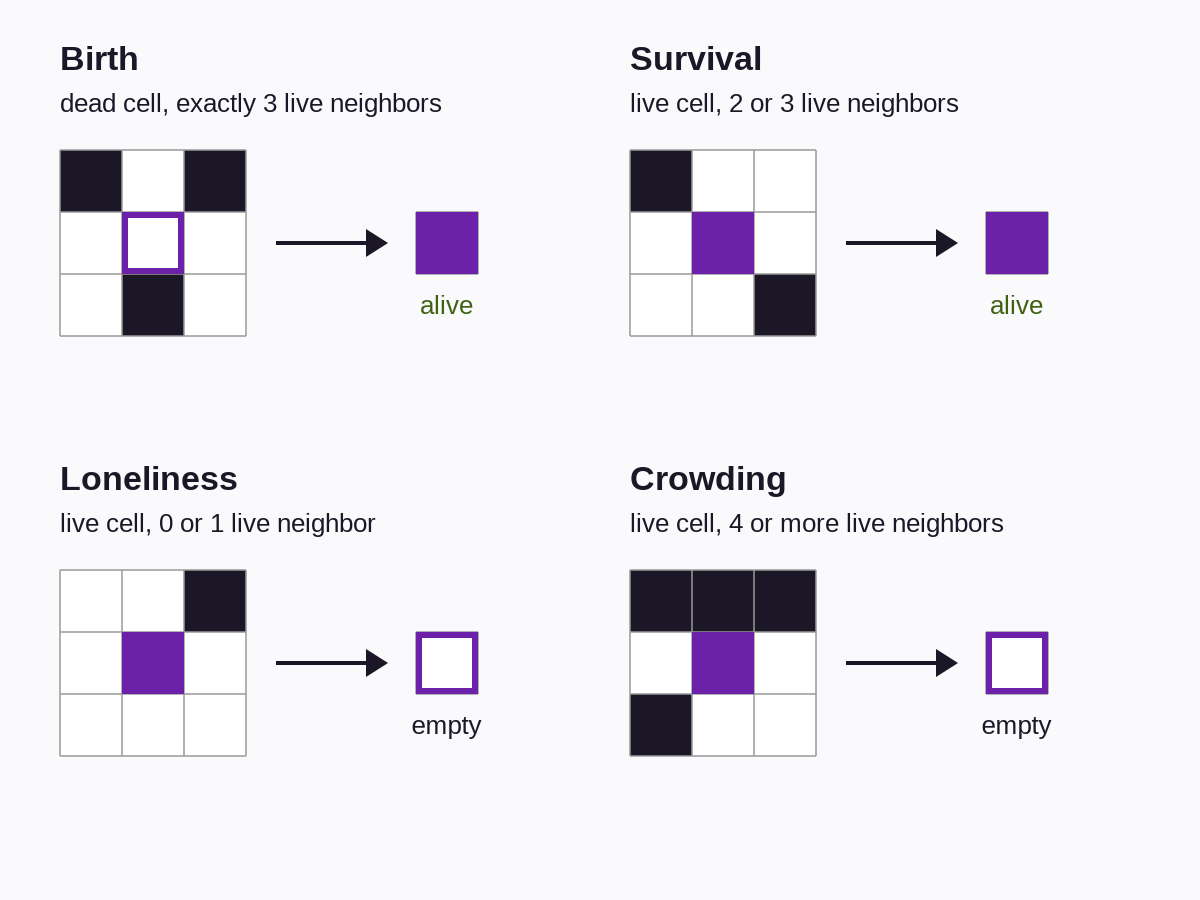
This page writes the rule in short as B3/S23: born with 3, survives with 2 or 3. Every count on this page comes from a program that applies exactly that rule, except where the last section changes it, and the two players run the same rule in your browser. Martin Gardner wrote about John Conway’s new game in his Mathematical Games column in Scientific American in October 1970. Brown and colleagues cite that column as their reference for Life; this page cites it from the bibliographic record only.
How does a glider walk across the grid?
Step the top board one generation at a time and watch the five cells. The shape tips over, folds, and rights itself. After 4 generations it is back in its first shape, moved one cell to the right and one cell down. Brown and colleagues give the same numbers: the glider has period 4 and moves 1 cell diagonally in those 4 generations.
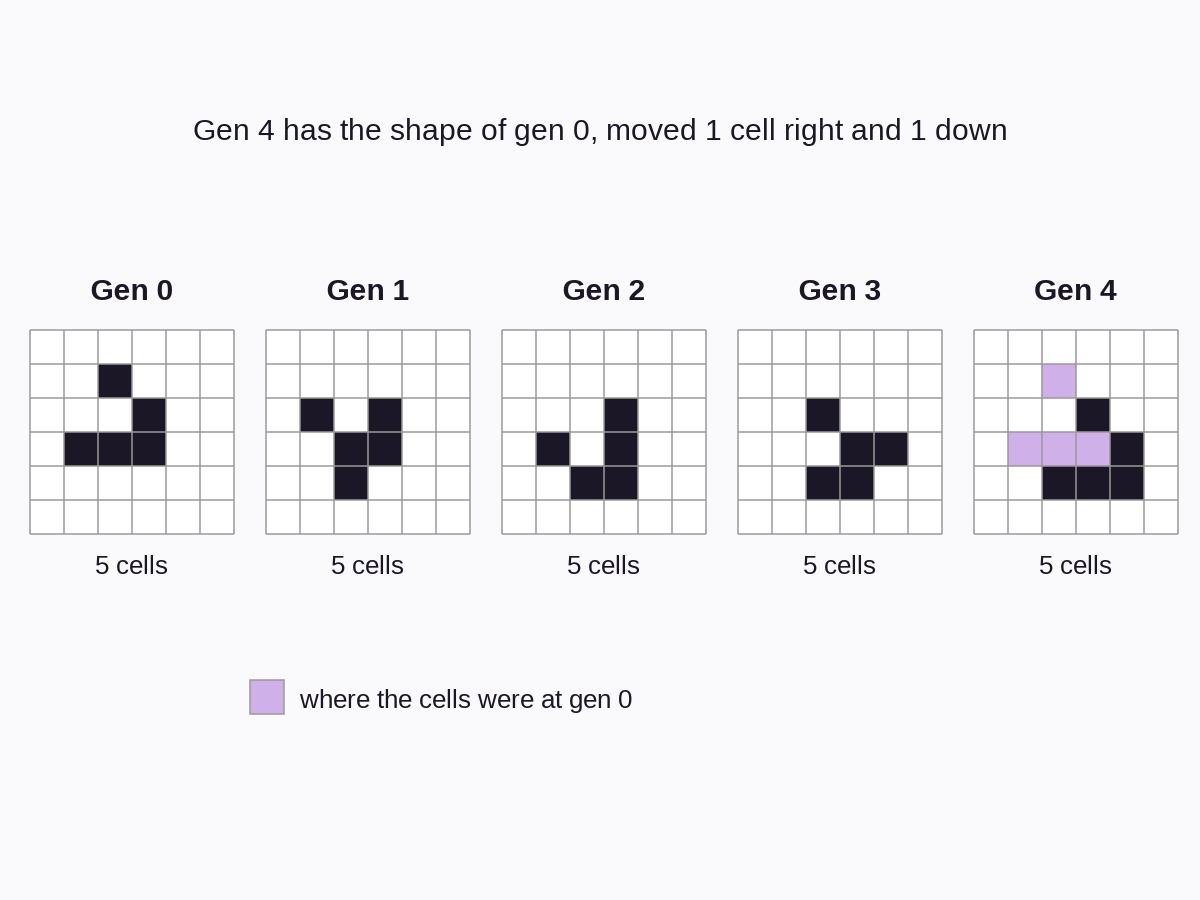
No cell ever moves. In the first step, 2 cells die of loneliness, 2 empty cells are born with exactly 3 neighbors, and 3 cells survive. The pattern travels because births happen on its leading side and deaths on its trailing side. The live-cell count stays at 5 in every phase, which the program checked for the first 8 generations.
Blocks, blinkers and other Game of Life patterns
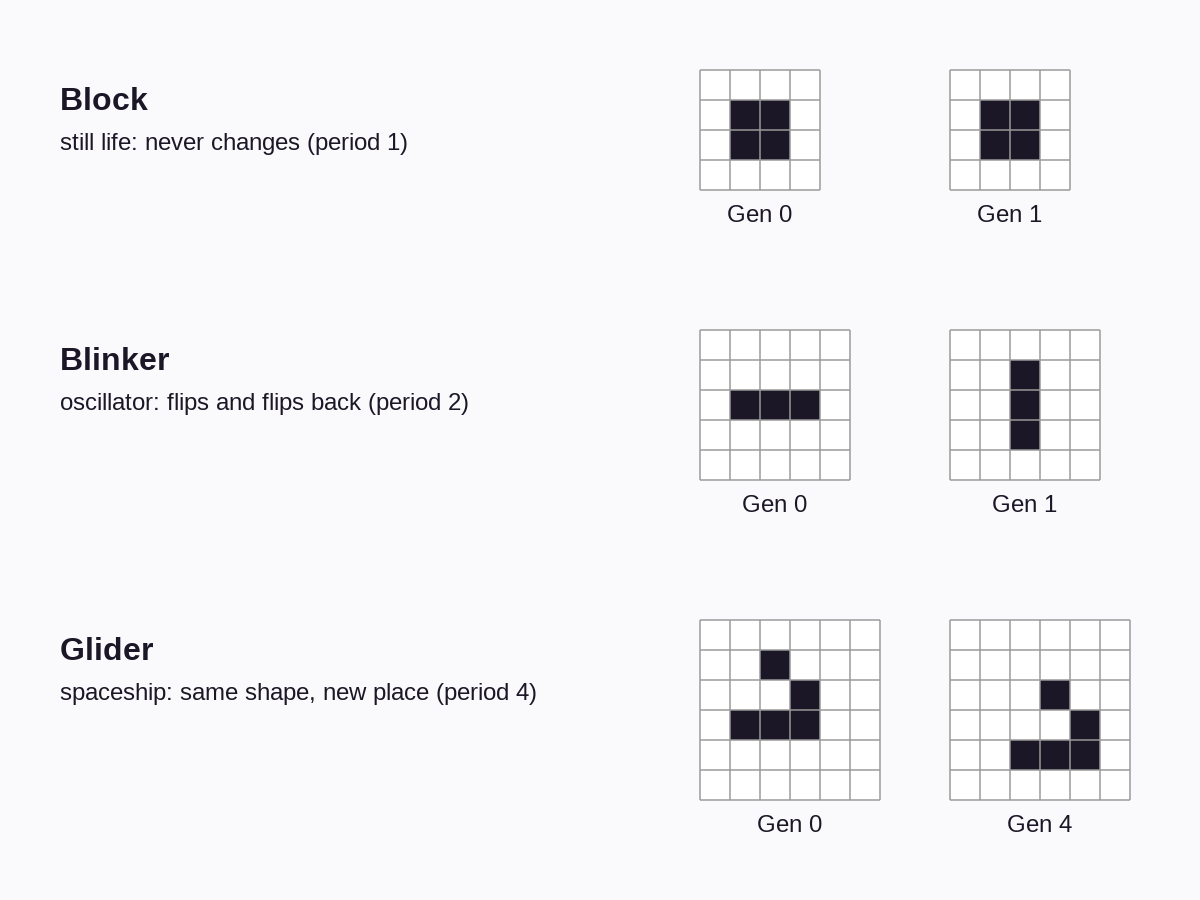
Brown and colleagues sort Life patterns by their period, the number of generations a pattern takes to return to its starting state. A pattern with period 1 never changes and is called a still life; the 2 by 2 block is one. A pattern that changes and comes back in place is an oscillator, such as the blinker, a row of 3 cells that stands upright for one generation and lies flat again the next. A pattern that comes back in a new place is a spaceship, and the glider is one.
Start Life from a random scatter of cells and, Brown and colleagues write, there is usually a burst of chaotic activity that settles into small patterns. Period 2 oscillators such as the blinker are common among the leftovers, period 3 oscillators turn up sometimes, and period 15 now and then. Their paper, posted in December 2023, reports the last two missing oscillator periods, 19 and 41. With those found, Life has an oscillator of every period, a property called omniperiodic.
The Gosper glider gun, one glider every 30 generations
The second board starts with 36 live cells: two small squares at the ends and two larger clusters between them. Step it to generation 30. The counter should read 41, because the gun is back in its starting shape and 5 more cells are leaving as one glider. That count is the gasp point of this page, the one press where doubt turns into seeing: nothing was added from outside, yet the board now holds 5 more live cells than it started with.
The Gosper glider gun on a 64 by 40 board
Your device asks for reduced motion, so the board does not play; the first four generations are drawn below.
The first four generations, 64 × 40 cells, edges held empty:
- Gen 0
- Gen 1
- Gen 2
- Gen 3
| Generation | Live cells |
|---|---|
| 0 | 36 |
| 1 | 39 |
| 2 | 43 |
| 3 | 48 |
game-of-life-gun.csv (the starting cells, CSV)
"The Gosper glider gun on a 64 by 40 board" by Explorable Illusions — https://explorableillusions.com/simulations/game-of-life/ — CC BY 4.0 (https://creativecommons.org/licenses/by/4.0/)
The players run at 1, 2 or 3 generations a second and never faster, the limit set out on the methods page; at the top speed, reaching generation 30 takes 10 seconds. Step 30 more and the counter reads 46, then 51 at generation 90 and 56 at generation 120. The program checked every 30th generation up to 270: each time, the gun’s own 36 cells sit exactly where they started.
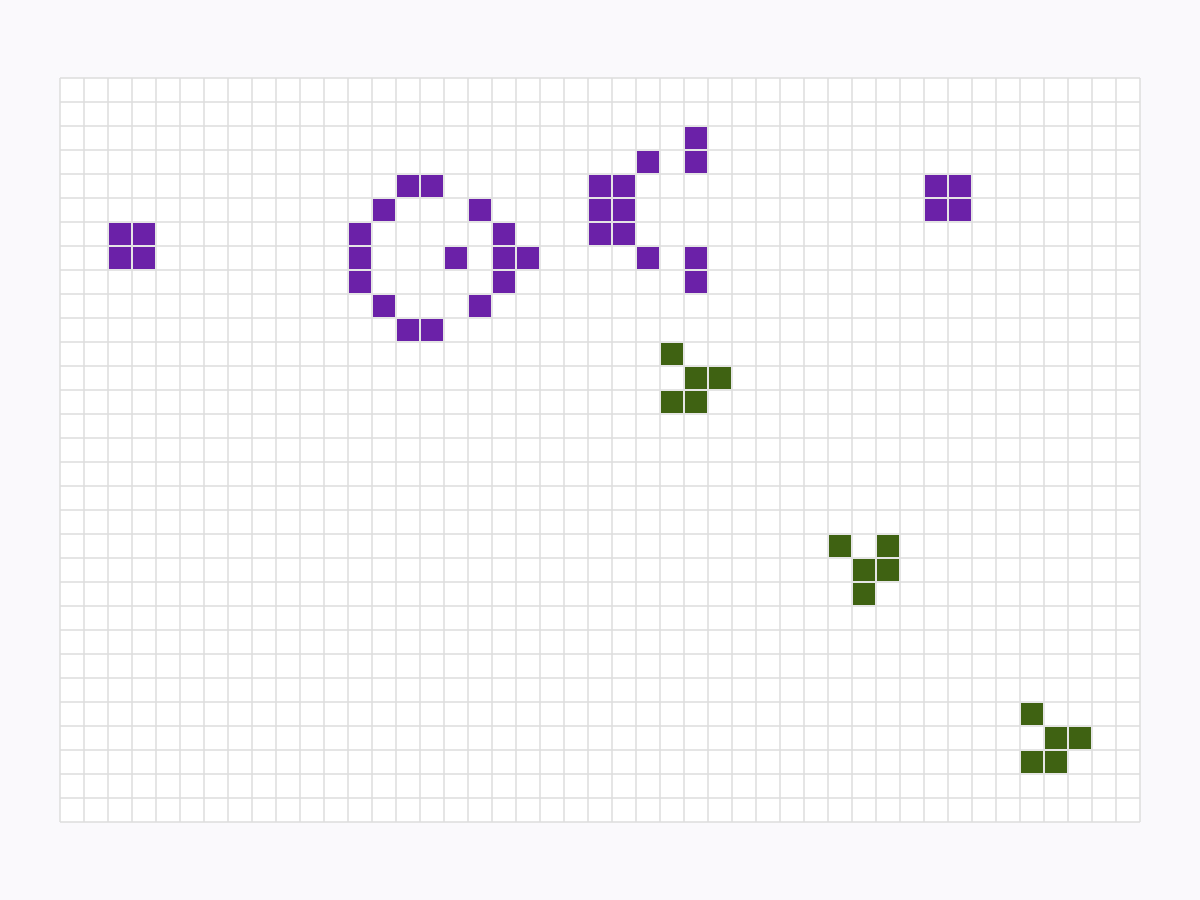
Brown and colleagues explain the machine: each half of it is a queen bee, a pattern found by Robert W. April that reappears facing the other way after 15 generations. In the gun, the two queen bees meet every 30 generations, and each meeting releases a glider. The pattern is named for Bill Gosper, and Brown and colleagues describe it as the first pattern found that grows without limit.
Explorable Illusions takes a position on boards like these: an animation you can only watch is decoration, and a model earns the word interactive when you can break it. The two players only play, step and reset under one rule. So the starting cells sit in the CSV file under each board, ready for any Life program, and the last section of this page changes the rule itself.
Why does the population never stop growing?
Between the checkpoints the count jumps around, from 36 up to 76 in the first 120 generations, as the two queen bees swell and shrink. At every 30th generation it falls back onto a straight line: 36 plus 5 for each glider released. On an open grid nothing ever stops a glider, so the count at generation 30 times k is 36 + 5k with no ceiling.
A Galton board shows a similar kind of surprise from local rules. Each bead only bounces left or right at each pin, yet together the beads build a heap with a shape of its own.
The Mandelbrot set works the same way in another medium: one short rule, repeated at every point of the plane, decides the whole shape. In Life the rule is local too. A cell sees only its eight neighbors, yet on an open grid the gun keeps adding gliders forever.
What happens at the edge of the board?
The gun player is a finite board, 64 cells wide and 40 tall, and the cells past its edges are held empty. The first glider reaches the bottom row at generation 136 and stops there as a 2 by 2 block by generation 142. A block is still: each of its 4 cells has 3 live neighbors, so nothing is born and nothing dies.
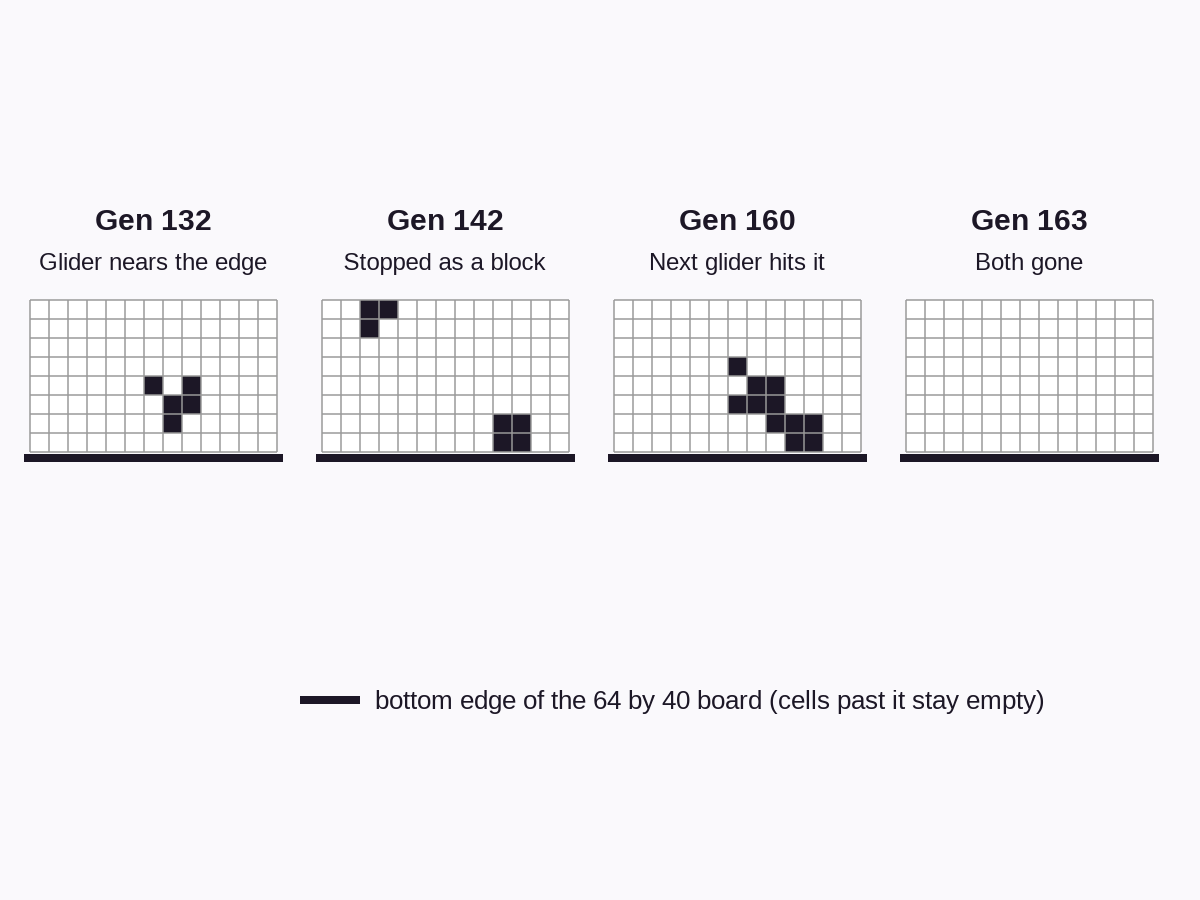
The second glider runs into that block at generation 160, and by generation 163 both are gone. From generation 103 on, the whole board repeats every 60 generations: one glider freezes into a block, and the next one clears it away. Over that cycle the count stays between 56 and 85 live cells. The program ran 3,000 generations, and the gun itself was never touched.
Edges change the story in a second way. When the program wraps the same 64 by 40 board, so that a glider leaving at the bottom comes back at the top, a returning glider hits the gun at generation 298. The gun does not recover in the first 1,000 generations, and by then 51 cells remain, repeating every 2 generations. As with a double pendulum, nothing random happens at any step: the same start on the same board always gives the same history.
Questions about the Game of Life
Is the Game of Life Turing complete?
Yes, according to a 2023 paper by Brown and colleagues: a Life pattern can be built to simulate any Turing machine. They note that this was argued in Life’s early days without building one, and that explicit Turing machines in Life came much later. They cite the 1982 book Winning Ways by Berlekamp, Conway and Guy for the argument and Paul Rendell’s 2015 book for a construction. This page has read their summary, not those books.
Can you win the Game of Life?
No. After the starting cells are set, each generation follows from the rules alone. Nobody takes a turn and nothing is scored; the only choice is the starting pattern.
Who created the Game of Life?
The game is named for John Conway. Martin Gardner described it in his Mathematical Games column in Scientific American in October 1970, and Brown and colleagues use that column as their reference for Life.
Check it yourself
Every number on this page comes from the same program and the same rule, B3/S23 unless the row says otherwise.
| Claim | Pattern and board | Program result |
|---|---|---|
| The glider repeats every 4 generations, one cell over diagonally | glider, open grid | 5 live cells at generations 0 to 8; generation 4 equals generation 0 moved 1 right, 1 down |
| A block never changes and a blinker flips back every 2 generations | block and blinker, open grid | block: the same 4 cells at generation 1; blinker: 3 cells, upright at generation 1, flat again at generation 2 |
| The glider returns to its starting cells on the wrap-around player | glider, 20 by 20, edges wrap | back on its starting cells at generation 80 |
| The gun adds 5 cells every 30 generations | Gosper glider gun, open grid | 36, 41, 46, 51, 56 live cells at generations 0, 30, 60, 90, 120 |
| The gun body repeats every 30 generations | Gosper glider gun, open grid | its 36 cells back in place at every 30th generation up to 270 |
| Growth stops on a board with empty edges | Gosper glider gun, 64 by 40, edges empty | block at the edge at generation 142; repeats every 60 generations from generation 103, with 56 to 85 live cells in each cycle |
| A wrap-around board wrecks the gun | Gosper glider gun, 64 by 40, edges wrap | gun first hit at generation 298 |
| Birth on 3 or 6 keeps the glider and breaks the gun | glider and Gosper glider gun, open grid, B36/S23 | glider still 5 cells moving 1 cell diagonally every 4 generations; gun down to 22 cells at generation 120, no glider released in 300 generations |
Live-cell counts by pattern, rule, board and generation (CSV) · what the file holds and its license
The download lists 202 rows, one per pattern, rule, board and generation, with the size of each pattern’s bounding box and the number of free gliders. The two players’ CSV files hold the starting cells, so any Life program that takes a list of live cells can rerun both boards.
Now break it
Change one number in the rule and watch which machine survives. Under B36/S23, a dead cell is also born when it has exactly 6 live neighbors. The glider never gives any cell 6 neighbors, so it walks on unchanged. The gun is another matter.
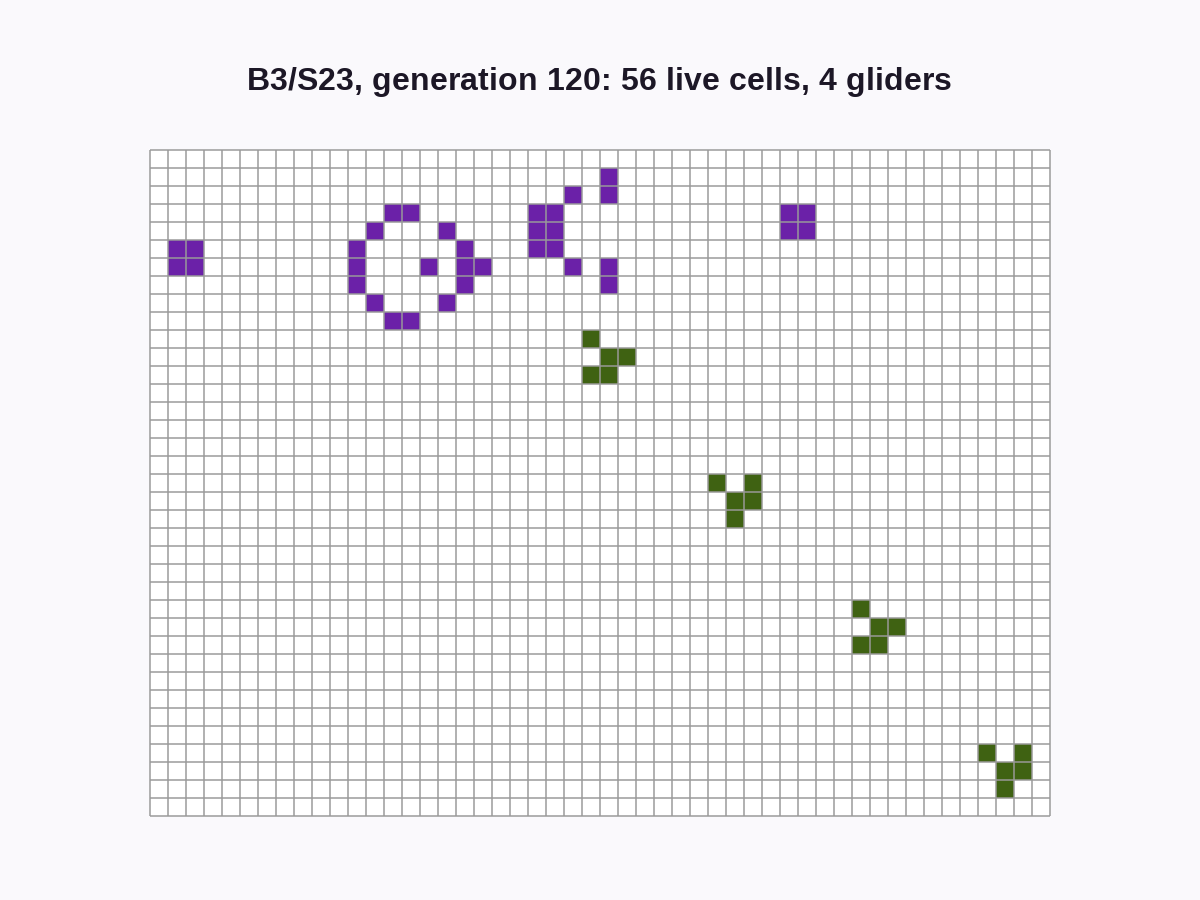
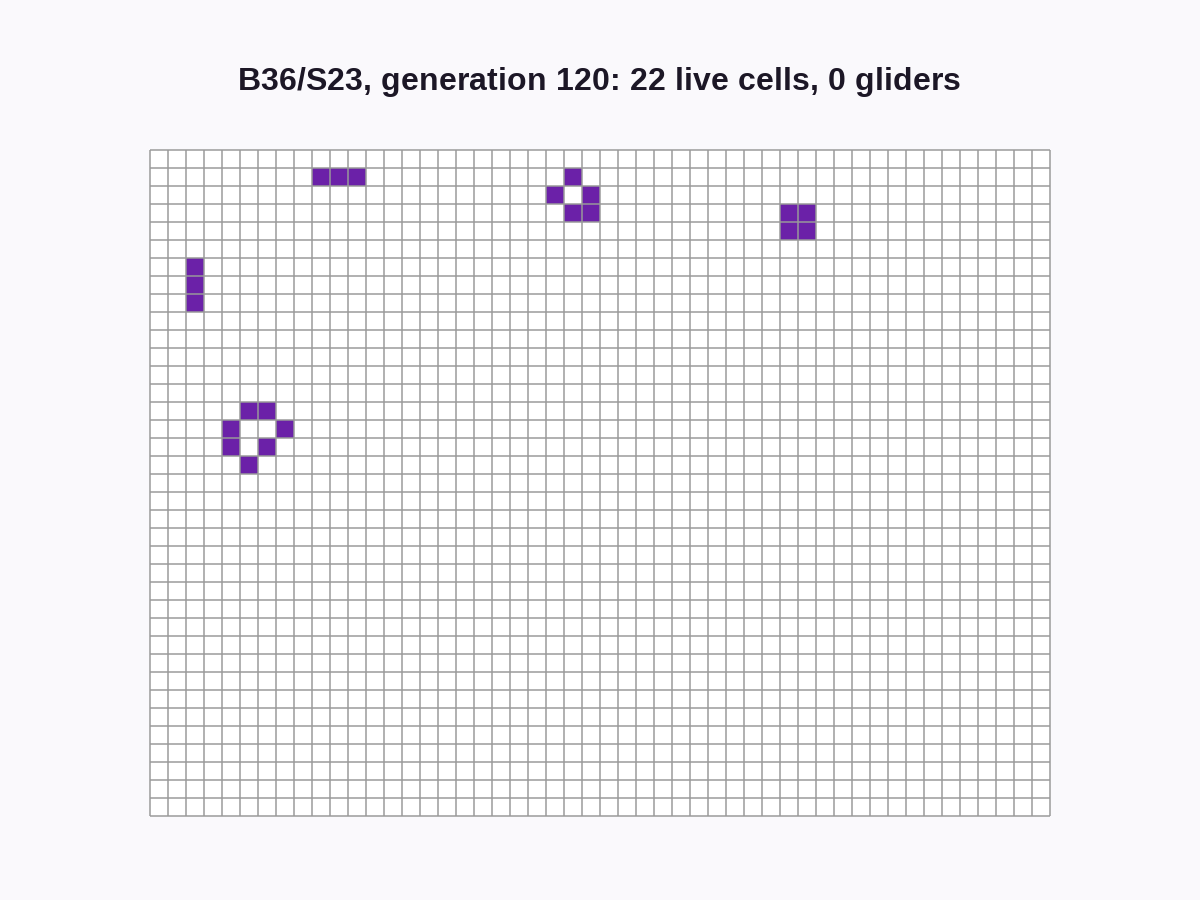
Under B36/S23 the same 36 cells swell to 80 by generation 42 and then fall apart. From generation 96 on, 22 cells remain, repeating every 2 generations, and in 300 generations not one glider leaves. Try a second change: let cells with 4 neighbors survive too (B3/S234). The glider then grows instead of walking, from 5 cells to 11 by generation 4 and 148 by generation 30.
Try this next: murmuration — a flocking model in which each bird reacts only to the birds near it, and the flock takes a shape nobody drew.
Sources
- Nico Brown, Carson Cheng, Tanner Jacobi, Maia Karpovich, Matthias Merzenich, David Raucci and Mitchell Riley, “Conway’s Game of Life is Omniperiodic,” arXiv:2312.02799v1 [math.CO], 5 December 2023. https://arxiv.org/abs/2312.02799Read: full text of version 1, with sections 1, 2.1 and 2.5.2 used hereText license: CC BY 4.0
- Martin Gardner, “Mathematical Games: The fantastic combinations of John Conway’s new solitaire game ‘life’,” Scientific American 223, no. 4 (October 1970): 120–123. https://doi.org/10.1038/scientificamerican1070-120Read: bibliography only
Cite this page
Explorable Illusions. (2026). Conway’s Game of Life: A Glider Gun Fires Every 30 Steps. Explorable Illusions. Published 2026-11-13. https://explorableillusions.com/simulations/game-of-life/
Add the date you read it. Figures and CSV files on this page are CC BY 4.0 unless their credit line says otherwise.
How pages here are checked Corrections log Report an error: contact@explorableillusions.com
More in Explorable Simulations
 Explorable Simulations
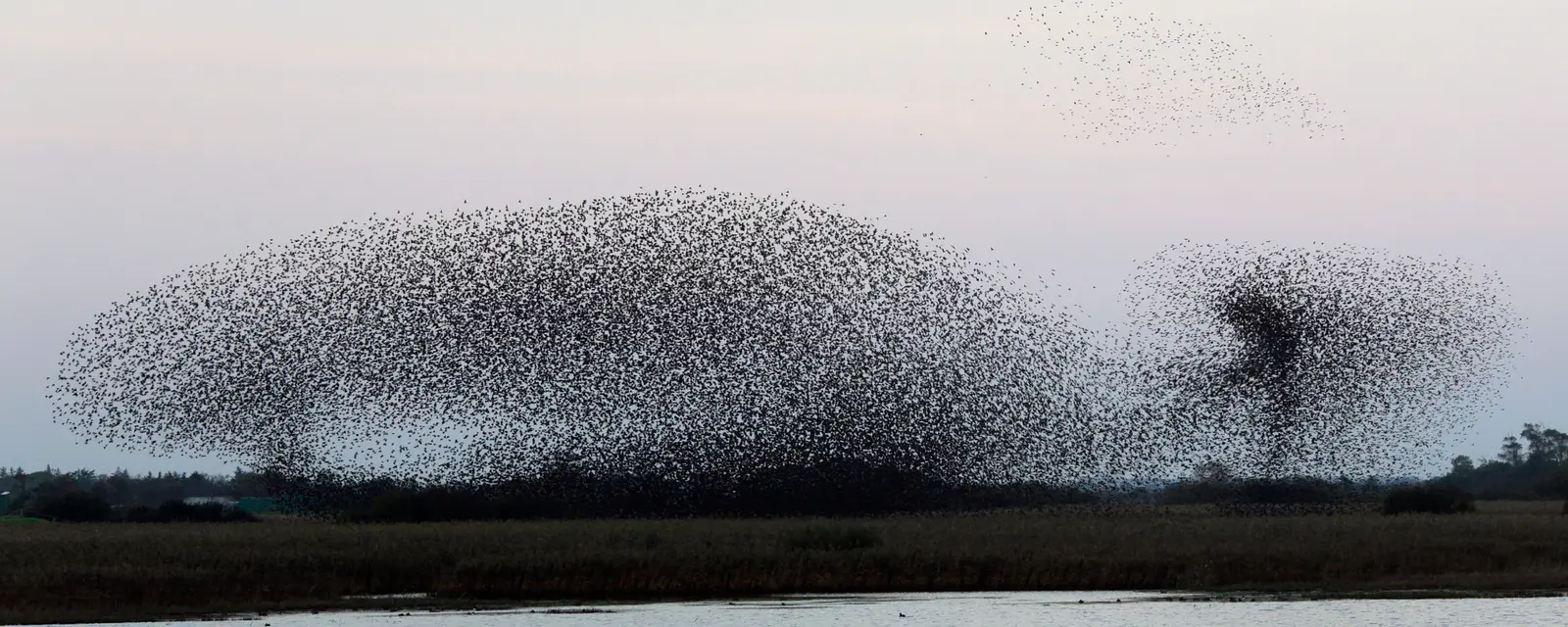
Murmuration: Starlings Track a Count, Not a Distance
In a starling murmuration, each bird reacts on average to about six or seven nearest neighbors, near or far (PNAS, 2008). Then run Reynolds’s three boids rules.
Picture credit
"Dance Of The Starlings" by Conni Nielsen — https://commons.wikimedia.org/wiki/File:Dance_Of_The_Starlings_(201781509).jpeg — CC BY 3.0 (https://creativecommons.org/licenses/by/3.0/)
 Explorable Simulations
Double Pendulum: In a Model, 120° Runs 0.001° Apart Diverge
In this page’s double pendulum model, two swings released 0.001° apart from 120° are over 10° apart after 9.4 s. From 5°, they stay in step for a full minute.
Picture credit (illustration)
Illustration: Explorable Illusions. Generated schematic image — not a photograph, historical record, or test stimulus. Reuse: CC BY 4.0 (https://creativecommons.org/licenses/by/4.0/), to the extent any rights exist.
 Explorable Simulations
Braess Paradox: A New Road Can Make Every Trip Longer
Open a zero-minute shortcut and each of 4,000 drivers in this model network arrives 15 minutes later. See why no one goes back, and Braess's own 83 and 92.
Picture credit (illustration)
Illustration: Explorable Illusions. Generated schematic image — not a photograph, historical record, or test stimulus. Reuse: CC BY 4.0 (https://creativecommons.org/licenses/by/4.0/), to the extent any rights exist.